


3. Building your programme
You have a problem statement and two or three goals with minutes next to them. Now it becomes tempting to start looking for entertaining activities. Don't. A programme that starts with the activities becomes a series of exercises that happen to follow one another. A programme that starts with the exercise in which your must-goal is actually carried out holds up when you run short of time along the way.
After this chapter:
- you work through five design steps in the order that stops you having to demolish anything afterwards.
- You test each block against head, heart and hands, and you see at once which column stays empty.
- You divide a half-day session into an opening, a body and a closing, in the right proportions.
- In the opening you make an agreement with the group that you close again in the tail.
- You sum up your entire course in a single anchor phrase.
Five steps, in this order
You first lay down your objective and target group fixed: the problem statement and no more than three must-goals, plus what you know from the intake about level, interests and mood. Then you choose the core exercise: in which component does the participant actually carry out the behaviour from your must-goal, and how many rounds of practice do you need for that? That exercise claims its time first; what is left over is your room for manoeuvre. After that you build the blocks, forty to sixty minutes per key point. Then you determine the sequence and the bridges: from simple to complex, from safe to challenging, with one sentence at every transition saying where you have come from and where you are going. And only at the very end do you make the running order with times and materials. If that takes you beyond your half-day, you go back to step 2 and cut from the core, not from the tail.
Head, heart and hands
For every block you set the same recipe alongside it. The head is the content: the model, the explanation, the answer to why something works the way it does. The heart is the motivation and the attitude: why would this participant put time into it, and what makes them feel safe enough to try something. The hands are the behaviour: what does the participant actually do, with their voice, their pen or their body.
The head is the component that you, as a subject-matter designer, fill the fastest, which is why it is the first to get out of hand. A block needs one model, not four. With every piece of theory, ask yourself whether the participant could still manage the core exercise without it. If so, it goes into the handout. The heart is the ingredient most often missing from the running orders of subject specialists, even though it determines whether the rest gets through. You fill it with an example from the participants' own world, with the questions they submitted beforehand, or with a short round in which everyone puts their own situation on the table. The hands take the most time and are given the least. Anyone who is genuinely going to do something needs to do it at least twice: once to notice how awkward it is, and once to feel the correction. So you don't count in exercises but in practice rounds.
Put the three words in the margin of your draft programme and note hd, ht or hn beside each block. Run down that margin from top to bottom and within ten seconds you can see whether your programme has turned into one long knowledge session. If a column stays empty, take out a piece of explanation and put a processing exercise in its place. Your block doesn't get any longer, but it does get better balanced.
Opening, body and closing
Every half-day session falls into three parts, each with its own task. The proportions are uneven, and that is as it should be: the opening and closing together take about a third of your time, the body the rest.
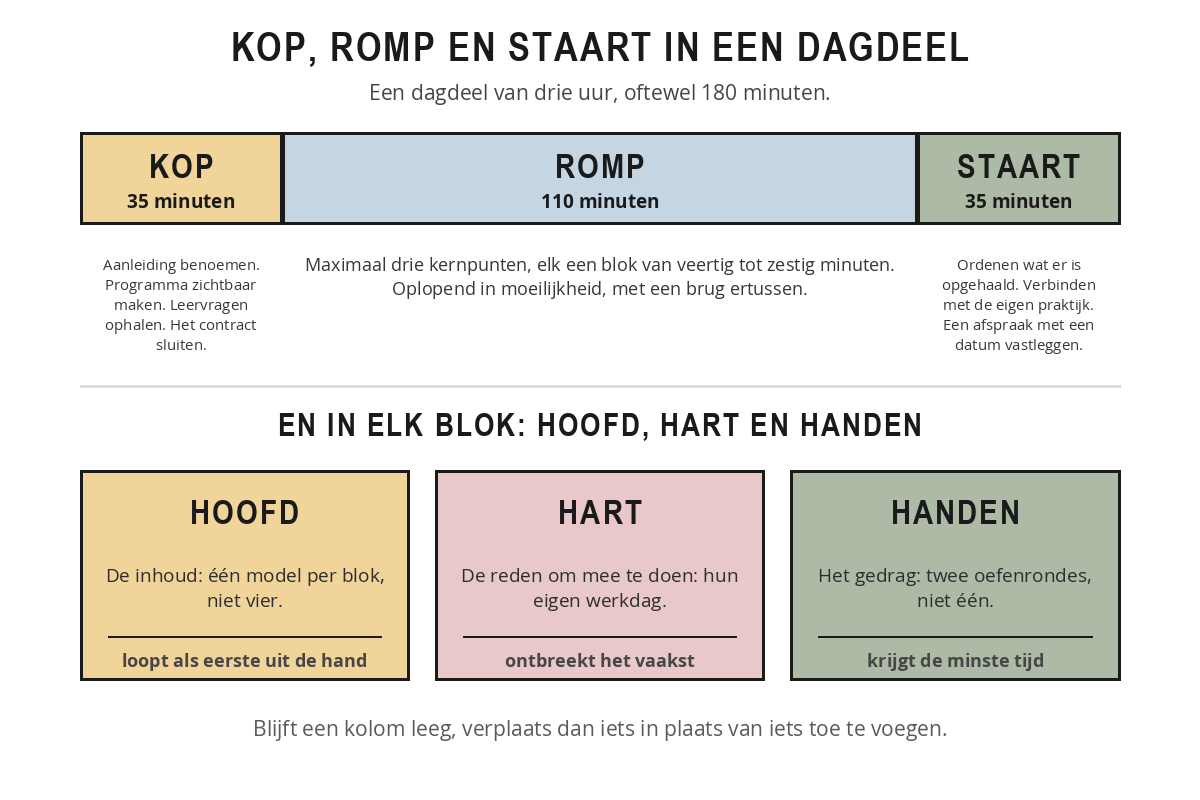
The heading has one job: getting the group to a point where they can start practising. That is more than a word of welcome and a round of names. You say out loud why this course exists and what led up to it, because otherwise participants will fill that in themselves, and usually less favourably than reality. You make the programme visible on the flip chart or the screen, so nobody has to keep scanning for what might be coming. You refer back to the questions participants submitted beforehand. And you close the psychological contract.
That last point is the unwritten agreement between you and the room. Participants expect something from you (expertise, pace, safety, usefulness) and you expect something from them (input, their own cases, taking part in an exercise). The problem with unspoken expectations is that they only become visible at the moment they are broken. Someone who thought they had come to listen will shut down when you announce a role play at a quarter past ten. So you make it explicit: what you are asking, what they get in return, and where the limit lies.
Sanne trains installation engineers who will from now on have to deliver bad news themselves about a job that has overrun. She opens like this: "In a moment you'll practise a conversation twice, using a job of your own. So I'm asking you to bring in something that didn't go well. What you bring in here stays in this room; the only thing I report back to your work planner is which themes we covered, not who said what. And if you really don't want to practise today, you tell me and you sit in as an observer."
Four sentences establish contribution, confidentiality and the option to step out. Sanne writes them on a flipchart sheet that stays up all day. If at half past one someone grumbles about 'all that role-play business', she points at the sheet rather than at herself.
The body: blocks around your key points
The body is where the actual work happens. The pitfall is that it turns into one long blur. You prevent that by covering no more than three key points per half-day, each in its own block of forty to sixty minutes, and tying those blocks together.
The first block is usually the simplest. You build up in difficulty: first one skill in a clean situation, then the same skill with a more difficult conversation partner, and finally a situation in which the participant has to choose for themselves which approach fits. That way the level of difficulty keeps pace with what the group can now do. At every transition you say out loud what has just happened, what it produced and why the next block follows from it. That takes twenty seconds and it is the difference between a programme and a list.
The closing is not a leftover
The last twenty minutes determine what a participant takes back to work, and it is the component that is the first to be dropped as soon as the body runs over. The closing does three things, and none of the three happens by itself. Sorting: bringing the separate experiences and feedback points back to the essentials, preferably by having participants put that essence into their own words. Connecting with practice: where does this come back in their work, and what is different there from in the training room? Recording: an agreement with a date, written down, and visible to someone else. An intention that is only spoken aloud evaporates on the train home.
In the tail you also close the contract from the opening. You bring out the learning questions that went up on the flip chart at the start and go through them: which have been covered, which partly, and what happens to the rest. That last point is not a sign of weakness. Someone who hears that their question did not fit but does get a concrete follow-up leaves more satisfied than someone whose question quietly disappeared.
Reserve a fifth of your half-day for the tail and fix that time in your run-through as a block that does not move. If the body overruns, you cut an intermediate exercise or shorten a debrief. Put a hard time next to it: "16.10, wrap-up, no matter what". If you look at the clock at ten to four and you are still in the middle of an exercise, you know straight away what you are giving up.
One anchor word and one theme per half-day
Sixteen separate components do not yet make a programme. To you everything hangs together, but the participant only sees what is happening at that moment. An anchor phrase is the one sentence your whole course hangs on, in the participant's language, and it comes back all day: on the flip chart, in the handout, at every transition. "The other person first" for conversation skills. "Small and concrete" for goal setting. This free course has one too: first the gap, then the programme.
You won't find a word like that in a book. It comes from your problem statement or from the wording participants use themselves. If three people independently write that they 'jump to solutions too quickly', that's where your anchor lies. A usable anchor word contains no jargon, fits on a flipchart sheet and says something about what the participant does. Above each half-day session you then put a single theme with no more than five sub-topics. If a sixth appears, it belongs somewhere else or it goes.
If you are working with several half-day sessions, lay your components out on the table as sticky notes before you type anything up. One component per note, stating what participants do rather than what the theme is. One colour per function: yellow for head, pink for heart, green for hands. That way you can see the balance without counting. The core exercise goes down first, and anything that doesn't work towards it or follow from it can go. Whatever you like but can't place anywhere goes onto a parking pile beside it. When you divide things up, almost the same thing always happens: the green notes pile up in the final half-day session. And that is precisely the part that is the first to be dropped on the day itself.
Nadia has one half-day session of 180 minutes and three objectives. Her core exercise is a conversation in groups of three using a situation of their own, two rounds per person, with an observer watching for the observation and the request. That exercise claims 50 minutes and is the first thing to go into the schedule.
Her breakdown becomes: opening 35 minutes (background, programme, learning questions, contract, and a round in which everyone writes down a situation they have swallowed), body 110 minutes (block 1 of 25 minutes on the thought that holds you back, block 2 of 50 minutes with the core exercise, block 3 of 35 minutes with a more difficult conversation partner), tail 35 minutes (putting the core into words, transfer questions, an agreement with a date). Then she lays the recipe alongside: head 30 minutes, heart 45, hands 85, plus 20 for breaks and transitions. The hands column is the largest. In her first draft it was the other way round, with 70 minutes of theory and a single round of practice.
Work out one half-day session of your own course, on a single A4.
- Your problem statement in two sentences, and below it your must-have objectives with the level noted.
- Your core exercise: what does the participant do, how many practice rounds, how many minutes?
- The blocks of your body section, with a title and the planned minutes per block.
- Your closing: which three things happen there, and the hard start time for it.
- Your anchor word, in no more than five words, and where it comes from: your problem statement or the language of your participants.
- Per block: how many minutes of head, how many of heart, how many of hands?
Add up the minutes. If you are over, cross things out until it fits and note down what you have cut and why that was possible. Which column is the thinnest in your case?
Summary
- The order is: objective and target group, core exercise, blocks, sequence and bridges, and only then the running order.
- The core exercise claims its time first. What is left is your room to manoeuvre.
- Every block gets a head (the content), a heart (the reason to take part) and hands (the behaviour). If a column stays empty, you move something rather than add something.
- A half-day session consists of an opening, a body and a closing. The opening and closing together take about a third of your time.
- In the opening you deal with the background, the programme, the learning questions and the psychological contract. In the tail you organise, connect with practice and set an agreement with a date.
- The tail gets a fifth of your time and a fixed finishing time. If the body overruns, you cut from the body.
- One anchor phrase for the whole course, one theme per half-day, and no more than five sub-topics beneath it.
Your programme is in place. That leaves the question you should already have agreed during the intake: how will you know later on whether it worked? That is chapter 4.
Your body section overruns and you have twenty minutes left for a tail you had planned at thirty-five. What do you do, according to this chapter?
You lay the recipe next to a forty-minute block and count: head 30 minutes, heart 10, hands 0. What is the obvious intervention?
What is the function of the psychological contract in the opening of your course?