


2. Learning objectives you can test
In chapter 1 you put the gap down on paper. Now that gap needs a size. Because as long as your objective is "more insight into giving feedback", you cannot determine which working method fits it, how much time you need for it, or whether it has been achieved. A sharp learning objective does all three things at once. That is why designers say: a good objective is half the design already.
After this chapter:
- You distinguish the four levels of learning objectives and know which verb belongs to which level.
- You make an objective testable with four questions: who, what, in which situation and how well.
- You spot directional words such as "becoming aware of" and replace them with behaviour you can see.
- You convert an objective into programme time, so that you know in advance whether it fits.
- Sort an overly long list of objectives into must, would be good and nice to mention.
Why "gaining insight into" is not an objective
Objectives that begin with "having knowledge of", "gaining insight into" or "becoming aware of" can be crossed out. Those are not objectives but directions. They have one property that gives them away: nobody can disagree with them, and nobody can establish whether they have been achieved. By the end of the day, participants have always gained insight into something.
The test that makes an objective usable is strict: can an outsider establish whether it has been achieved? If not, the fuss about "was the course a success" will be breathing down your neck later on. As soon as you replace the directional word with something you can see or hear, two things happen at once: the objective becomes testable, and the level becomes clear of its own accord.
Four levels of learning objectives
Every learning objective sits on one of four steps. The higher the step, the more practice and time the objective demands. That makes the level a planning instrument in itself: it tells you in advance whether your objective fits within the available hours.
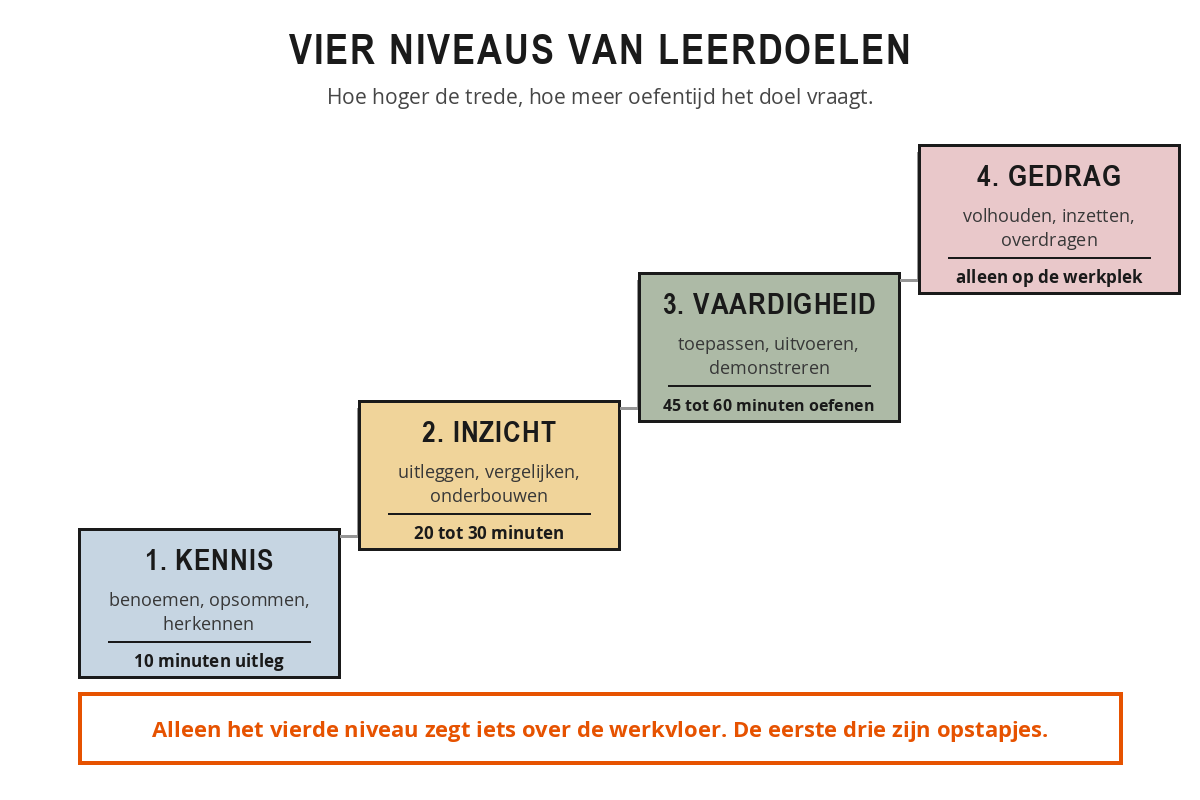
At the knowledge level the participant knows something they did not know before: facts, concepts, the steps of a procedure. Suitable verbs are name, list and recognise. You reach this level quickly, and that is precisely why designers pile up too much here. At the insight level he understands why something works the way it does, sees the difference between two cases and can justify a choice: explaining, comparing, substantiating, distinguishing. At the skill level he performs the behaviour in the safe environment of the course, in a role play, a conversation or a product: applying, carrying out, demonstrating. That calls for practice with feedback and therefore a good deal of programme time. At the behavioural level they apply it in their own workplace, including in situations that do not resemble the exercise: sustaining it, using it, passing it on. You do not reach that level in the training room, only with agreements, assignments and a follow-up moment afterwards.
A client asks for a course on the new complaints procedure. The same subject at four levels:
- Knowledge: the participant names the five steps of the complaints procedure in the correct order.
- Insight: the participant explains why step 2 comes before step 3 and what goes wrong if you reverse them.
- Skill: during the course, the participant handles two complaints according to the procedure, including the registration.
- Behaviour: the participant handles the next three complaints in his department according to the procedure and discusses them in the team meeting.
Only the fourth objective says anything about the workplace. The first three are stepping stones. If your outline contains only the first one, you have designed a forty-minute course and reserved three hours.
Four questions that sharpen an objective
An objective becomes usable once you can answer four questions. Who does it? Most objectives start with "the participant". If you notice yourself writing "I will cover" or "attention will be paid to", then your programme is central rather than the learning. What does that person do? Here you put down the verb you can see: names, sorts, calculates, carries out, refuses, chooses. Anything you can film is usable. In what situation? A skill does not exist separately from a context: giving feedback to a colleague who is older and has been with the company longer is something different from giving feedback in general. The situation immediately determines what your exercise looks like. How well or how often? The standard is what makes it measurable: a number, a time limit, a number of visible steps, or a product the participant delivers.
You do not have to nail down every objective with all four questions. For knowledge objectives, the standard is often superfluous. For behavioural objectives, it is precisely the situation and the standard that matter most, because that is where the difference lies between "can do it in the practice room" and "does it on Monday morning".
From vague to sharp
The quickest way to improve an objective is to replace the verb. The rest of the sentence then follows by itself. "Participants gain insight into conversation techniques" becomes "the participant identifies three moments in a recorded conversation at which the adviser offers a solution too quickly". "Participants are familiar with the new procedure" becomes "the participant carries out the five steps of the returns procedure in the right order, without the manual to hand". "Participants become aware of their own pitfall" becomes "after the exercise, the participant names the behaviour they display under time pressure and the alternative they will try out over the next two weeks".
Every rewritten objective immediately tells you which working method goes with it: a film with a viewing question, a performance assignment, an exercise with a follow-up discussion. That is the gain.
One objective per sentence is the rule of thumb. As soon as there is an "and" or a comma in it connecting two different actions, you have two objectives on your hands, each requiring its own practice time. Splitting them costs you thirty seconds and prevents you from overlooking half an objective later on.
The be-smart check
Once your objectives are sharp, you run them past be-smart. The familiar smart letters test how you write down an objective; the b and the e are about something else, namely whether there is enough drive behind it. Inspired: do you believe in this objective yourself? If you shrug your shoulders as you write it down, that is a signal to go back to your problem statement. Energy: who puts in time and attention, during the course and in the weeks afterwards? Specific: what, where, when, how much and with whom. Measurable: can you establish progress and end result? Acceptable for the participant and his environment; an objective that his department does not support will collapse within two weeks. Realistic and relevant: does it match what this group can handle, and does it matter to the organisation? Traceable: is a date or moment given by which it must be finished?
Always run through the four test questions first and only then apply the full be-smart check. Otherwise the s and the m are the first to come under pressure, because they are about exactly the same wording.
Calculating with learning time
The most common design error is not in the wording of objectives, but in the number. You have four hours and seven objectives, and so you achieve none of them. The level of an objective tells you how much time it takes. You convey a knowledge objective in ten minutes of explanation plus a short check. A skill objective calls for explanation, demonstration, practice, feedback and a second round of practice: count on at least three quarters of an hour, with twelve participants more likely an hour. An attitude objective costs the most, because you first have to make room for the existing conviction before anything can be placed alongside it.
A useful rule of thumb: per three-hour session you let one skill objective land properly, alongside two or three supporting knowledge objectives. Everything you plan on top of that comes off the practice time, and it is precisely in that practice time that behaviour changes.
Choosing what to cut
If your list is too long, you divide it into three piles. Must: without this objective the course is not complete and the problem has not been addressed. This is where your main exercise belongs. Would be good: valuable, but the participant can do without it. You schedule it if you are on track, or you hand it out as reading material. Nice to mention: interesting for you as a subject-matter expert, not necessary for the participant. This pile goes into the appendix.
You take the outcome back to your client. You don't come with less, you come with a reasoned choice. "In four hours we can either practise the absence interview or work through the whole absence protocol. I can't fit both in. Which would your team benefit from most?" That way you make them co-owner of the choice, and you avoid the reproach afterwards that you didn't cover enough material.
Nadia starts with seven objectives for her fourteen team leaders: knowing the difference between behaviour and person, being able to name the four g's, knowing when feedback is inappropriate, being able to conduct a feedback conversation, being able to deal with a defensive reaction, recognising their own pattern of putting things off, and being able to receive feedback. She adds the levels and adds up the minutes: two knowledge objectives of ten minutes, one insight objective of twenty, three skill objectives of fifty and one attitude objective of forty. Together 220 minutes, while she has one half-day session of 180 minutes, including opening, closing and a break.
She keeps three. Must: "the team leader holds a conversation about behaviour he has observed within the past week, starting with his observation and ending with a request" (skill, 50 minutes). Must: "the team leader names the thought that stops him from starting the conversation, and the counter-argument he uses against it" (attitude, 30 minutes). Would be good: "the team leader distinguishes behaviour from person in four example sentences" (insight, 15 minutes). The rest goes into the reading material and into the conversation with the director.
Take your own training question and the problem statement from chapter 1.
- Write down all the objectives that are currently in your head or in your outline, without filtering.
- Write the level behind each objective: knowledge, insight, skill or behaviour. Underline the verb and check whether it matches that level.
- Estimate the number of minutes for each objective, including exercise and feedback. Add them up and compare this with the time you actually have.
- Divide the objectives into must, would be good and nice to mention.
- Rewrite the objectives from the "must" pile using the four test questions, and then run them past be-smart.
- Formulate one sentence with which you raise the dropped objectives with your client.
Note down how many objectives are left. For most designers the list goes from seven or eight to two or three.
Summary
- Directions such as "gaining insight into" are not objectives: nobody can establish whether they have been achieved.
- Every objective sits at one of four levels: knowledge, insight, skill or behaviour. The level tells you how much time it will take.
- Four questions make an objective testable: who does it, what does that person do, in which situation and how well or how often.
- Replace the direction word with a verb you can see or hear. One objective per sentence.
- Be-smart adds the driving force: inspired, energy, specific, measurable, acceptable, realistic and relevant, traceable.
- Count in minutes: a knowledge objective costs ten minutes, a skill objective three quarters of an hour to an hour, an attitude objective even more. One skill objective really lands per half-day session.
- Too many objectives? Divide them into must, would be good and nice to mention, and hand the choice back to your client. Cut objectives, not practice time.
You now have two or three objectives with a number of minutes beside them. In chapter 3 you build a programme around them.
"The participant handles the next three complaints in their department in accordance with the procedure." Which level is this objective at?
You have three hours and your list of objectives adds up to 220 minutes. What do you do according to this chapter?
Which wording meets the four test questions: who, what, in which situation and how well?