


Introduction
Someone asks what you do. You hear yourself say your job title, you add a bit around it, and after half a minute the other person nods politely and looks past you. The odd thing is: you know exactly what you are talking about, and still it did not come out. That moment comes along more often than you think. With a new client, in the corridor, at the start of a meeting, at a birthday party. Pitching is about that one minute.
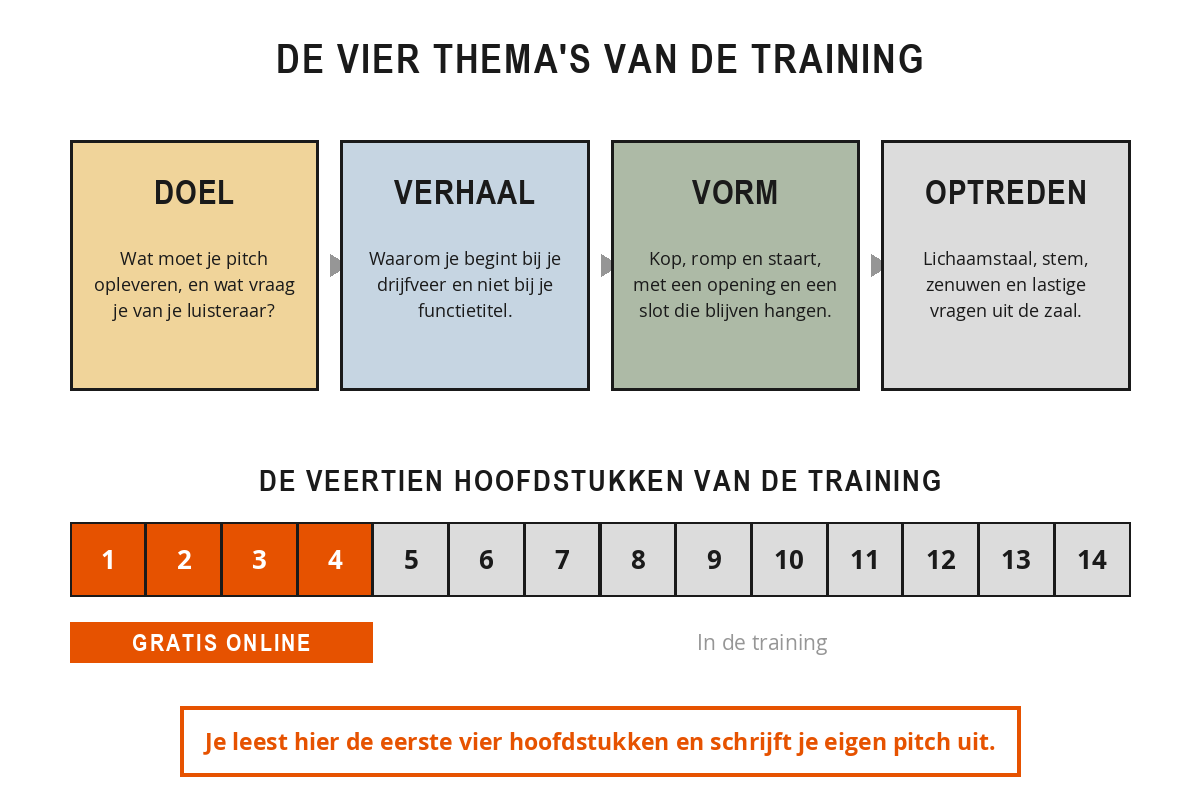
This free course contains the first four chapters: the orange part of the bar above. At the bottom of chapter 4 you will find the full course.
What you will learn
You start with the question of what your pitch needs to achieve: what does your listener know, think, feel or do afterwards, and what are you asking of them. Then you build your story from your motivation rather than from your job title, using the Golden Circle and a struggle from your own practice. Next you put that story into a form that fits sixty seconds: head, body and tail, with an opening and a closing that you prepare word for word. And finally you start practising, because a pitch gets sharp by saying it out loud, not by rewriting it at your desk.
The common thread running through these four chapters: a pitch is not a summary of yourself, but an invitation to the other person. It has succeeded if a question comes back.
How the course is structured
The course follows four themes that build on one another. You start with the objective: what should your pitch achieve, and what are you asking of your listener? Then comes the story: why you start with your motivation and not with your job title. Then the form: opening, body and closing, and the first and last sentences that stick. And you finish with the performance: body language, voice, nerves and awkward questions from the audience. The first three themes are online here; the fourth you do with a trainer present, because for that you really have to be on your feet.
Practical tips for use
- Before you start, choose one concrete pitch that you are actually going to give. With each chapter you sharpen it further, so that at the end you have a worked-out version instead of loose notes.
- Keep a notepad or a blank document to hand. The exercises only work if you actually complete them.
- Say everything out loud. A sentence that looks fine on paper often turns out to be twice as long when spoken.
- Record yourself on your phone. What you feel while speaking and what someone else sees are almost always miles apart.
- Don't read it all in one go. One chapter a week, with a real pitching moment in between, gets you further than reading through it in a single afternoon.
Before you start, record your starting point. Write down four sentences:
- My pitch is about …
- My listener is …
- What I want them to do afterwards …
- What I currently find hardest about pitching …
Keep those answers. In chapter 4 you will look back at them.
Each chapter ends with a short knowledge check of three questions: answer them correctly to mark the chapter as completed. Your progress is saved automatically in your browser.
Enjoy reading, and above all: enjoy that one minute.