


1. What your pitch must achieve
Most pitches go wrong before a single sentence has been spoken. Not because the speaker cannot phrase things well, but because he has never worked out what he actually wants to achieve. A pitch that is not working towards anything is a collection of nice sentences. This chapter is about the question that precedes all the others: where should your listener be when you have finished talking?
After this chapter:
- You formulate a goal sentence that starts with your listener and not with yourself.
- You know the four verbs know, think, feel and do, and you know why a doing verb is the strongest.
- You can test your goal sentence with the reversal question.
- You know which five kinds of help you can ask a listener for, and why you pick one of them.
- Turn your sender sentences round into sentences that start with the benefit for the other person.
- You reduce your talk to two core points and one core message.
Start at the end
A goal sentence is one sentence that starts with "Afterwards" and ends with your audience. Not "I want to talk about my new service", but "afterwards the man next to me at the table knows that I halve his quotation process, and he asks for my card". The difference lies in who is the subject of the sentence. As long as you are the subject, all you are measuring is whether you got through your story. And getting through your story is not an achievement; anyone can talk for a minute.
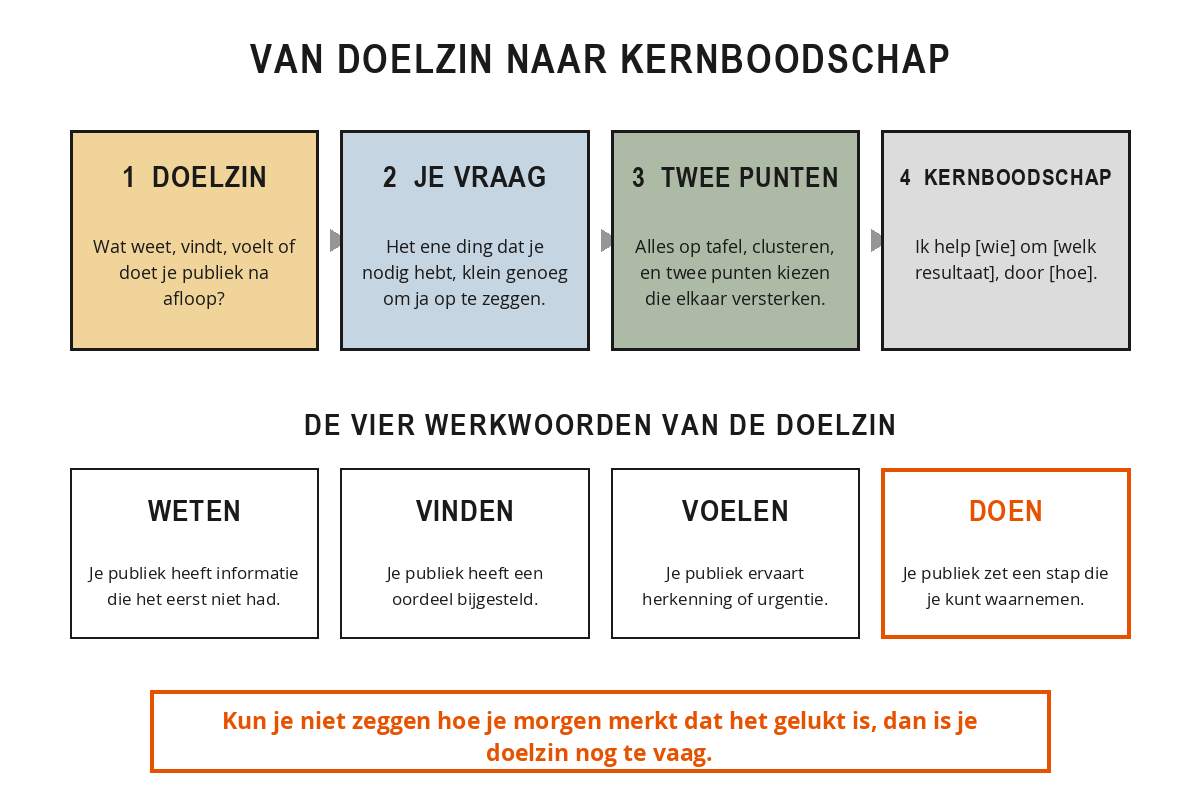
The route runs in four steps. First your goal statement: what does your audience know, think, feel or do afterwards? Then your question: the one thing you need from your listener, small enough to say yes to. Then two key points: put everything you could say on the table, cluster it, and choose two points that reinforce each other. And finally your core message: the one sentence that remains once your listener has forgotten everything else.
Four verbs for pinning down what you want
There are four kinds of outcome, and all four ask something different of your story.
- Knowing: your audience has information it didn't have before. "Afterwards, my audience knows that we also take on assignments of under five thousand euros."
- Believing: your audience has adjusted an opinion or a judgement. "Afterwards, my audience sees an interim controller not as a last resort but as a smart move."
- Feeling: your audience experiences something, such as recognition, urgency or relief. "Afterwards my audience feels the irritation of a stalled schedule all over again."
- Doing: your audience takes a concrete action. "Afterwards, at least one person schedules an introductory meeting."
The most powerful version is a goal sentence with an action verb in it, because that forces you to work out what your listener is practically supposed to do with your story. A pitch without a desired next step ends in a polite nod, and a polite nod is worth nothing.
Test your goal statement with the reversal question: how will you notice tomorrow that it has worked? If you cannot give an observable answer to that, your goal statement is still too vague. "They understand what I do" is not observable. "They can retell in one sentence what I do" is.
Marloes is an interim controller. She goes to a meeting of a business association and first writes down: "I want to tell people what I do and how I work." She practises for a minute, delivers the pitch three times that evening and goes home feeling good. In the two weeks that follow, nobody calls.
At the next meeting she first writes a goal sentence: "Afterwards, at least one director knows he can call me if his bookkeeper drops out, and asks how soon I can start." That same pitch, with that goal behind it, sounds different: she no longer talks about her working method but about the Friday afternoon when a director rang her because nobody knew where the figures were. She ends with: "I can be at the table within three working days." That evening two people ask how soon she can start.
What you need from your listener
Your goal sentence comes with a second question: what do you need from the people listening to you in order to take a step forward? That question feels uncomfortable, because you don't want to come across as someone who is there to take. Yet it works the other way round. People like to help, but only if they know what with. A closing line such as "so if there's anything, you know where to find me" leaves your listener with a good feeling and zero action.
What you can ask falls into five types. Resources are money, materials, space or equipment: an investment, a budget from another department, a test location. People is someone else's time: a sounding board, a colleague who is freed up for two days, an expert who takes a look on one occasion. Access are doors that someone else opens for you: an introduction to a buyer, a slot on the management team's agenda, a name and a telephone number. Knowledge is information you lack: experience from another sector, figures about the market, feedback from someone who has already been through the process. And support is support without anything changing hands: a signature, a mandate, a colleague who says out loud in the meeting that he thinks it is a good idea.
From those five you choose one. Not three, and certainly not all five. Your listener remembers two things from your story, and if one of those has to be your question, then there can only be one question.
Make your request so small that saying yes is easier than "I'll have to think about that". So do not ask for a partnership, but for a twenty-minute coffee. Not for budget, but for permission to run a trial with one team. The big question comes in conversation two.
What's in it for your listener
While you are talking, one question is running unconsciously in the background for your listener: what is in this for me? That sounds selfish, but that is simply how attention works. If you do not answer that question, someone politely switches off while carrying on nodding.
The shift lies in your sentences. Most pitches are full of sentences that start with the speaker: what he does, how many years he has been doing it, which method he uses. You do not have to overhaul your story, you turn the sentences around, so that the benefit comes first and your working method comes after it.
- "I work with a certified intake method" becomes "after one hour-long conversation you know where you stand".
- "We provide maintenance on installations" becomes "you will no longer get a phone call on Friday afternoon saying everything has ground to a halt".
- "I am a copywriter with ten years' experience" becomes "you no longer have to slog away at that brochure yourself for three evenings".
A good test: read your pitch out loud and count how often you start a sentence with "I" or "we". Twice is the maximum you allow yourself.
From everything you could say to two key points
From a one-minute pitch, your listener will remember at most two things. Sometimes one. That is not a matter of ill will, but of how memory works: everything that is spoken passes by exactly once and competes with everything else going on at that reception. So the question when putting your pitch together is not what else you can add, but what can go.
You make that choice in four steps. First you write down everything you could possibly say, without judging it, on separate slips of paper: facts, figures, client names, arguments, anecdotes, questions you are often asked. Ten minutes on the clock, and you do not stop until the time is up, even if you think you have finished. Then you group together what belongs together; usually four to six clusters remain. Next you test each cluster against your listener: which cluster hits their pain or their wish hardest? That cluster stays. And then you pick one more to go with it and scrap the rest. Two points that reinforce each other work better than four points competing for attention.
Don't throw away the notes that dropped out. That is your reserve material for the conversation that arises after your pitch, and it often comes in more useful there than in the pitch itself.
Torn between two key points? Choose the point you can support with a concrete example. A point without an example remains an assertion and evaporates as soon as you have finished speaking.
Your core message in one sentence
What is left you compress into your core message. That is the sentence with which someone will describe you to a colleague the next day. Not a slogan, not a job title, but a sentence with a problem and a solution in it. A workable template is: I help who to what result, by how. Short, in spoken language, without hedges. You say it out loud and note whether you stumble. If you stumble, the sentence is still too long or too abstract.
Joost advises bakeries on their stock. After his brainstorm he is left with three clusters: waste in the bakery, the figures from client De Vries, and an order he missed out on years ago.
His first attempt at a core message: "I am a consultant in the field of inventory optimisation in the food sector." That is a sentence about what he is, full of words that nobody repeats.
His final version: "I help bakers to stop throwing away crates at the end of the day, by letting their orders move with the weather." At De Vries, the daily waste fell from forty loaves to twelve, and that figure is immediately his proof. His question at the drinks is kept small: he is looking for two bakers who want to halve their returns, and anyone who knows one is welcome to say so.
Develop your own pitch in three rounds.
- Aim: write one goal sentence that begins with "Afterwards" and ends with your listener. Test it with the reversal question: how will you notice tomorrow that it worked?
- Question: for each type (resources, people, access, knowledge, support), note down what you need. Circle one and write it out as a question of no more than twelve words.
- Choosing: set a timer for ten minutes and write at least twenty notes. Group them into clusters, pick two and formulate your core message using the template. Say it out loud three times and cross out one word each round.
Summary
- Your goal sentence begins with "Afterwards" and ends with your listener, not with yourself.
- The four verbs are to know, to think, to feel and to do. A do-verb is the strongest, because it forces you into a concrete next step.
- The reversal question tests your goal sentence: how will you notice tomorrow that it worked?
- What you can ask for falls into five types: resources, people, access, knowledge and support. You choose one and make it small.
- Sender sentences you turn around into sentences that start with what the other person gains. At most two sentences may start with "I" or "we".
- Two key points is the maximum that sticks. Write everything down, cluster it, test it against your listener, and then choose.
- Your core message is one sentence: I help whom, to achieve what result, by what means.
Which of these four is a usable goal sentence according to this chapter?
You need five things: budget, someone to think it through with you, an introduction to the buyer, market figures and a signature. What do you do in your one-minute pitch?
Why do you reduce your pitch to two key points?