


4. Practising until it sounds like you
All the parts are now ready: a goal, a request, two key points, a story and a blueprint. What is still missing is the final round, and that is also the round most people skip. Your pitch does not become sharp because you rewrite it at your desk, but because you say it out loud to someone who knows nothing about it yet.
After this chapter:
- You put your pitch on paper in a form that you can speak aloud rather than read out.
- You know how many words fit into a minute and what to do if there are more.
- you run through your text using a fixed checklist.
- You ask for feedback with one specific focus rather than "what did you think of it".
- You use the retelling question to measure whether your core message lands.
- You weigh up feedback instead of simply swallowing it, and you change one thing per round.
- You move smoothly from your pitch into a conversation, without it becoming a sales talk.
Your pitch on paper
A pitch that only exists in your head changes every time you tell it. Sometimes in your favour, more often not. By writing it down you see where your sentence gets stuck, where a word is too abstract and where you are trying to say two things at once.
You write out your text the way you would say it, not the way you would email it. Short sentences, spoken language, one thought per sentence. If you read a sentence back and think "I would never say it like that", you delete it straight away. You already know the order: your core message at the top of the page, then your inswinger word for word, then one sentence bridging to your listener, then key point one in claim, evidence and image, then your link, then key point two, and finally your question and your closing sentence, both word for word.
Then you count your words. At a speaking pace of roughly 130 words per minute, that one minute holds about 130 words. If you are at 200, you do not speak faster but cut seventy words. Speaking faster is the most common solution and the worst one: your listener switches off at exactly the moment it becomes interesting.
Read your text through once and delete every hedge: "actually", "a bit", "I think that", "maybe", "somewhat". Then check whether the sentence still works. Usually it becomes shorter and stronger at the same time.
The checklist
Before you start practising, go through your text once with a fixed list. That way you catch most problems while adjusting is still cheap. Is your core message in there in one sentence? Do you have exactly two key points, not three? Is there evidence with each point, so a figure, a name or a result? Is the benefit for your listener up front, or does almost every sentence start with "I" or "we"? Are the hedging words and the jargon gone? And does your ending finish with a concrete next step, including who, what, when and where?
If you can't come up with an answer to several of the questions, that is no reason to start polishing sentences. The problem then lies a layer deeper, with your choices. Going back to your two core points and choosing again takes ten minutes and gets you further than an hour of rewriting.
First version from Thomas, who builds dashboards: "I've actually been working in data visualisation for about eight years now and I think we can help companies quite well with that, with dashboards and reports among other things." Thirty-three words, three hedges, not a shred of evidence.
After the checklist: "Managers take decisions based on last month's figures. We make sure they can see this morning what happened yesterday. At three insurers that saved two weeks per quarterly report." Thirty-two words, so hardly shorter, but the hedges are gone, the benefit comes first and the evidence follows on behind.
The practice loop
Your own pitch always sounds better in your head than it does in the room. You know what you mean, so you hear what you mean. A listener only hears what is actually there. That is why you only make progress with feedback from outside, and with feedback that goes further than "nice one".
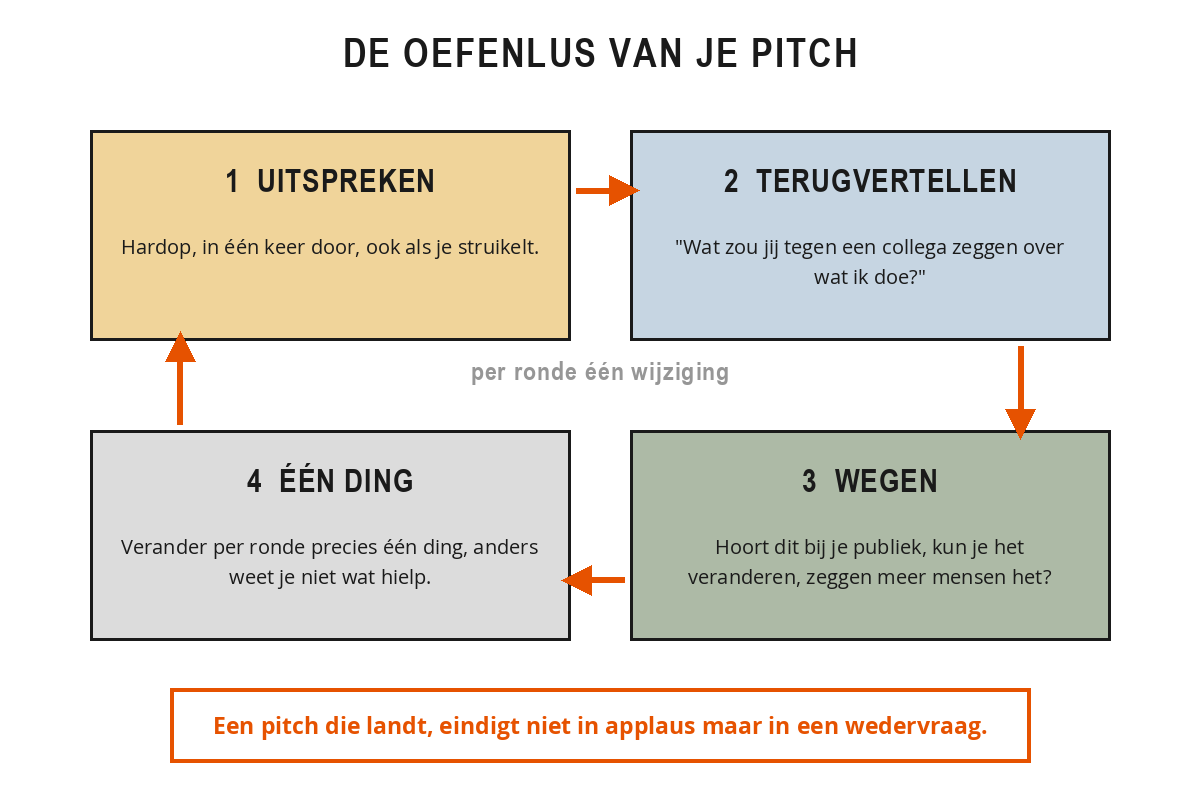
The loop has four steps. You start with speaking out: out loud, in one go, even if you stumble. Beforehand you say what you want to be assessed on, because anyone who asks "what did you think of it?" gets a polite answer. The listener then does not know what to look out for, so he looks out for everything and says something general. So choose one element in advance: your opening, your pace, your ending, your posture or how understandable your core message is. And say it out loud: "For me, only pay attention to the first twenty seconds. Does it grab you?"
Then it comes retelling. That is your most important measuring instrument, and you ask that question before the question about the element you chose: "What would you say to a colleague about what I do?" If your core message comes back in different words, it has landed. If you get a list of your duties back, you are still in your what and not in your why.
After that you go weigh up. You do not have to take on board every remark; feedback is information about how it landed with that one listener, not an instruction. You weigh up three things: does this person belong to your target group, is the remark about behaviour you can change, and are more people saying the same thing? That last point is the strongest signal. One person who finds your opening too long may simply have a different taste. Three people who lose interest at the same point indicate a gap in your story.
And then you change one thing. Exactly one. If you rebuild your entire pitch after every round, then after three rounds you no longer know what made the difference. After that the loop starts again, and three rounds is the minimum.
Esther practises her pitch three times in two weeks. Round one is with a fellow professional. In response to the retelling question she gets back: "You do something with processes at housing associations." Her core message is about waiting times for tenants, so that has not come across. She changes one thing: she takes out the word process optimisation and starts with the tenant who has been waiting eleven weeks for a repair.
Round two is with her neighbour, who knows nothing about the sector. His version of it: "You make sure people get helped faster when their tap is leaking." Exactly right. He does find her closing vague. She changes one thing again: her question becomes "do you know anyone at a housing association I could call?"
Round three is with a colleague who knows her well. She says that she now sounds like herself, and that in round one it sounded more like a brochure. Two weeks, three rounds, three changes. That was all.
Record yourself on your phone and watch the recording twice: once with the sound off and once with sound only. Without sound you see your posture, your gestures and where you look. Without the picture you hear your pace, your filler words and whether your sentences end on a falling note. And bear in mind that the first time you'll be startled by something unimportant: your hair, your voice, a gesture. That is normal and it says nothing about your pitch.
From pitch to conversation
A pitch that lands well does not end in applause but in a question back. That is where the real work begins, and it is also the moment when many people freeze: the story is finished, and then what?
The transition flows smoothly if you have one sentence ready for it. After your closing sentence you fall silent, you hold eye contact and you let the other person respond. If nothing comes, you open up yourself with a question about the other person: "And what are you dealing with at the moment?" or "How do you solve that now?" From that moment on your role shifts. You are no longer a sender but a listener, and that is exactly what your pitch was meant to achieve.
Three things keep that conversation open. The first is asking further questions before you make an offer: two questions about the other person's situation before you say what you can do for them. Your offer then becomes an answer rather than a sales pitch, and you can hear that difference straight away. The second is naming one concrete next step, so not "let's keep in touch" but "I'll send you that example on Thursday, is that all right?" Small, with a day in it, easy to say yes to. And the third is following up within two days. Do what you promise quickly, otherwise the momentum is gone and next time you start all over again.
Your pile of rejects from chapter 1 also comes in handy here. Everything that did not make it into your pitch you can now use, because the other person is asking for it themselves. That feels different from cramming it in, and it sounds different too.
You schedule three practice rounds over the next two weeks and put them in the diary. For each round you note:
- The date and who you are pitching to.
- The element you are asking for feedback on, stated out loud before you begin.
- The answer to the read-back question, written down word for word.
- What you take on board, and why.
- The one change you make before the next round.
Also prepare your transition sentence: the question with which you open the conversation after your closing line. Write it down word for word and say it out loud three times. And finally, take another look at the four sentences you wrote down in the introduction. Does your answer to "what I want him to do afterwards" still match what your closing now says?
Summary
- Write out your pitch the way you would say it: short sentences, spoken language, one thought per sentence.
- About 130 words fit into a minute. If you are over that, you cut; you do not speak faster.
- The checklist looks at your core message, two key points, evidence for each point, the benefit up front, hedging words removed and a concrete next step.
- Ask in advance for one specific angle instead of "what did you think of it".
- The playback question measures whether your core message lands: "What would you say to a colleague about what I do?"
- Weigh feedback on target group, how far you can influence it and repetition. The same thing three times is a signal, once is an opinion.
- Change exactly one thing per round, and do at least three rounds.
- Ask questions before you offer anything, name one concrete next step and follow up within two days.
Your pitch has 190 words and therefore takes almost a minute and a half. What do you do?
What is the retell question and what do you measure with it?
Your pitch is finished and someone asks a follow-up question. How do you stop the conversation turning into a sales pitch?
Ready for the next step?
You have completed the free starter of Pitching. The next chapter in the full course is Pitching is communicating: The communication model, three types of noise and the signals your listener sends back while you are speaking.
Take the 1-day training course →From €625,- excl. VAT · with an experienced trainer alongside you