


3. Head, body and tail
You now know what your pitch has to deliver and where your story comes from. What is still missing is the blueprint. A pitch that is well put together feels almost self-evident to the listener, and that feeling doesn't come from nicer sentences but from the order underneath them.
After this chapter:
- You know what KISS means and how to apply it to a one-minute pitch.
- Can you divide your story across the opening, body and closing, with the right division of time.
- You build each key point with a claim, a piece of evidence and an image.
- You know why the primacy and recency effect determines what your listener remembers.
- Do you connect your points with bridges rather than with "and er".
- Do you have a first and a last sentence that you know word for word.
KISS and dividing up your minute
KISS stands for keep it simple and stupid: keep it so simple that a listener who is only half paying attention can still follow you. That is not an insult to your audience, but a tribute to the circumstances. At a drinks reception, in a lift or between two agenda items, nobody has their full attention available.
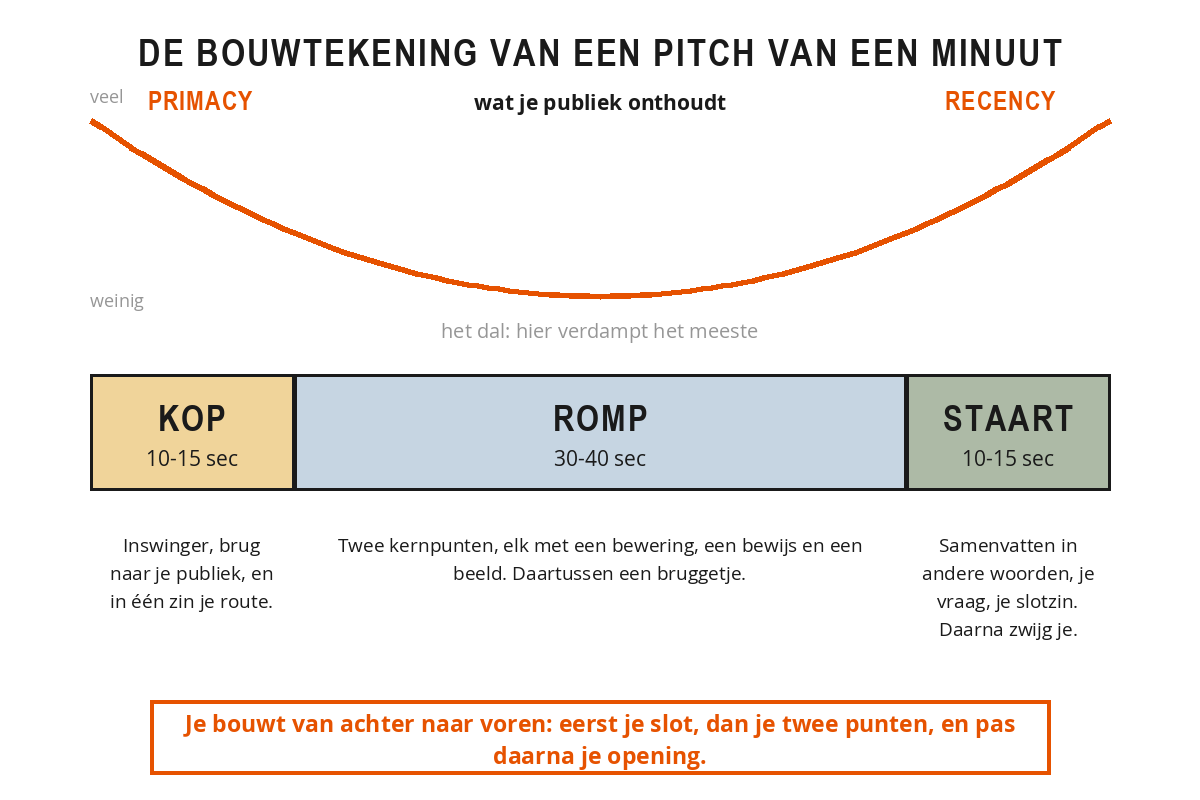
The stack has three layers. The heading is your opening: it grabs attention and gives direction. Allow ten to fifteen seconds, about a fifth of your time. It contains your inswinger, your bridge to your listener and, in one sentence, your route. The body is the content: your two key points, each with a claim, a piece of evidence and an image, with a bridge in between. That is thirty to forty seconds, roughly sixty per cent. The tail is your closing: summarising in different words, your question, your final line. Again ten to fifteen seconds, and then you stay quiet.
If you don't allow for that division in advance, the head gets too long, the body overruns and the tail disappears altogether. Your pitch then doesn't end, it just stops.
Do not build your pitch from front to back, but start at the tail: first note down what your listener should be left with. Then choose the body that works towards it, and only at the very end do you write the head. That way your opening automatically becomes an announcement of something that really follows.
What sticks, and where
Researchers had test subjects listen to lists of words and then asked them which words they remembered. The outcome was always the same: the first words stuck, so did the last ones, and everything in between evaporated. The primacy effect means that what comes in first gets the most room, because there is nothing yet for it to compete with. The recency effect means that what comes in last is still on top of the pile at the moment someone consults their memory. In between lies the dip, and that is where most of it evaporates.
For your pitch that means something uncomfortable. You can put your sharpest figure and your best example in the middle, and still your listener will describe you the next day in the words you started and finished with. That curve cannot be avoided, but it can be used: you deliberately place your two key points on the peaks instead of in the trough, and of your entire pitch there are exactly two sentences you know word for word. Your first and your last.
The head: getting in
Your opening hook is your way in: the first sentence with which you draw attention to yourself and immediately give direction. It is short, it is just surprising enough and it belongs to your subject. An opener that is merely entertaining but has nothing to do with your story costs you credit.
There are many ways to open, and these five almost always work. The provocative question, which your listener answers in their head: "How many quotations did you send last month that you never heard back about?" The surprising figure, which clashes with his gut feeling: "Of every ten quotes this company sends out, four are late." The statement, which not everyone immediately agrees with: "Meetings are the most expensive form of procrastination we have." The anecdote, a small moment from your own week, in two sentences, with place and time in it. And the struggle from the previous chapter, the one with the most weight and the shortest route to recognition.
After your opening hook there are two more short steps. First the bridge to your listener: one sentence in which you make clear why this concerns them, with the benefit up front. Then your route: "I am going to tell you two things: where most of your team's time leaks away, and what we do about it." An announcement like that gives your listener a folder to file your information in, and gives you a promise to keep, which makes you less likely to wander off. Never name more than three. "I'll run through five topics" is not an announcement but a warning.
The body: claim, evidence, image
The body is where you set out your two key points. Everything you say here belongs to one of those two points. As soon as a third subject creeps in, your listener loses the thread and you have nothing left to sum up at the end.
A key point that consists only of a claim remains a claim. A key point that consists only of an example remains an anecdote. The combination works. First you say in one sentence what your point is. Then you put something alongside it that demonstrates this: a figure, a client name, a result. And then you make it visible with a concrete situation. Together those three steps take about twenty seconds, so two key points fit exactly into the forty seconds you have.
Bas sells quotation software. His first key point in three steps.
Claim: "We are bringing the turnaround time of a quotation down from two weeks to two days."
Evidence: "At three installation companies it is now under 48 hours."
Image: "On Monday morning the estimator sees one list, and it is finished before the coffee runs out."
Without the evidence it is an advertising slogan. Without the image it remains a figure that nobody repeats. With all three in it, it takes eighteen seconds.
The order of your two points matters. The point you mention last is closest to your ending and therefore sticks best. So put the point that has most to do with your goal sentence in position two, and the point that mainly creates recognition in position one. That way you start in your listener's world and end with what you want to achieve.
Hanneke is a physiotherapist and wants GPs to refer patients to her. She has two key points: her own measurement protocol, and the fact that many people with back problems have been putting up with them for a year already.
In the wrong order she starts with her measurement protocol and ends with the waiting list. Her closing is then about recognition, while her aim is to get referrals.
In the right order she starts with the patient who has been walking around with it for a year, and ends with her protocol and the result that 70 per cent are symptom-free within six weeks. As it stands she ends with what the GP gains from it, and that is precisely the moment at which he decides.
Bridges between your points
There is space between your key points, and that space is audible. In practice, almost everyone fills it with 'er', 'right', 'well' or a sip of water. That sounds like a pause, not like a transition, and all your listener notices is that you have briefly lost your place.
A bridge looks both ways: it closes off the point you have just made and opens the next one, in a single sentence, two at most. Three types work almost every time. The feedback session refers back to your announcement: "That was the first point. Now the second." The cause-and-effect bridge makes the next point follow on from the previous one: "And that is exactly why that project ground to a halt." The question bridge hands the floor to your listener for a moment, by asking out loud the question that was already on their mind: "The question, of course, is: what does that cost?"
The strongest bridge is often not a sentence at all. You finish your last sentence, you stay silent for two beats, you take half a step sideways and then you start on your next point. That silence works like a blank line: everyone hears that a new section is beginning. Two beats feel like ten to you, and exactly right to your listener.
The tail: getting out
Your tail is the last thing your listener hears and therefore sticks best. Yet in many pitches this is the weakest part: the story simply stops, followed by "yes, well, that was it really". In five words you give away all the credibility you have built up over fifty seconds.
You summarise first, but not word for word, because then it sounds like a copy of your announcement. You pull your two core points together into one sentence that sits closer to your objective sentence than to your list. A seller of charging points who opened with "I'll tell you why charging at work is cheaper and how to get it arranged" closes with: "In short: cheaper charging than at home, and you need do nothing for it except sign once."
Then comes your question from chapter 1, with who, what, when and where in it. "Give it some thought" is not a question. "Drop by later and I'll put you in the March trial" is.
You write out your closing sentence word for word in advance and learn it by heart, because at the moment you need it you feel the most tension. It is short, it contains your core message and it is clearly the end. If your voice drops at the end of that sentence, everyone hears that you have finished. If your voice goes up, your listener keeps waiting. And after your closing sentence you put a full stop: most pitches leak away in the three sentences that follow.
You place your pitch into the blueprint.
- Write your closing sentence down, word for word. Count the words; if the count goes above fifteen, cut until you are under it. Strike out all the hedges: "actually", "maybe", "I think", "a bit".
- You note down two key points, each with a claim, a piece of evidence and an image. Put the point closest to your goal sentence in second place.
- Write it down bridge between point one and two, and deliberately choose which of the three types you use.
- Write your inswinger out in full, plus one sentence bridging to your listener and one sentence announcing your points.
- Say the whole thing out loud with a stopwatch. If you run over the sixty seconds, cut into the body, not the tail.
- Finally, say your first and your last sentence one after the other, without the body in between. Do they sound like the same story?
Summary
- KISS keeps your pitch manageable: one core idea, two key points, no side tracks.
- The division of your minute is roughly twenty per cent head, sixty per cent body and twenty per cent tail.
- The primacy and recency effects mean that the beginning and the end stick while the middle evaporates. Only your first and your last sentence do you learn word for word.
- The opening consists of an opening hook, a bridge to your listener and an announcement of no more than three points.
- Each key point gets a claim, a piece of evidence and an image, together about twenty seconds.
- You put the point closest to your goal sentence last.
- Bridges can be a callback, a cause-and-effect bridge or a question bridge. Two seconds of silence works too.
- In the tail you summarise in different words, ask your question and end with a short, prepared closing line. Then you say nothing.
Your one-minute pitch is running over: you are at eighty seconds. According to this chapter, where do you cut?
What does a well-developed key point in the body consist of?
You have two key points: recognition for your listener, and the point that lies closest to your goal sentence. In which order do you put them?