


2. Increasing proactivity
Being proactive is not a character trait that you either have or lack. It is a set of habits, and habits can be recognised, practised and extended. That is good news, because it means you can change something about it this week.
After this chapter:
- You recognise the four characteristics that proactive people have in common.
- You can name, for each characteristic, which concrete behaviour goes with it.
- You score yourself on each of the four characteristics and know where your biggest gain lies.
- You weigh up the advantages of proactive behaviour against the price it sometimes demands.
- You choose, from six routes, the two you will start with tomorrow.
Four characteristics of proactive people
In the entrepreneur, the team leader and the administrative assistant who sees everything coming just that little bit earlier, the same four characteristics keep recurring. They reinforce one another, and all four can be developed.
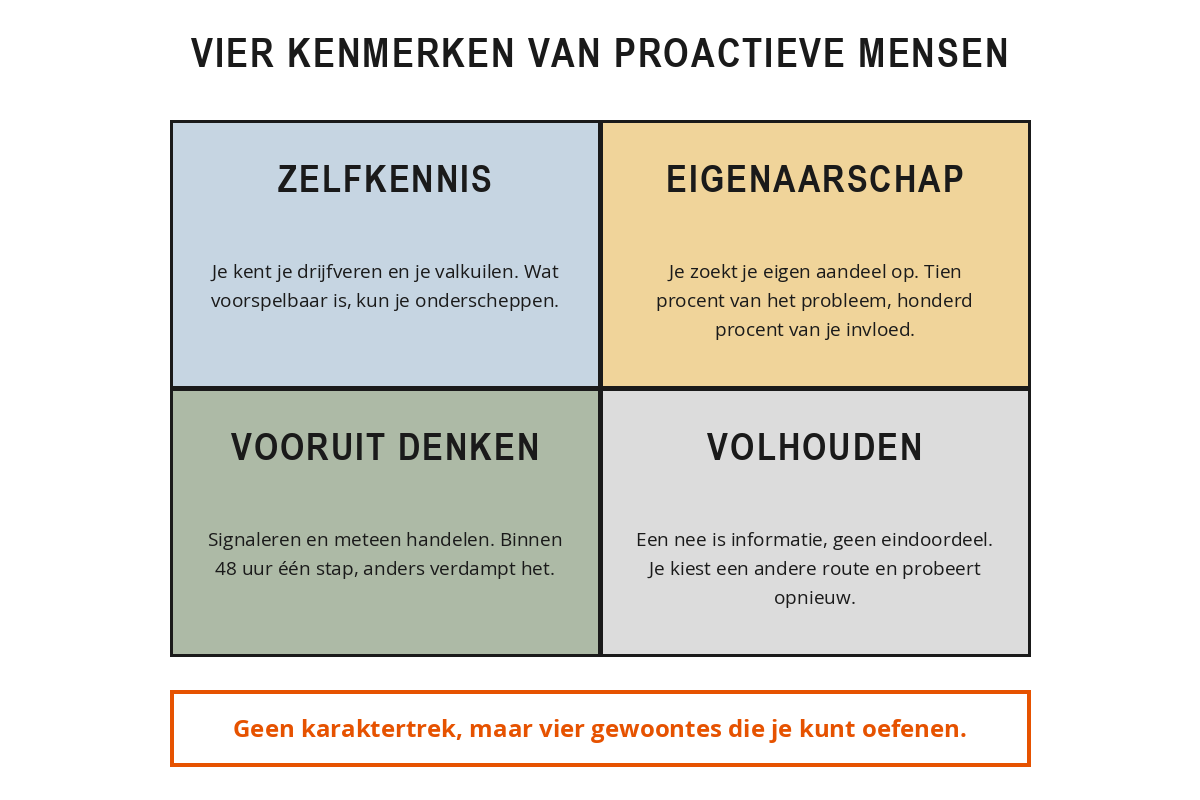
Self-knowledge. Proactive people know what sets them in motion and what holds them back. They know their drivers, their pitfalls and the situations in which they drop out. That knowledge is not a luxury, because you can only make a choice in the space between stimulus and response once you notice that the space is there. It starts small. You notice that you always go quieter when a particular colleague criticises you. You see that on Friday afternoons you no longer take on a single difficult conversation. You discover that when things get busy you start with the easy tasks. Such patterns are not right or wrong, but they are predictable. And what is predictable can be intercepted.
Ownership of your own part in it. The second characteristic is that proactive people seek out their own part in things rather than push it away. Not out of guilt, but because their own part is the only bit they can do something about directly. Ownership does not mean that everything is your fault. It means that in every situation you ask which part lies within your reach, and what you do with it. A project is delayed by a supplier. Your part may be that you raised the alarm too late, or that you had no plan B. That part may be ten per cent of the problem. But it is the ten per cent you can change something about tomorrow.
Two colleagues receive the same rejection of their project proposal. Sander says: "They simply did not look at it. Typical of this organisation." Nadia says: "I sent it by email on the day of the quarterly closing. That was bad timing on my part. This week I will ask for twenty minutes in the diary and then I will explain it in person." Both are right about the facts. But only Nadia's sentence contains a next step.
Thinking ahead and acting straight away. The third characteristic is the combination of anticipating and taking the initiative. On their own, those two achieve little. Anyone who only looks ahead becomes a good forecaster of trouble that then happens anyway. Anyone who only springs into action without looking ahead keeps on fighting fires. You recognise the combination by a small behavioural pattern: a risk is spotted and within the same week there is a first step. Not a complete plan, not a worked-out calculation, but an email, a question, half an hour set aside. Proactive people immediately turn a signal into something tangible, because they know that an observation you do not act on within three days simply evaporates.
A handy rule of thumb is the 48-hour rule: if you see something coming, you take one concrete step within two days. Even if it is only an appointment with yourself in your diary. A signal that is left any longer turns into a complaint of its own accord.
Persevering when things go against you. The fourth characteristic is perseverance. Proactive behaviour does not always produce immediate results. Your proposal is rejected, your colleague answers curtly, your initiative disappears into a drawer. Anyone who then concludes that there is no point falls back into waiting. Proactive people take a no differently. They treat that no as information, not as a final verdict. What did the other person not know? Was it the timing, the form or the content? Who needs to agree with it first? They then choose a different route and try again. That does not require a thick skin, but it does require the ability to see a rejection of your proposal as separate from a rejection of you.
The price of initiative
Proactivity is usually presented as something that can only bring benefits. That is too easy. Anyone who takes the initiative pays a price for it, and anyone who does not know that price will not keep it up for long.
You automatically get more work. Those who pick things up get found. Colleagues learn that a problem stays with you until it is solved, and so the next problem comes your way too. The result is a set of tasks that nobody deliberately assigned and that appears in no job description.
Not everyone is waiting for your initiative. You take on a process that has been running that way for years. To you that is an improvement; to the colleague who devised the process it can feel like criticism. A manager, too, may experience it as being bypassed: you have acted in an area for which he feels responsible. The resistance you then meet is rarely about your idea. It is about the route.
Your mistakes become more visible. Those who wait and see do little wrong. Those who act make choices, and not every choice works out well. Because you took the initiative, the mistake is yours as well. You can no longer fall back on the thought that that was simply what had been agreed.
It takes energy. Thinking ahead, preparing conversations, starting again after a no: it takes attention that you are not giving to something else at that moment. People who move from reactive to proactive mainly notice fatigue in the first few weeks. New behaviour takes more energy than habitual behaviour, until it becomes a habit itself.
Karin sees that the monthly report is late every time. In two evenings she builds a template that halves the work and sends it to the entire department. The response: two colleagues are enthusiastic, her team leader asks why she did not discuss this first, and the controller feels it does not comply with the standard. A month later the template is introduced after all, once the team leader has presented it as his own proposal in the management meeting. Karin has achieved her aim, but not the recognition. Anyone who sees this coming in advance holds the conversation about the route earlier and thereby prevents a good deal of friction.
With a new initiative, check three things in advance: who will notice it, who feels ownership of it, and what it will cost you if it goes wrong. Three minutes of thinking often saves you three weeks of repair work.
Six routes to greater proactivity
Proactivity does not grow through a decision, but through repetition. These six routes are all small enough to start on tomorrow and big enough to make a difference after a month. You do not have to take all six at once; two is enough.
- Changing your language. Replace "I have to" with "I choose to", and "they aren't doing anything" with the name of the person you are going to address. Within a week you will notice that different sentences also prompt different questions.
- Keeping small promises. Reliability is the fuel of influence. Commit to one thing a day that you are certain to deliver, however small, and deliver it on time. Those who keep their small promises are offered the big assignments.
- Scheduling a fixed moment to look ahead. Put twenty minutes in your diary once a week with just one question: what is coming my way in three weeks' time and what can I already do about it now. That is anticipation in its simplest form.
- Asking for what you need. Much reactive behaviour stems from missing something and not reporting it: information, mandate, time, equipment. A concrete request to a concrete person brings the subject within your own reach.
- Asking for feedback on your behaviour. Your blind spot is by definition invisible to you. Ask two colleagues: in which situation do you see me holding back while you expect me to act? That question yields more useful information than a general question about how you are doing.
- Evaluating weekly. Take five minutes on Friday to look back: where did I take the initiative, where did I let it slide, and what made the difference. Without looking back you simply repeat the same pattern.
Score yourself on the four characteristics with a mark from 1 to 5 and support each mark with a concrete situation from the past month.
- Self-knowledge: score and situation.
- Ownership: score and situation.
- Thinking and acting ahead: score and situation.
- Persevering in the face of resistance: score and situation.
Then look at your lowest score and choose two of the six routes that do the most about it. For each route, note the first action in the form: if this situation arises, then I will do this. Add a day and a time. Finally, note which of the four prices you most expect with those two routes, and what you will do to absorb it.
Summary
- Proactive behaviour rests on four characteristics: self-knowledge, ownership of your own share, thinking ahead and acting straight away, and persevering when you meet resistance.
- Self-knowledge makes your patterns predictable, and what is predictable you can intercept.
- Your own share is often small, but it is the only part you can change something about tomorrow.
- Anticipating and taking the initiative only work together: spotting something without taking a step evaporates, action without looking ahead is firefighting.
- A no is information, not a final verdict. Ask yourself what the other person did not know and choose a different route.
- The price of initiative: more work, resistance to the route taken, more visible mistakes and loss of energy for as long as the behaviour is new.
- The six routes: changing your language, keeping small commitments, scheduling a fixed moment to look ahead, asking for what you need, asking for feedback on your behaviour and evaluating weekly.
Sander and Nadia receive the same rejection. According to this chapter, what is the difference in Nadia's response?
Karin spends two evenings building a template and circulates it. Her team leader asks irritably why she did not discuss it first. Which price of initiative is this?
According to this chapter, what is the problem with looking ahead without acting straight away?