


1. Proactive versus reactive
Between what happens and what you do there is always a moment of choice. That moment is the core of acting proactively. In practice, most people miss it in a flash: the email comes in, the eyebrows go up, and a reply is already there before you have decided you wanted to send it.
After this chapter:
- Describe your proactive conduct using three definitions: anticipating, taking the initiative and taking responsibility for your own response.
- You recognise the four forms in which reactive behaviour shows itself at work.
- You can name what waiting costs you in the short and the long term.
- You place your own behaviour in a specific situation on the scale from waiting to acting yourself.
Three definitions of proactive
Acting proactively is an umbrella term that can mean three different things in practice. They reinforce one another, but they also genuinely ask something different of you.
Anticipating. You look ahead and act on what is likely to happen. You see that the staff shortage will cause problems in July, so you arrange cover back in May. Anticipating means doing the work before it becomes urgent. That rarely feels pressing, and that is precisely why it is the first thing to go in a busy week.
Taking the initiative. You take action without anyone asking you to. You see a problem, you pick it up, and you report afterwards what you have done. Anyone who waits for an instruction is reactive by definition, however hard that person works.
Taking responsibility for your own reaction. This is the hardest of the three. Between a stimulus and your response there is a space. That stimulus can be anything: an angry email, a cancelled budget, a colleague interrupting you for the third time. In that space you make a choice. Someone who is reactive does not experience that space and says: "He makes me angry." Someone who is proactive says: "I am becoming angry, and I choose what I do with that."
In the team meeting, Sanne hears that her project has to be finished a month earlier. Her first thought is: this can't be done, they're just making things up. She keeps that thought to herself and asks a question instead: "What is the minimum result that has to be there in four weeks' time?" With that answer she drops two deliverables and meets the deadline. The situation has stayed exactly the same; only the way in is different.
The reactive counterpart
Reactive behaviour is not the same as being lazy or unmotivated. It is often precisely the hard workers who act reactively: they run from incident to incident and are exhausted at the end of the day. The difference is not in how much you do, but in who sets the ball in motion.
Reactive behaviour usually stems not from unwillingness but from habit. Anyone who has worked for years in an organisation where decisions are taken from above naturally unlearns taking the initiative. Waiting costs nothing and rarely causes trouble. That makes it a comfortable and entirely understandable choice. It appears in four forms.
- Passing the buck. The responsibility goes to someone else. "That is the planning department, that is not my call." Often factually correct, but it also ends the conversation.
- Postponing it until it becomes urgent. The problem has been visible for ages, but only when it catches fire does anything happen. The work is then done under pressure and with less quality.
- Complaining without an addressee. The frustration goes to colleagues at the coffee machine, not to the person who can do something about it.
- Over-accommodating. Everything is swallowed to keep the atmosphere pleasant. On the outside it looks like cooperation, on the inside the irritation piles up.
In Joost's department, the monthly report has been going wrong for six months. Everyone knows it. People grumble about it in the corridors. Joost says to a colleague: "They ought to set that system up properly." When he is asked in the team meeting whether there are any problems, no one says a word. Six months of grumbling produced zero minutes of conversation with someone who could do something about it. In the seventh month, the report goes wrong again.
A useful test when something annoys you: can you name within ten seconds who you should be speaking to about it? If not, you are probably complaining. If so, you have your next action right there.
What waiting costs you
The direct costs are visible: deadlines that are only just met, rework, conversations that take place too late. The indirect costs are greater and almost nobody notices them. Someone who rarely takes the initiative is also rarely asked. Your sphere of influence slowly shrinks as a result, without there being a moment you can point to when it happened. A year later you are in fewer meetings than the year before and you do not quite know how that came about.
There is an emotional price too. If the cause of your situation always lies outside yourself, then so does the solution. In the short term that feels safe, because it isn't your fault. In the long term it produces a sense of powerlessness, and that feeling is even accurate, because you have given away your own room to act.
Five positions on a scale
Proactive and reactive are not two boxes, one of which you sit in. It is a scale, and you are somewhere different on it in each situation. On one topic you act of your own accord, on another you have been waiting for months. The five positions below run from no control to full control.
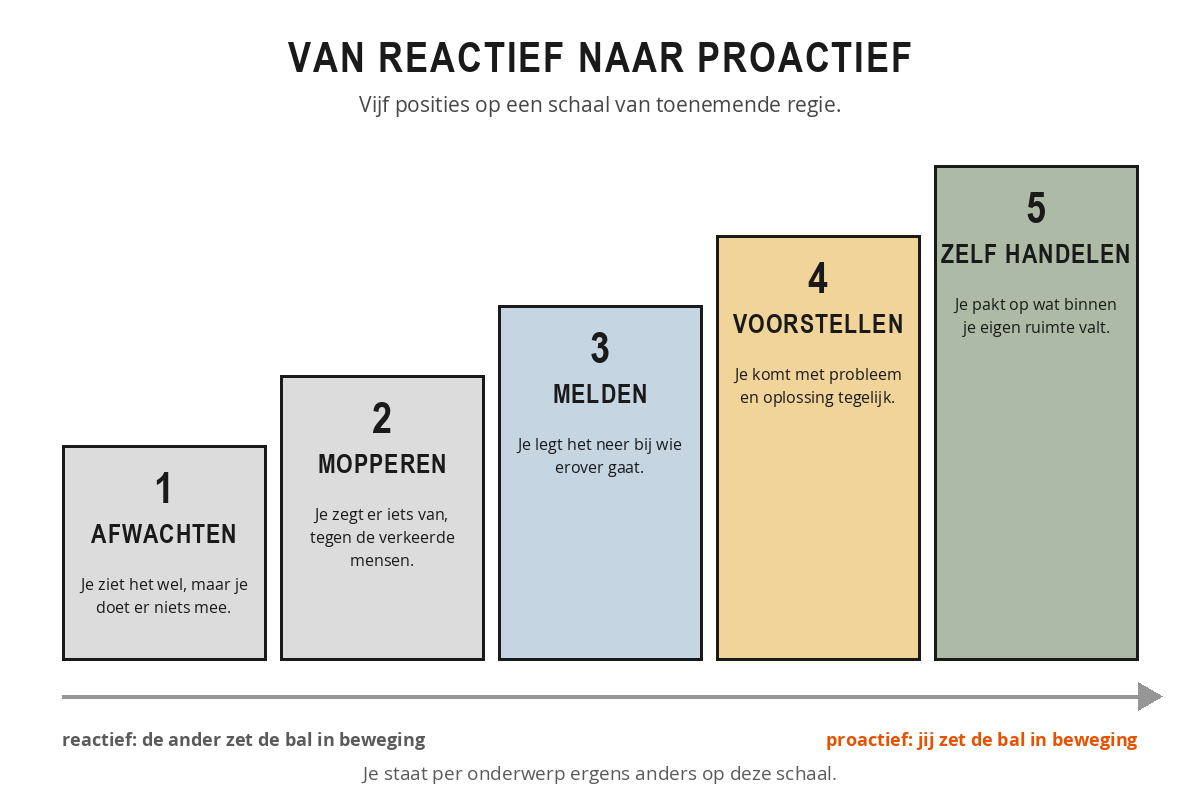
Position 1, waiting. You do see it, but you do nothing with it. You assume that someone else will pick it up, or that it will blow over by itself. This is the only position in which nobody ever knows that you saw it coming.
Position 2, grumbling. You do say something, just to the wrong people. The information does reach the organisation, but not a place where anyone can act on it. This feels like action and is not.
Position 3, reporting. You put the problem to the person who is responsible for it. That is a real step forward: the subject is now on the table. But you leave the whole follow-up to the other person, and that often means it stays there.
Position 4, proposing. You come forward with a problem and a possible solution at the same time. You don't just say that the reporting is going wrong, but also what you would do about it and what you need to do it. The other person decides, but the decision is now a yes or a no rather than an open question.
Position 5, acting yourself. You deal with whatever falls within your own remit and report afterwards what you have done. This is the quickest position and at the same time the position where you can get it most wrong, because you have not asked anyone beforehand.
Five is not always the right answer. On a topic that someone else feels ownership of, position four is often wiser than five. What matters is that you are aware of the position you tend to get stuck in. Most people are at two when it comes to their biggest irritation.
Pick three issues at work that have annoyed you over the past month. Write them down and give each one a score from 1 to 5: where do you stand now?
- Choose the topic with the lowest score.
- Note down the name of the person who can do something about it. If there is no name, that is your first piece of research.
- Write down in two sentences what position four looks like: what is the fact, and what is your proposal?
- Put in your diary when you are going to say those two sentences. A date, a time, a name.
Afterwards, note down in two sentences what the response was. You will need that note in chapter 2.
Summary
- Acting proactively means three things at once: looking ahead, taking action yourself and taking responsibility for your own reaction.
- Between stimulus and response there is a space. Reactive means that you do not notice that space.
- You recognise reactive behaviour by shifting responsibility, postponing until it becomes urgent, complaining without an addressee and over-adapting.
- The bill for waiting comes later: your sphere of influence shrinks and you start to feel powerless.
- The scale runs from waiting through grumbling, reporting and proposing to acting yourself. You are in a different place on it for each subject.
- Position four, a problem accompanied by a proposal, is the safest big step forward in most work situations.
In May you can see that the staff shortage will lead to problems in July, and you arrange cover now. Which definition of proactive is this?
For six months Joost has grumbled about the report at the coffee machine and said nothing in the team meeting. Which position on the scale is he in?
What does this chapter call the biggest cost of reactive behaviour?