


Introduction
For many people a payslip is a page full of abbreviations. Grondslag LH, SV-loon, bijzonder tarief, werkgeversheffing Zvw. As long as the net amount is correct nobody looks at it, but as soon as an employee asks a question or the Belastingdienst sends back a notification, you want to know exactly where every figure comes from. Payroll administration is not a matter of pressing buttons in a software package; it is understanding what that package does.
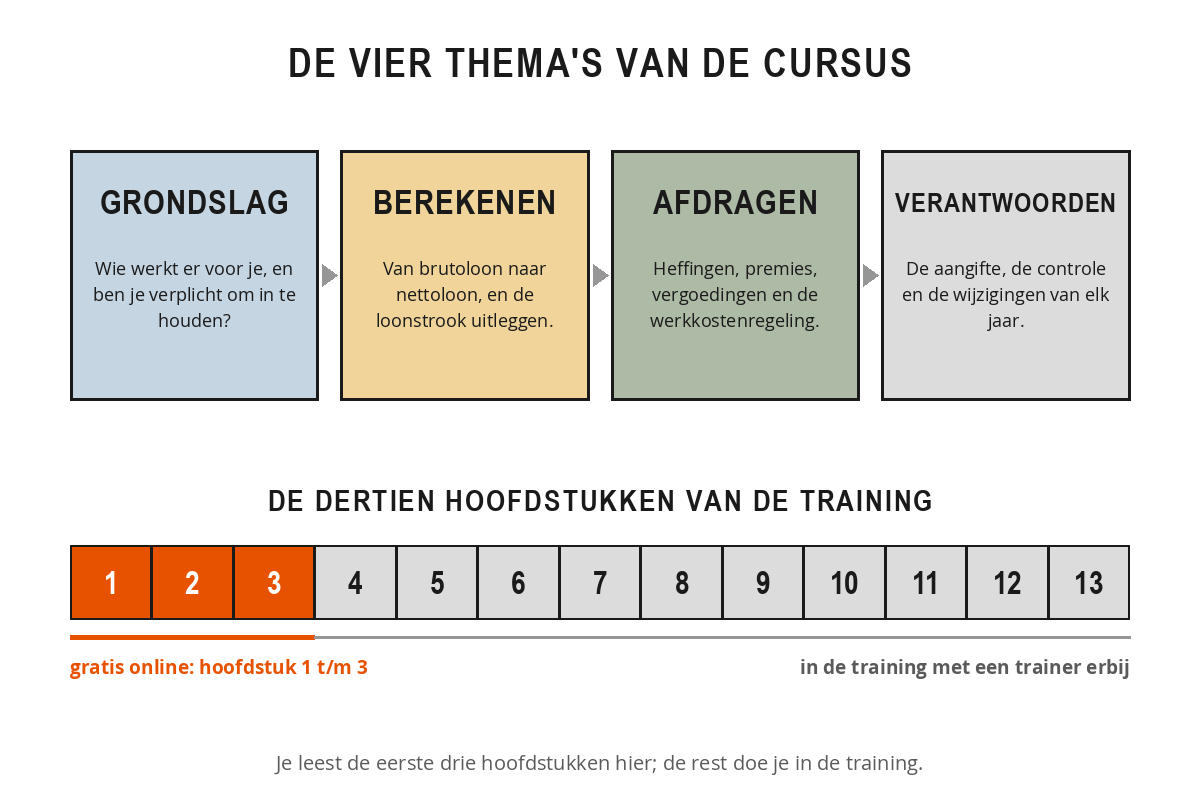
This free course contains three chapters: the orange part of the bar above. At the bottom of chapter 3 you will find the full course.
What you will learn
You start with the question that comes before everything else: does this person actually work for you in the eyes of the law? If there is an employment relationship, you are required to withhold, and everything else follows from that. If there isn't, the worker arranges their own tax. Then you start calculating. You see how gross pay is built up, which amount forms the basis for payroll tax, in which order the deductions are applied and what is left at the bottom line. Finally you look at the closing stage: the payroll tax return, what the Belastingdienst automatically checks against it and how to properly correct an error from an earlier period.
How the course is structured
The course follows four themes that build on one another. You start with the basis: who works for you, and are you obliged to withhold? Then comes calculating: from gross pay to net pay, and being able to explain the payslip to the people you produce it for. After that remitting: the taxes, the contributions, the expense allowances and the work-related costs scheme. And you finish with accounting: the return, the check by the Belastingdienst and the changes that come round again every year. Each chapter contains theory, a diagram, examples from practice and an exercise that you apply to your own administration.
This course contains percentages, contributions and amounts that the legislator sets annually. The payroll tax tables, the tax credits, the contribution percentages, the maximum contribution wage, the statutory minimum wage, the discretionary scope of the work-related costs scheme, the untaxed allowances and the addition percentages change every year, and sometimes part-way through the year. What you read here is intended to help you understand the technique and the concepts. The figures you use in your own administration should always be taken from the current tables of the Belastingdienst and the Handboek Loonheffingen, which usually appears at the end of December.
Practical tips for use
- Keep a calculator and a real payslip to hand. The examples become a good deal more tangible when you set them alongside a document you know.
- Do the exercises before you move on. The sections build on one another, and practising is the quickest way to get to grips with the logic.
- Keep the Belastingdienst website open alongside as a reference, and look up every figure you are going to use in your own situation.
- Make a note of your questions as you go. Some concepts only fall into place once you are a chapter further on.
- Don't read it all in one go. One chapter at a time, with time to apply it to your own payroll administration, will get you further than reading through it in a single afternoon.
Each chapter ends with a short knowledge check of three questions: answer them correctly to mark the chapter as completed. Your progress is saved automatically in your browser.
Enjoy the read, and above all: enjoy the payslip that you will soon be able to explain line by line.