


1. When is there an employment relationship
Who actually works for you? The question sounds simple, but the answer determines everything that follows: whether you have to withhold payroll taxes, which contributions apply and which documents belong in your administration. The tax reality comes in more varieties than just employee and self-employed person, and it is precisely the intermediate forms where things go wrong.
After this chapter:
- You can recognise the difference between a real, a deemed and an improper employment relationship.
- You know the three characteristics a real employment relationship must meet.
- You can indicate per type what this means for withholding and contribution payments.
- You will recognise the risk cases in which the Belastingdienst may establish an employment relationship, even where you did not see one yourself.
The pivotal point of the entire payroll tax
The term employment relationship is the pivot of payroll tax. If an employment relationship exists between you and the person carrying out work for you, you are liable to withhold. If it does not, the worker arranges their own tax and you simply receive an invoice. That sounds clear enough, but in practice it becomes murky. A self-employed contractor who in fact functions as an employee, a trainee receiving a payment, a supervisory director without an employment contract: all cases in which you have to stop and think.
The law distinguishes three categories, and you need to be able to recognise all three. The main thing to remember: all three lead to a withholding obligation. So the question is not whether you must withhold, but by which route you arrive there and which exceptions apply per route.
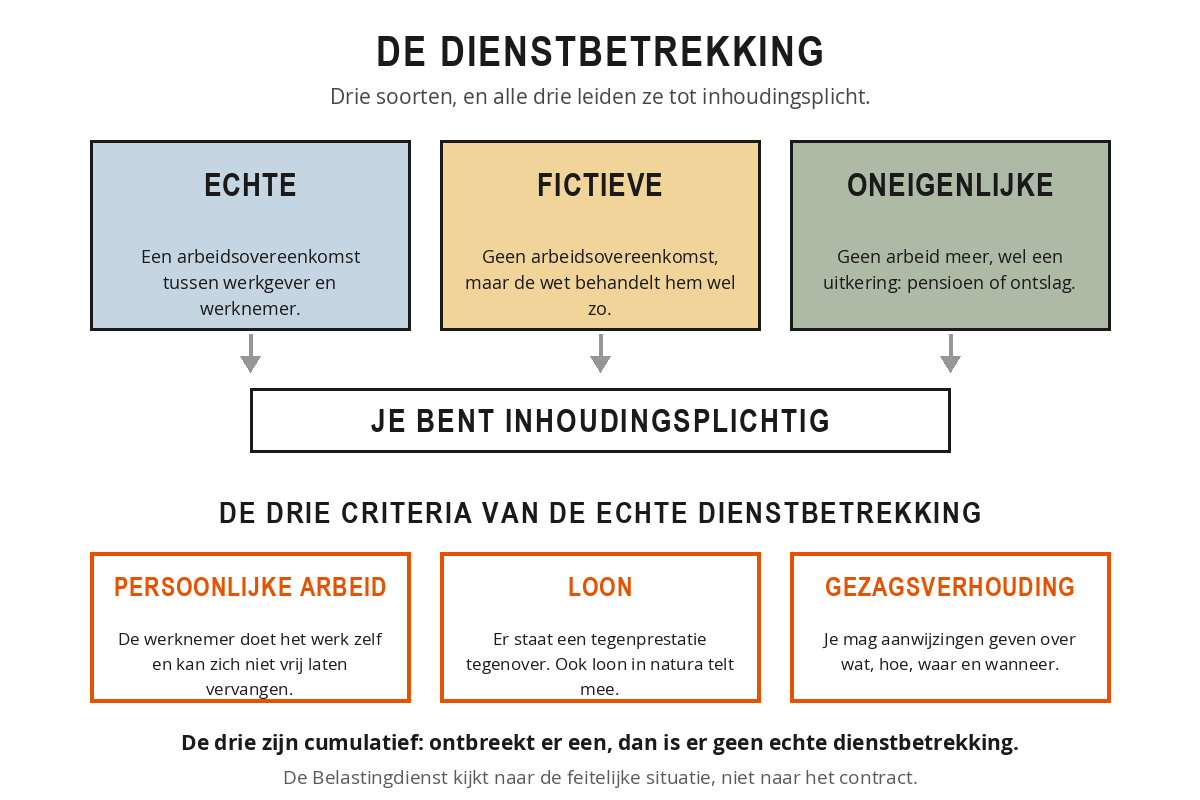
The genuine employment relationship is the most common form and the basis around which your administration revolves. It is also known as the employment relationship under private law, because it rests on an employment contract between two parties. Whether that agreement was set down in writing or concluded verbally makes no difference for tax purposes. What counts are the actual circumstances.
The deemed employment relationship is an employment relationship in which one element of the real employment relationship is missing, but where the legislator nevertheless wants you to withhold payroll taxes. For tax purposes, the relationship is treated as if there were a real employment relationship, even though the civil-law picture does not entirely fit. The Tax Administration's Payroll Taxes Handbook lists these cases exhaustively, so you cannot invent one yourself, but you do need to be able to recognise them all. The most important ones are interns with a realistic payment, supervisory directors of companies, holders of a substantial interest who work for their own BV, homeworkers who produce for a single client on a regular basis, agency workers in their relationship with the employment agency, and persons treated as employees: people who work for you at least two days a week and earn at least forty per cent of the minimum wage doing so. In all these cases you are obliged to withhold, and in principle the same rules apply as for an ordinary employee, sometimes with an exception for a specific contribution. The director-major shareholder, for example, is insured under the Health Insurance Act, but not under the employee insurance schemes.
The improper employment relationship finally there is the case in which no work is performed at all, but you still pay out a benefit. Think of a severance payment, a pension payment or a benefit under the WW or WIA. Payroll tax must be withheld there too, because for tax purposes the benefit counts as wages. For payroll administration this means that you will regularly have to deal with payroll taxes for former employees and pensioners as well.
The three criteria for a genuine employment relationship
A genuine employment relationship does not come about simply because a contract is headed "employment contract". Three characteristics are decisive, and they are cumulative: all three must be present at the same time. If one is missing, there is no genuine employment relationship for tax purposes, whatever the paperwork is called.
Personal performance of work. The employee must carry out the work personally and may not simply have someone else take their place. For a self-employed contractor the position is different: in principle they can send a colleague to take over the work. If someone is free to be replaced by any third party, this criterion is not met and the relationship looks more like a contract for services. Note the word free: a short absence during which a colleague steps in is a normal practical situation and does not count as free replacement.
Wages. There is a consideration in return for the work. That does not have to be money; wages in kind, board and lodging or a product from your own business also count. A purely symbolic payment, or a reimbursement of only the costs actually incurred, is not wages in the tax sense. That is why a volunteer who is only reimbursed for travel costs usually falls outside the scope of an employment relationship.
Relationship of authority. In practice this is the trickiest criterion. There is a relationship of authority if you can give instructions about what is done, how, where and when, and the other person has to follow those instructions. It is about the power to do so, not about whether you use it on a daily basis. A self-directing professional can therefore perfectly well work under an employment contract. Does someone work entirely independently, set their own working hours, methods and prices, and bear entrepreneurial risk? Then the relationship of authority is probably absent.
Pieter is a graphic designer and sends an invoice to advertising agency Vorm & Kleur every month. He works four days a week at their office, receives his assignments from the creative director, uses the agency's software and hardware and works exclusively for them. If he falls ill, the schedule simply shifts; sending a fellow self-employed contractor is not allowed.
On paper, Pieter is a self-employed entrepreneur. If you run through the three criteria, all three are present: personal work (replacement is ruled out), wages (the monthly invoices) and a relationship of authority (the director's instructions). If the Tax Administration establishes this, Vorm & Kleur can be assessed retrospectively for payroll taxes, with fines on top.
Nadia is on a four-month work placement and receives 400 euros a month, while her actual expenses come to about 80 euros a month. Only a small part of that 400 euros is therefore a reimbursement of costs; the rest is payment for her work.
That means it is no longer a pure expenses reimbursement and a deemed employment relationship arises. You withhold wage tax and national insurance contributions and pay the income-related contribution under the Health Insurance Act, but you do not pay employee insurance contributions. Had Nadia only been reimbursed for those 80 euros in actual costs, she would have remained outside the scope of payroll taxes.
Unsure about the status of someone who works for you? Go through the three criteria one by one and write down, for each criterion, exactly what applies in your situation. If any one of the three is a clear no, there is no genuine employment relationship. And be honest in your assessment: the Belastingdienst looks at the actual situation, not at the label you attach to it. "He has a Chamber of Commerce number" is no free pass if the relationship of authority and the personal performance of work are in fact there.
Special employment relationships
Besides the clear-cut cases, in practice you will come across all kinds of intermediate forms. On-call workers working on a zero-hours contract work irregularly, but as soon as the on-call worker turns up there is simply an employment relationship: withhold tax, pay the contributions and process the hours worked. Since the Balanced Labour Market Act came into force, additional rules also apply, such as a call-up period of at least four days and the obligation to offer a fixed number of hours after twelve months.
Trainees who only receive an expenses allowance fall outside payroll tax; if they receive a genuine payment, there is a deemed employment relationship with simplified rules, as in Nadia's example. Self-employed contractors work on the basis of a contract for services and are not employees, but since the Assessment of Employment Relationships (Deregulation) Act came into force the Belastingdienst has taken a critical view of such arrangements. If the self-employed person in fact works as an employee, with fixed working hours, under authority and without bearing any risk, the tax authorities may still classify the relationship as an employment relationship, with additional assessments for payroll taxes, contributions and fines, often with retroactive effect.
The director-major shareholder works for his own BV and is subject to wage tax through the so-called customary salary, a minimum amount set annually by the tax authorities. He is not insured under the employee insurance schemes, because there is in fact no relationship of authority; for the Health Insurance Act, however, the BV does pay the employer's levy. And if your partner or a child who helps out works in the business, an employment relationship can arise, but it need not. For a partner, different rules often apply if there is no real relationship of authority, and for children under 21 who work in the business there is a simplified scheme with fewer administrative obligations.
The thresholds in this chapter are not fixed. The minimum wage of which persons treated as employees must earn forty per cent, the customary salary of the director-major shareholder and the age limits for children working in the business are set anew each year, and the rules on bogus self-employment are in flux. Always check the current amounts and conditions with the Belastingdienst or in the Handboek Loonheffingen before basing a decision on them.
Look at these four situations and decide in each case whether there is a (deemed) employment relationship. Support your answer with the three criteria.
- A student is on a four-month work placement and receives 400 euros a month, while the actual expenses come to about 80 euros.
- A self-employed copywriter delivers one blog article each month, works from home and invoices per article.
- A sales assistant works three days a week in your shop, receives instructions from the branch manager and uses the shop's till.
- The director-major shareholder of a one-man BV works full time for his own company and pays himself 50,000 euros a year.
Then take out your own administration. Who do you work with on a structural basis without an employment contract? Go through the three criteria for that person and write down, for each criterion, what actually happens.
Summary
- There are three types of employment relationship: the genuine, the deemed and the improper. All three make you liable to withhold.
- A genuine employment relationship rests on an employment contract, whether written or verbal. The actual circumstances are what count.
- The deemed employment relationship is an exhaustive list from the Handboek Loonheffingen: trainees with a genuine payment, supervisory directors, the director-major shareholder, home workers, temporary agency workers and persons treated as employees.
- In an improper employment relationship there is no longer any work, only a payment: a pension, a severance payment, WW or WIA.
- The three criteria for a genuine employment relationship are personal performance of work, pay and a relationship of authority. They are cumulative.
- A purely symbolic payment or a pure expense allowance is not wages; free substitution means there is no personal labour; setting your own working hours and methods and bearing entrepreneurial risk point to the absence of authority.
- The Tax Administration assesses the actual working practice, not the contract. In long-running relationships with self-employed contractors, an approved model agreement only helps if you also act in accordance with it.
A copywriter invoices you per article, works from home, decides for himself when he writes and may, if necessary, have the work done by a colleague. What does that mean for the employment relationship?
What does this chapter mean when it says that the three criteria are cumulative?
You pay a former member of staff a severance payment. No more work is being carried out. What applies for tax purposes?