


3. The payroll tax return
The payroll tax return is the final piece of your payroll administration. Every wage payment you have made this period comes together here in a single message to the Dutch Tax Administration. If that message is correct, the rest usually is too. And if it is not, you often find out sooner than you think, because the figures are checked automatically.
After this chapter:
- You know which data appear in the payroll tax return and how the collective section and the employee section relate to one another.
- Whether you know the filing and payment deadlines and what happens if you miss them.
- Whether you can process a correction through a supplementary return or a correction notice for an earlier period.
- You recognise the main signals the Belastingdienst uses to check whether your return is internally consistent.
- Whether you know how the four levels of inspection follow on from one another.
What you submit each period
The payroll tax return is the monthly or four-weekly account of everything you have paid out in wages and withheld in taxes and contributions. You file the return digitally via the Belastingdienst portal or, far more commonly, automatically from your payroll software. The message consists of two parts that are always submitted together.
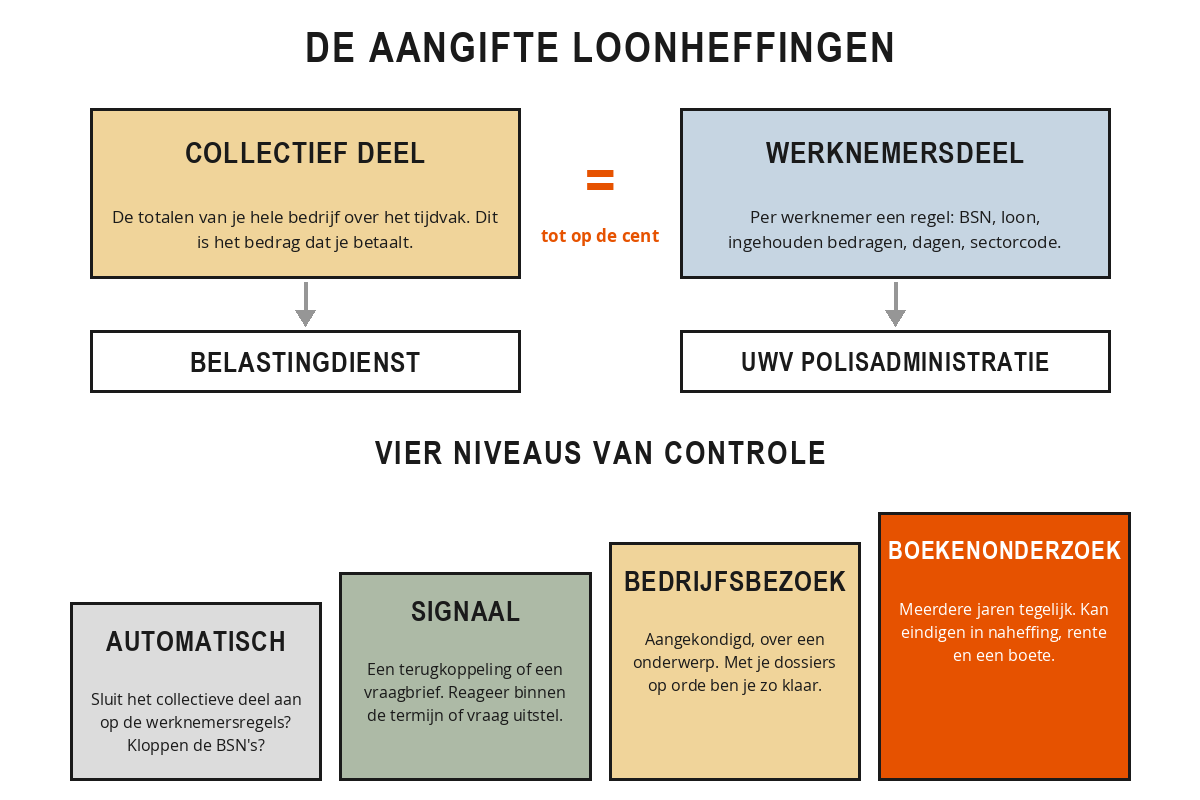
The collective section gives the totals for your entire company in that period: total wages, payroll tax, employee insurance contributions, the income-related Health Care Insurance Act contribution and any remittance reductions offset. That is the amount you will actually pay.
The employee section, also known as the nominative return, contains an itemised line for each employee: the BSN, the wage, the amounts withheld, the days worked, the sector code, the code for the nature of the employment relationship, whether the payroll tax credit has been applied, and all the data the UWV needs for the polisadministratie. That polisadministratie is not a formality: benefits are later calculated from it, so an error in an employee line ultimately affects your member of staff.
The total of all employee lines must be exactly equal to the collective section. If the two differ by so much as a cent, the system rejects the return. That is strict, but it is also your best check: a return that gets through is at least internally consistent.
Filing and payment deadlines
Your filing period is stated in the return letter you receive each year from the Belastingdienst. For most employers that is a month, for some a four-week period. The rule is simple: you file and you pay within one month after the end of the period. In concrete terms that means the return for January must be received by the last day of February at the latest, payment included. With four-week periods it works the same way, only the dates shift each year.
Two things to watch closely. First, the return and the payment are separate obligations. A return filed on time without payment counts as a default, and the other way round just as much. Secondly, late an immediate penalty. For a first default there is a grace period of seven calendar days, but after that a default penalty follows automatically. In the case of repetition or intent, those penalties mount up considerably.
Installation company De Wit duly files its return for January on 20 February, but the payment is left until 5 March. The return itself is therefore on time; the payment is not, as it had to be received by the last day of February at the latest.
Because this is a first default and the payment falls within the grace period of seven calendar days, no default penalty is imposed this time. If the same thing happens again in March, that leniency is used up and the penalty follows automatically. The point of this example: filing and paying are two separate actions, and the payroll package only does the first one for you.
Put the submission dates for the whole year in your diary in January, with a reminder five working days in advance. Payroll packages often file the return automatically, but responsibility for timely filing and payment remains with you as the employer.
Supplementing or correcting
It happens that after filing you discover that something is wrong. A forgotten hour of overtime, an incorrectly applied payroll tax credit, an employee who turned out to have started later than reported. There are two ways of putting that right, and the difference lies in the period in which you discover the error.
Have you already submitted the return but the period has not yet closed? Then you simply file a new, complete return. It overwrites the previous one. This is called a supplementary return.
If the period has closed and you need to correct an earlier period, you send a correction message along with your next regular return. That correction notice sets out the full, correct situation for that earlier period, so not just the difference. The balance, whether positive or negative, is offset against the current return.
When preparing the return for March, which you file at the end of April, you discover that in February you overlooked a bonus of 1,200 euros gross for Karim, one of your engineers.
You file your regular return for March and add a correction message for February to it, with the correct and complete February figures for Karim. The additional payroll tax and contributions due are added to the amount payable for March. Karim himself receives the bonus by means of a separate payslip for February or through a recalculation on the March payslip, depending on how your payroll software handles it.
A correction message is not, incidentally, an opportunity to optimise things; you are putting right factual errors. Correcting systematically tells the Belastingdienst that your primary records are not in order, and you can then expect an audit of the books.
What the Belastingdienst sees immediately
The return is automatically recalculated for internal consistency. A few checks that are always carried out: does the collective section match the sum of the employee lines exactly, are the BSNs valid and known in the polisadministratie, does the reported wage fit the number of paid hours and the sector code, does the payroll tax credit applied match what the employee previously indicated, and do the contribution percentages fall within the range for your sector.
If anything deviates, you receive feedback. Sometimes this is only a signal notice, sometimes a request for clarification. Ignoring it is not an option: an unanswered signal often ends in an additional assessment.
The four levels of inspection
Those automated checks are only the beginning. Behind the scenes, risk models compare your return with those of comparable employers, and with your own returns from earlier periods. If you deviate from these structurally, you end up on a list for further investigation. The inspection escalates through four levels, from light and automated to far-reaching.
Level 1, the automated check. The system recalculates whether the collective section matches the employee lines and whether the BSNs, hours, sector code and contribution percentages are correct. This happens with every return, without any human involvement.
Level 2, the signal. If something deviates, a signal message or a query letter follows. That is not yet an accusation, but it is a moment at which you can put something right before it becomes an additional assessment. Respond within the stated period, and if you do not have the answer to hand: request an extension. Silence is interpreted as agreement with the inspector's position.
Level 3, the company visit. This is relatively light. An inspector visits to look at a specific topic: the work-related costs scheme, the identification of new employees, or the processing of company cars. The visit is announced in advance and you know which documents to have ready. In practice, the inspector arrives with a list and goes through it with you. Are your personnel files in order, can you trace every allowance back to an agreement, and do your work-related costs entries tally? Then you are done within a couple of hours. If copies of identity documents are missing or you cannot substantiate an exempt allowance, the visit often leads on to a more extensive investigation.
Level 4, the books inspection. That is a different story. The inspector examines several years at once, requests the general ledger, payroll journal entries, contracts, expense claims and correspondence, and compares everything with the returns filed. An investigation like this often runs on for weeks and ends in a report. If something is wrong, an additional assessment, interest and sometimes a penalty for deliberate non-compliance will follow. The Dutch Tax Administration can look back five years, and as much as twelve where foreign elements are involved. An error from an old year that you never put right can therefore be corrected retroactively across all the intervening years.
Where things usually go wrong
There are a few themes that the Dutch Tax Administration comes across time and again. Wrongly untaxed allowances, such as a travel allowance above the tax-free norm of 23 cents per kilometre mentioned in the syllabus, a telephone allowance without any business necessity, or a working-from-home allowance on top of a fully reimbursed workplace. Incorrectly classified employment relationships: the self-employed contractor who in practice works under authority, with fixed hours and without entrepreneurial risk, precisely the case from chapter 1. The Dutch Tax Administration then reclassifies the arrangement as employment, with additional payroll taxes assessed. A company car without a watertight mileage record, where no addition to taxable income was applied because the employee supposedly did not drive privately, but there is no trip record to substantiate this. Exceeding the free margin of the work-related costs scheme, discovered too late, as a result of which the 80 per cent final levy was not paid. And incomplete identification: no copy of a valid identity document in the file, or an expired residence document without an extension.
The amounts and percentages in this chapter are taken from the syllabus and are intended as illustrations. The tax-free mileage allowance, the final levy percentage under the work-related costs scheme, the discretionary margin and the level of the default and deliberate non-compliance penalties are adjusted periodically, and the deadlines may change as well. Payroll administration is not a field in which you learn the rules once. Every year there are changes to, at the very least, the payroll tax and tax credit tables, the contribution percentages for the employee insurance schemes and the Health Care Insurance Act, the maximum contribution wage and the statutory minimum wage, the discretionary margin under the work-related costs scheme, the tax-free allowances and the addition percentages. Check every figure you use with the Dutch Tax Administration and in the Payroll Taxes Manual, which is usually published at the end of December. This chapter is not tax advice.
Do not see a letter of enquiry as an attack, but as a chance to put something right before it becomes an additional assessment. In addition, set aside half a day in the first week of January every year to go through the changes and check your pay components against the new tables. Your payroll software will process the updates, but collective agreement links and your own pay components are not recalculated automatically. An hour of preparation in January saves an additional assessment in October.
Go through your last four payroll tax returns and answer the following for each one:
- Was a signal message attached to it? If so: was it followed up?
- Have I filed any corrections, and have they been processed?
- Which item has risen or fallen most sharply over the past period, and can I substantiate that?
For each return, note down one point you want to check before the next inspection moment. Then check whether a valid proof of identity is in the file for every member of staff; that is the point at which a company visit most often gets stuck.
Summary
- The return consists of a collective section with your company's totals and an employee section with one line per employee. The sum of the employee lines must equal the collective section to the cent.
- The employee section feeds the UWV policy administration, from which benefits are later calculated.
- You file your return and pay within one month of the end of the period. Filing and payment are separate obligations.
- Being late is immediately a default. For a first default a grace period of seven calendar days applies, after which the fine follows automatically.
- If the period is still running, you correct it with a complete new return. If the period has passed, you send a correction message along with the next return, setting out the full correct situation.
- Inspection escalates through four levels: automatic checking of the figures, a signal or query letter, an announced company visit on a single topic, and a books investigation covering several years.
- The Dutch Tax Administration can look back five years, or twelve where foreign elements are involved.
- Common points of correction: unjustified tax-free allowances, bogus self-employment, a missing mileage record, exceeding the free margin and incomplete identification.
Why does the system reject a return in which the collective section differs by one cent from the sum of the employee records?
At the end of April, while preparing the return for March, you discover that you forgot a bonus in February. What do you do?
According to this chapter, what is the difference between a company visit and an audit of the books?
Ready for the next step?
You have completed the free starter of Payroll Administration. The next chapter in the full course is Introduction to payroll administration: The importance of accurate records, the administrative obligations and the parties involved with their responsibilities.
Take the 2-day course →From €1250,- excl. VAT · with an experienced trainer included