


2. From gross pay to net pay
At first glance a payslip looks like a jumble of amounts, codes and abbreviations. Even so, there is a logical structure behind it, and it follows a fixed order. Once you see that order, you can explain every line, including to the employee standing at your desk with it.
After this chapter:
- You understand how gross pay is built up from fixed and variable components.
- You can recognise and place the main deductions from gross pay.
- See the difference between the taxable wage, the SV wage and the net pay actually paid out.
- You can work through a simple gross-to-net calculation from start to finish.
- You can go through the standard items on a payslip with an employee.
What gross pay consists of
Gross pay is the starting point of every salary calculation: the amount you agree with your employee before any deductions. But that single figure from the employment contract is rarely the whole story. A payslip usually shows several items that together make up the gross pay for the period.
The fixed pay components are the components that recur in every pay period. The basic salary is the agreed pay for the period based on the contract hours: for a full-time employee the full monthly salary, for a part-time employee a proportionate share. Added to that is the holiday allowance, by law at least eight per cent of gross pay; you usually set this aside monthly and pay it out in May or June, although some employers choose to pay it out monthly. A thirteenth month or year-end bonus is an extra period's pay that is normally paid out in November or December, if the collective agreement or the employment contract provides for it. And finally there are the fixed allowances: a shift allowance, a job-related allowance or a personal allowance above the collective agreement wage.
In addition there are the variable pay components, which vary by period and make the January payslip different from the February one. Overtime is the hours worked above the contract hours, often with a supplement percentage such as 125 or 150 per cent. The irregular hours allowance applies to work in the evenings, at night, at weekends or on public holidays; the percentage is usually set out in the collective labour agreement. Bonuses and commissions are one-off or periodic payments based on performance, turnover or results. The part of the travel allowance that exceeds the tax-free threshold counts as gross pay. And benefits in kind are added at their taxable value, for example the addition to taxable income for a company car.
Taxable wage, SV wage and Zvw wage
Before you can calculate anything, you need to know what you are calculating on. That is not always the full gross pay. On the payslip you come across three wage concepts that you have to keep apart. The wage for payroll tax purposes, also known as the taxable wage, is the amount on which you calculate wage tax and national insurance contributions; the company car addition is included in it, but the employee's pension contribution has already been deducted. The wage for employee insurance contributions, the social insurance pay (SV-loon), is the basis for the WW and WIA contributions and for the Zvw contribution. That pay is usually almost the same as the taxable pay, with a few exceptions, for example in the case of the WW franchise or special payments. The pay for the Health Insurance Act (Zvw) is, finally, the amount on which the employer's Health Insurance Act levy is calculated; for most employees it is the same as the social insurance pay, up to the maximum contribution wage.
Many payroll packages show a separate line on the payslip for "Basis LH" and "Basis SV". If the two differ, there is almost always a pension contribution, a company bicycle scheme or a taxable addition behind it. If you can explain that difference, you can read virtually any payslip.
Sanne works 40 hours a week and has a gross monthly salary of 3,200 euros. She drives a company car with a taxable addition of 250 euros per month. In March she works 6 hours of overtime at 125 per cent.
Her gross pay for March then consists of the basic salary of 3,200.00 euros, the overtime of 138.45 euros (6 hours times an hourly rate of approximately 18.46 euros times 125 per cent) and the taxable addition of 250.00 euros. Her wage for payroll tax purposes therefore comes to 3,588.45 euros.
For the SV wage you deduct the addition again, because no employee insurance contributions are due on the addition. The wage for employee insurance contributions is therefore 3.338,45 euro. Two bases, from a single payslip.
The deductions
Gross pay is what your employee earns on paper, not what appears in their bank account. In between are the deductions. Some of these are required by law and are paid over to the Belastingdienst, others follow from collective labour agreement or company arrangements, such as pension.
The largest item is almost always the payroll tax. This is a collective term for two deductions that appear together on a single line: payroll tax, a tax withheld in advance of income tax that is settled later in the tax return, and national insurance contributions for AOW, Anw and Wlz. The two are shown together because they have the same basis and the same rate. The rate rises in bands, and the Belastingdienst publishes new tables each year. You use the white table for regular pay from current employment and the green table for benefits and pay from former employment.
The payroll tax would work out high if there were no tax credits applied. Every taxpayer is entitled to the general tax credit, and anyone in work also receives the employed person's tax credit. These credits reduce the amount you withhold. Important: you apply the payroll tax credit with only one employer at a time. If someone works for two employers, the employee chooses where. You record this in the payroll taxes details statement.
If your employee applies the payroll tax credit with you while also applying it with a second employer, he will be left with too much net pay and will receive an income tax assessment later on. He is responsible for this himself, but it is sensible to ask on joining whether another employment contract is still running.
The seven steps at a glance
Now that you know which deductions apply, you put them in the right order. That order is prescribed by the Belastingdienst. If you depart from it, the net amount will not be correct and you run the risk of your payroll tax return being rejected.
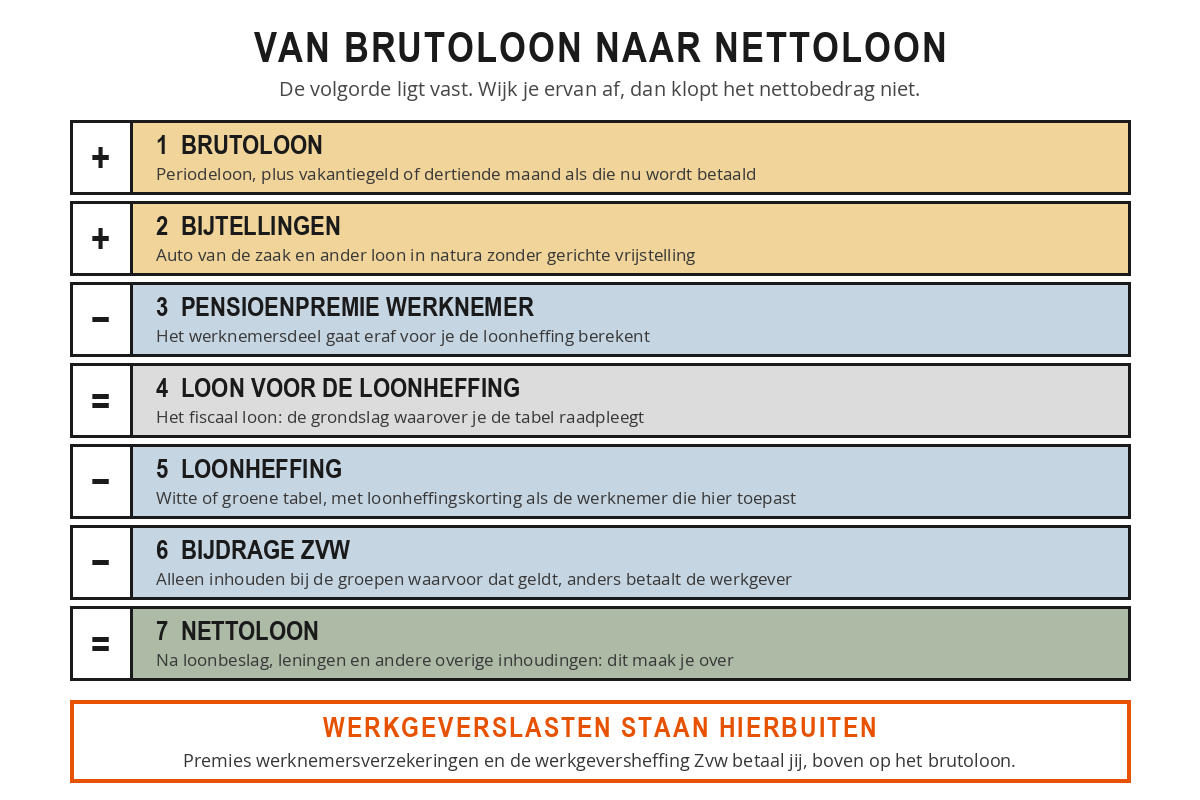
Step 1, determining the gross pay. Start with the agreed gross salary for the pay period. Add holiday pay, a thirteenth month or a one-off payment if these are paid out in this period.
Step 2, adding up the additions. If your employee has a company car that is also used privately, you add the taxable addition to their pay. The same applies to other benefits in kind, such as a phone or bicycle that does not fall under a specific exemption.
Step 3, deducting the employee's pension contribution. The part of the pension contribution that your employee pays himself is deducted before you calculate payroll tax, because that contribution is deductible for wage tax purposes.
Step 4, determining the pay subject to payroll tax. What you are left with is the basis on which you calculate the payroll tax: the taxable pay.
Step 5, withholding payroll tax. You look up the correct amount in the white or the green table. White for wages from current employment, green for benefits and pensions. You only apply the payroll tax credit if the employee has opted for it.
Step 6, withholding the Zvw contribution where this applies. In most situations you, as the employer, pay the employer's Zvw levy yourself and withhold nothing. For some groups, for example directors and majority shareholders or certain benefit recipients, you do withhold the employee's Zvw contribution from their pay.
Step 7, processing the other deductions. Think of a wage attachment, a loan your employee is repaying or the personal contribution for a lease car. What remains is the net pay you transfer.
Sanne works full-time and earns 3,500 euros gross per month. In this example she has no company car and applies the payroll tax credit with you. Her employee pension contribution is 175 euros.
You work through the steps: gross pay 3,500, additions 0, minus the employee's pension contribution is minus 175, so the wage for payroll tax purposes becomes 3,325. You withhold payroll tax on that amount; in this worked example we assume a notional rate that comes to 650 euro. The Zvw contribution is 0 here, because the employer pays the levy. There are no other deductions. Net pay therefore comes to 2,675 euro.
Note that the 650 euro is an invented amount to illustrate the order of calculation. You look up the exact payroll tax amount in the current table from the Belastingdienst, and that changes at least once a year, sometimes halfway through the year.
Employer costs are not included
What your employee receives net is only part of the story. On top of the gross pay, you as the employer also pay the employee insurance contributions (WW, WIA, ZW) and the employer's Zvw levy. Those amounts do not appear on your employee's payslip, but they do appear on your payroll cost overviews and in your payroll tax return. For an average employee, the syllabus works with roughly twenty to thirty per cent employer costs on top of the gross pay. For Sanne in the example, a gross salary of 3,500 euros therefore quickly costs you 4,300 to 4,500 euros per month.
All percentages and amounts in this chapter come from the syllabus and serve to illustrate the method. The tables for payroll tax, the tax credits, the contribution percentages, the maximum contribution wage and the company car addition percentages are set anew each year, and are sometimes adjusted mid-year. Never calculate using the figures from a course example; look up the current tables from the Belastingdienst and in the Handboek Loonheffingen. For your actual payroll run, use up-to-date payroll software: calculating by hand is fine for understanding the logic, but it goes wrong as soon as a rate or a threshold shifts.
Explaining the payslip
For many employees, the payslip is an opaque document. When you are explaining something to a new employee, after a pay rise or when questions come up about holiday pay, it helps if you know exactly where each figure comes from.
By law, a number of details must be shown: the name of the employer and the employee, the pay period, the gross pay and how it is made up, all deductions specified, the net pay and the amount actually paid out, the statutory minimum wage that applies to this employee, and, where pay is hourly, the number of hours worked. In addition, cumulative totals are almost always shown: the total gross pay, payroll tax withheld and holiday pay accrued since the start of the calendar year.
If you are explaining a payslip, work in the same order as the calculation itself. First what comes in, then what goes out, and lastly what remains. Start with the gross pay and explain any differences straight away: a pay rise, a back payment, a correction from last month. Then the special remuneration: holiday pay, thirteenth month, bonus. These are often taxed at the special rate, which looks higher than the rate on regular pay. Then the taxable additions, and make clear that a taxable addition is only a calculation item for tax purposes; your employee does not actually receive that money. Next the deductions: pension contribution, payroll tax and, where applicable, the employee's Zvw contribution. This is where you get most questions, so explain that payroll tax is a prepayment on income tax and that the pension contribution is deductible. Then the net allowances, such as travel expenses or a working-from-home allowance, which are added to net pay untaxed. And finally the net pay and the payment, which sometimes differs from the sum total because of an advance or a wage attachment.
Marco comes to see you after three months. He does not understand why his holiday allowance in May turned out so low. His payslip shows a gross holiday allowance of 2,800 euros, but he receives 1,540 euros net.
You show the "special remuneration" line and point out the rate of 49.5 per cent stated there. You explain that this is the special rate, based on his annual income from the previous year, and that it works out high because Marco is at the start of a new pay scale. When he files his income tax return next spring, the Belastingdienst will settle this, and he will probably get part of it back.
By explaining that briefly and clearly, you stop Marco feeling short-changed and build trust in the payroll administration.
Draw up a short one-page standard explanation describing the most common items on your payslip, and send it out with a new employee's first payslip. It saves you questions, and it shows that you are open about the payroll administration.
Take a payslip of your own or of a colleague (with permission) and work through the seven steps.
- Gross pay this period, additions to taxable income, employee pension contribution.
- Wage for payroll tax purposes, and the payroll tax according to the payslip.
- The employee's Zvw contribution where this applies, and the other deductions.
- The net pay you calculated, alongside the net pay stated on the payslip.
Does your calculated net pay match what is shown? If not, which item causes the difference? Note down which lines you could not immediately place and look them up with the Belastingdienst.
Summary
- Gross pay consists of fixed components (basic salary, holiday allowance, thirteenth month, fixed allowances) and variable ones (overtime, unsocial hours allowance, bonus, excess travel expenses, pay in kind).
- Keep three pay concepts apart: taxable pay, social insurance pay (SV-loon) and pay for the Health Insurance Act (Zvw). The difference usually lies in a pension contribution or an addition to taxable income.
- The order is fixed: gross pay, add the additions, deduct the employee's pension contribution, wage for payroll tax purposes, deduct payroll tax, then the Zvw contribution if applicable, then the other deductions. What remains is the net pay.
- The white table applies to current employment, the green one to benefits and pensions. You apply the payroll tax credit with one employer at a time.
- Employer's charges (WW, WIA, ZW and the employer's Zvw levy) fall outside the gross-to-net calculation, but do count towards your wage costs.
- A payslip must show the gross pay, all deductions, the net pay, the pay period and the applicable minimum wage.
- The special rate on holiday pay and bonuses looks high, but it is settled through income tax.
- Every rate and every threshold in this chapter changes each year. Check them with the Belastingdienst.
In what order are the employee's pension contribution and the payroll tax deducted, and why?
An employee drives a company car. What does that addition do to the bases on his payslip?
Marco is taken aback by the rate applied to his holiday pay and asks whether that can be right. What do you explain?