


Introduction
You were asked because you know it. You know the link, you know why that setting affects another screen, and you solved last month's fault while the rest were still on the phone. So they asked whether you would just explain it to the department. And there you stand, in front of twelve people who have to work with the new package tomorrow, and you notice that knowing and explaining are two different things.
The odd thing is: the more you know about a subject, the harder it becomes to pass it on. You have forgotten what it was like not to know it. You skip steps that are self-evident to you, you use words that are ordinary to you, and the group nods. Nodding is cheap. Only during the exercise do you see what has really got through.
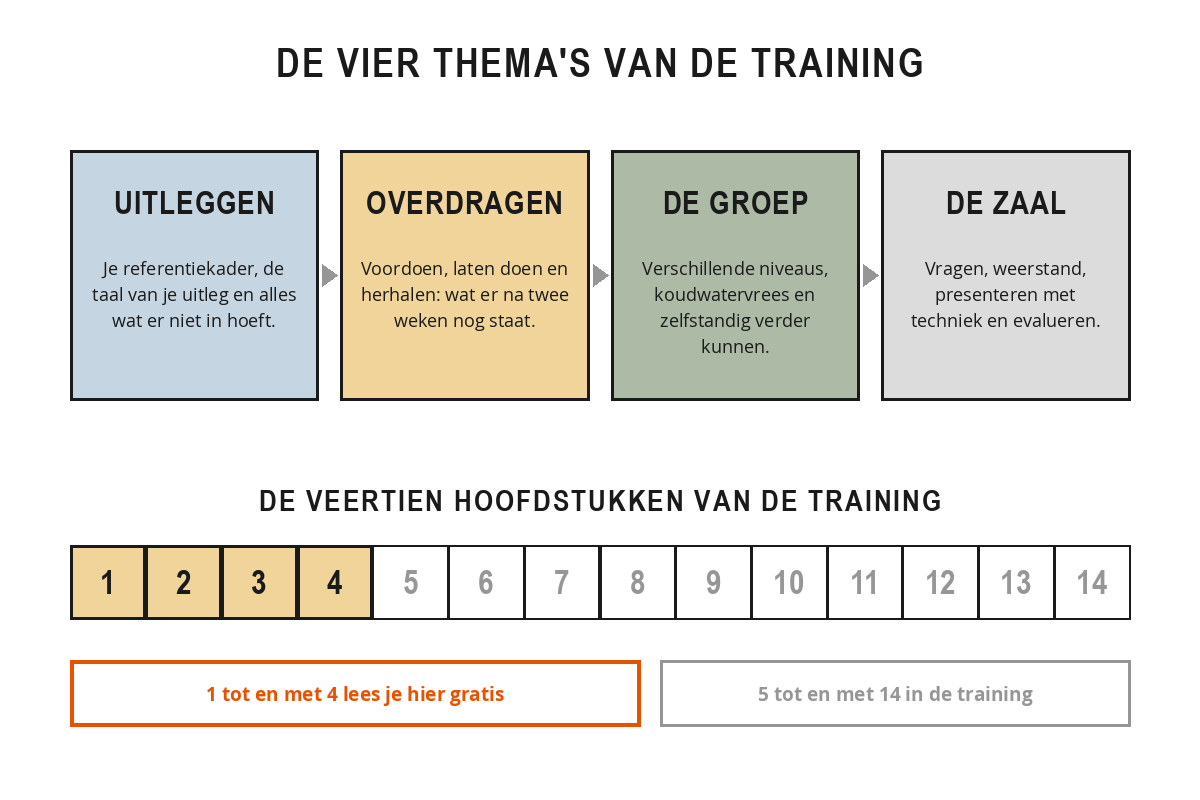
This free course contains four chapters: the orange part of the bar above. Below chapter 4 you will find the full course.
What you will learn
Chapter 1 is about the reason your explanation does not land: your frame of reference is not that of your listener. You learn to translate jargon and to reduce your explanation to what the task actually requires. Chapter 2 deals with the balance between talking and doing. Bales' learning pyramid shows that almost everything that sticks comes from the participant's hands and not from your mouth, and that produces a calculation you can apply to your own session plan. Chapter 3 is about the group in which the levels vary widely: one person has finished while another has not yet put their hands on the keyboard. You get four steps with which you determine, per topic, how independently someone should finish. Chapter 4 is about questions: six types, the choice between now, later and separately, and how to stay calm when a question hits a nerve.
How the course is structured
The full course runs through four themes. First explaining: how your message lands with the other person and what you leave out. Then transferring: demonstrating, having them do it and repeating, so that something is still in place two weeks later. After that the group: differing levels, cold feet and being able to carry on independently. And finally the room: questions, resistance, presenting with technology and evaluating. In this free course you read the key chapter from each of those four themes. What it does not cover is the design work: formulating learning objectives, the intake meeting with your client and building a session plan that holds up. That is work that goes better with someone looking over your shoulder.
Practical tips for use
- Choose one session that you will be giving soon and keep it with you throughout the course: the roll-out of a package, a knowledge transfer to the service desk, an explanation to new colleagues. All the exercises fit that one subject.
- Keep your script or your slides to hand. In two of the four chapters you will be counting minutes in your own programme.
- Don't read it all in one go. A chapter a week, with something you try out in between, yields more than reading through it in an afternoon.
- Try out one thing from each chapter for real. Reading about short cycles changes nothing about your session plan.
- Afterwards, ask one participant what he is going to do at his own workplace tomorrow. That answer says more than an evaluation form.
Each chapter ends with a short knowledge check of three questions: answer them correctly to mark the chapter as completed. Your progress is saved automatically in your browser.
Enjoy the read, and above all: enjoy the next group sitting in front of you.