


4. Questions during your explanation
You are ten minutes into creating a user when a question comes up about the link with the HR system. A good question in itself. You answer it, a follow-up question comes, and ten minutes later you are three topics further on while half the group has switched off. Questions are not an interruption of your programme; they tell you what is landing, what is missing and who is dropping out. But you do have to choose what to do with them, and within a few seconds.
After this chapter:
- You recognise six types of question and know what each type asks of you.
- You quickly decide whether to answer a question now, park it or handle it separately.
- Work with a parking flipchart without questions disappearing.
- You stay calm with a question that grates, using four steps you can practise in advance.
- Give your answer to a question you do not know the answer to, without losing face.
Six types of question
Two questions that sound identical can hide completely different intentions. Your answer only hits home once you have grasped the intention. Six types come up most often in a technical training course.
In the case of a information question the participant is missing a fact or an action: where is that button, what is that field called. Answering briefly and concretely works best here, because every digression costs you pace. A in-depth question comes from someone who understands the basics and wants to know what lies beneath. That is a gift, but almost never for the whole group: usually you park it or pick it up during the break. A application question translates your explanation to their own department, their own files or their own version. That is a question you want to hear, because that is where the move to practice begins. Take your time over it.
A checking question tests whether you really know it. Sometimes that comes from uncertainty about the material, sometimes from uncertainty about you. The answer matters less here than the calm with which you give it. With a status question mainly shows what the participant already knows; there is usually not even a question mark at the end. You acknowledge the knowledge briefly, involve the group and move on. And finally the disguised objection: there is a question, but underneath it lies resistance. "Doesn't this just take more time?" is not a request for information.
You can rarely tell the type from the words alone. The way someone says it gives away more than the sentence itself: an information question comes out neutrally, a veiled objection puts extra weight on a single word. The rest of the group tells you something as well. If three people nod along, the question belongs to everyone. If nobody looks up, you have an individual question on your hands. And if you are unsure what is meant, simply ask: "Do you want to know how to do it, or are you wondering whether it works that way at your place too?" That one counter-question saves you five minutes of answering the wrong question.
Now, later or separately
Not every question deserves an immediate answer. You make three choices, and you make them within a few seconds.
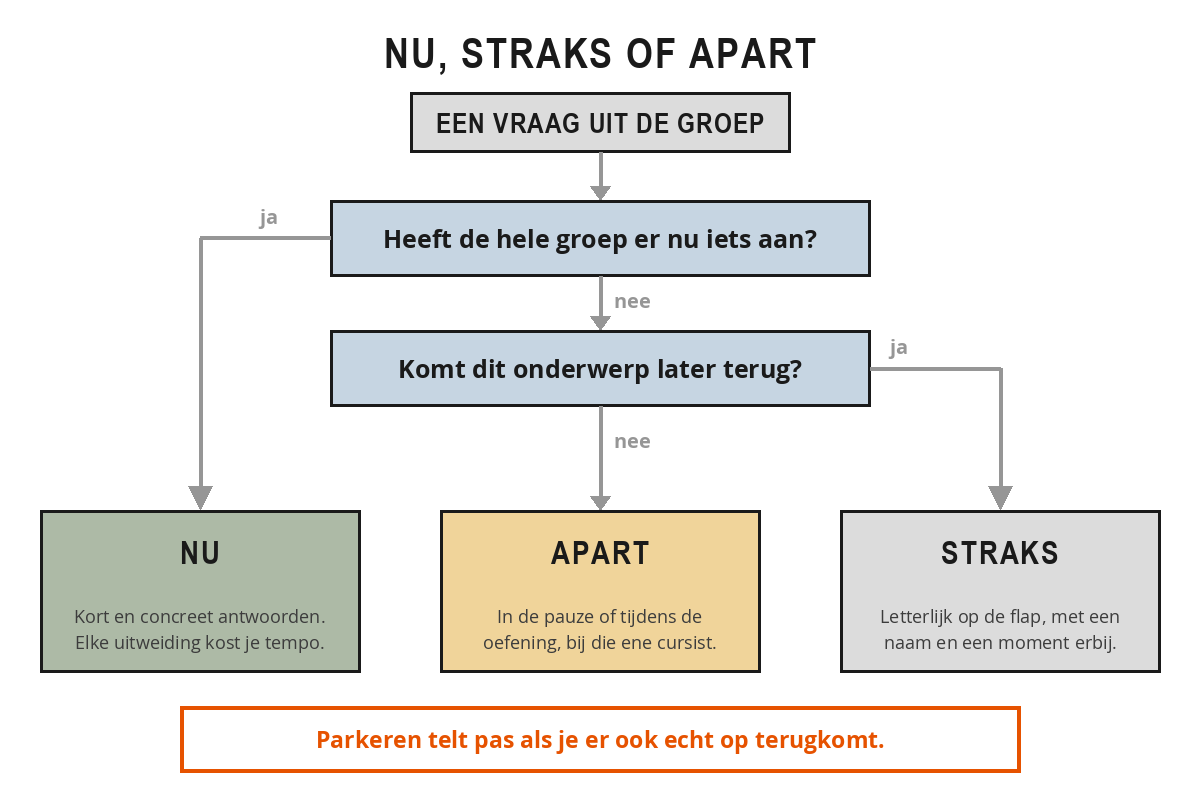
The first question you ask yourself is: does the whole group benefit from this now? If so, you answer it now, briefly and concretely. If not, the second question follows: does this topic come back later in the programme? If so, it goes on the sheet and you deal with it later, at the moment it fits. If not, you take it separately up, in the break or during the exercise with that one participant.
Trainers skip the middle route most often, and that is precisely the route that saves your programme. A good question at the wrong moment drags the rest of your day off course.
The parking flipchart
A parking sheet is a sheet on the flip chart on which you note down questions you are not dealing with now, together with an agreement on when you will come back to them. It stays visible all day and only comes off the wall once everything has been ticked off. That works in five steps.
At the start of the day you put up a blank sheet headed Parked questions and explain in one sentence what it is for. You note the question as literally as possible, in the participant's own words, with their name after it. You say straight away when you will come back to it: after the next block, after lunch, or at the end of the day. You go through the sheet at those announced moments and tick off what you have dealt with. And if anything is left at the end, you agree who will look into it and when the person asking will get an answer.
That fourth step is where the parking flipchart stands or falls. If you never come back to it, the participants will work out within half a day that the flipchart is a drain. From that moment on they stop asking their question, or they ask it all the more loudly.
Halfway through a course on a new ticketing system, Youssef asks how the link with the old archive works. An interesting question, but the group is in the middle of creating a ticket. The trainer writes on the flip chart: "Link to old archive (Youssef)", and adds: "I'll pick that up after the break, because that's when we'll be looking at the existing data." After the break he starts with that question. Youssef knows he has been heard, and the rest of the group has learnt that parking a question means something here. In the second half of the afternoon three more questions go on the flip chart, without anyone pushing them through out loud.
Write the question down in the asker's own words, not in yours. The moment you "translate" it into your own phrasing, the asker no longer recognises it and feels their point has been watered down. Two seconds longer spent writing saves you a discussion after the break.
Staying calm when a question hits a nerve
A critical question lands on your body before it lands on your mind. Your breathing quickens, you start talking faster and you answer before you have heard the whole question. That is exactly where the answers you later regret come from.
Four steps keep you calm at the moment it hits a nerve. Breathe first, speak after: you let the question land and take one low breath. That pause lasts a second and a half and feels like ten to you, but the group sees someone who is thinking. Summarise the question in your own words. You gain time, you check whether you have understood it correctly, and the person asking notices that they have been heard. Choose your route deliberately: you answer it, you park it, or you hand it back to the group. All three are valid, and you say out loud which one you are choosing. And finally: acknowledge what you do not know. "I don't know, I'll look into it and you'll hear from me tomorrow" costs you no authority. A made-up answer that later turns out to be wrong does.
During a course on a new ticketing system, Marco sighs continuously. At the third exercise he says: "We used to do this in two clicks." The trainer breathes, summarises and replies: "Two clicks against five now, that's right. I'll put it on the flipchart and after the break I'll show you which two steps you can automate away." Marco nods. He works along for the rest of the morning, because his point has been written down rather than waved aside. Had the trainer gone on the defensive about the content, he would have won the argument and lost Marco.
The fact that your confidence grows by rounding off such situations well applies to your group too. Someone who manages one task independently is more likely to take on the second. So pitch your first exercise low enough for everyone to complete it, and name that result out loud before you scale up.
Take five questions from your last session, write them down word for word and work through these points for each question.
- The question, word for word as it was asked.
- The type: information, depth, application, checking, status or a veiled objection.
- How you could tell: the words, the tone or the group's reaction.
- What you did then: answered straight away, parked or handled separately.
- What you would do now, and why.
Then look at the pattern. Do you answer almost everything straight away? Then the parking flipchart is your next gain. Finally, write out your first sentence for the next time a question hits a nerve, and say it aloud three times with a pause for breath before it.
Summary
- Six types of question: information, depth, application, checking, status and the veiled objection. Each type calls for a different answer.
- You hear the type in the tone and in the group's reaction, not in the words alone. If in doubt, ask a question back.
- Two questions determine your route: does the whole group benefit from it now, and does the topic come back later? That gives you now, later or separately.
- A parking sheet only works if you really do come back to it at the announced moment; otherwise it becomes a dumping ground within a single half-day session.
- Write the question down in the asker's own words, with their name next to it.
- When a question hits a nerve: breathe, summarise, say your route out loud, and acknowledge what you do not know.
Halfway through, a participant asks: "Doesn't this just take more time than before?" What type of question are you dealing with here?
A question is not useful for the whole group, but the topic does come up later in your programme. What do you do?
You get a critical question and feel the tension rising. According to this chapter, what is the first step?
Ready for the next step?
You have completed the free starter of the Train the Trainer for IT professionals and technicians course. The next chapter in the full course is Standing in front of a group: Grounding, sentence melody and voice use, breathing and moving around the training room.
Take the 2-day course →From €1250,- excl. VAT · with an experienced trainer included