


Introduction
Most of tomorrow's revenue lies with the customers you already have today. Yet an account manager's attention often goes to the customer who shouts loudest, rather than to the customer with the most room to grow. Account management is about that choice: which customers get your hours, what do you want to achieve with them, and how do you get beyond that one regular contact who answers the phone.
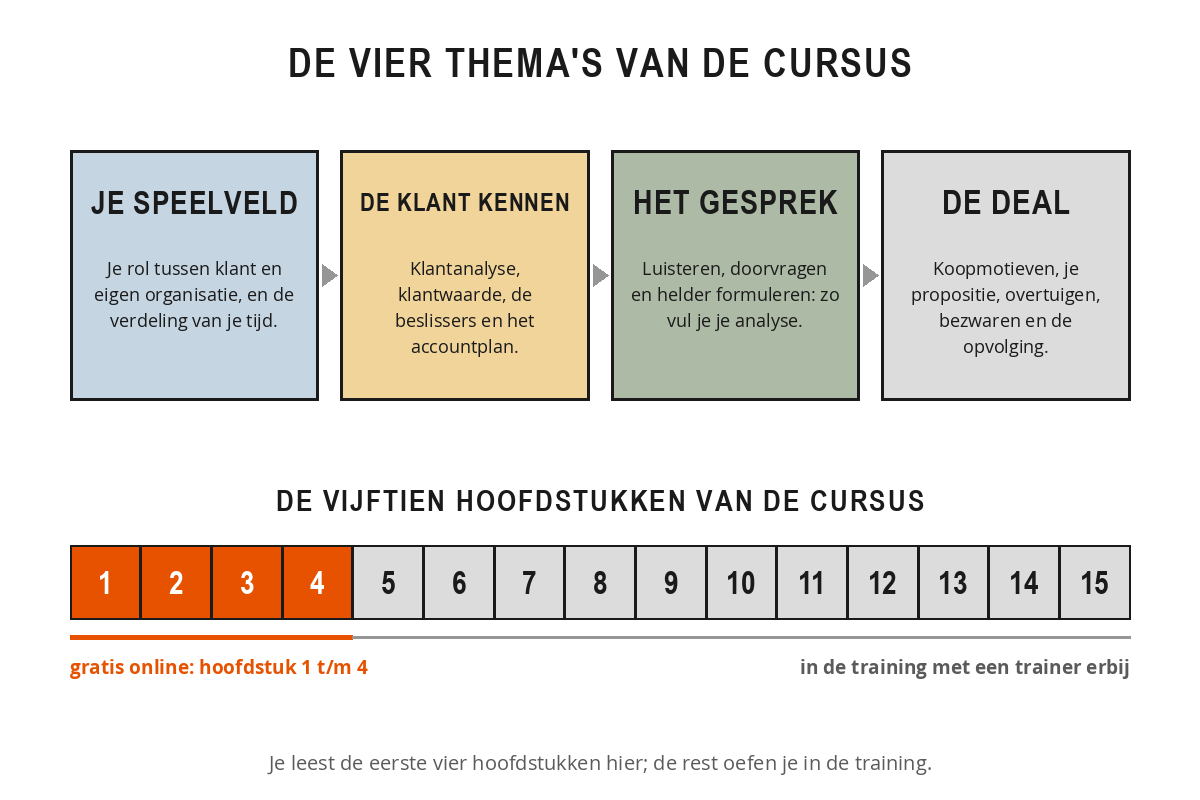
This free course contains the first four chapters: the orange part of the bar above. At the bottom of chapter 4 you will find the full course.
What you will learn
You start with your own playing field: what an account is, which tasks come with the role and how you distribute your customers across a customer pyramid. Then you move into the customer: you map them with a customer analysis and a SWOT, you determine what they are really worth, and you chart the group of people who together decide on a purchase. In the final free chapter you turn all of that into an account plan with objectives, actions and a contact calendar. The common thread: an account is not an order but a relationship, and you grow a relationship with a plan, not with luck.
How the course is structured
The course follows four themes that build on one another. You start with your playing field: your role between the client and your own organisation, and how you divide your time across your portfolio. Then comes knowing the client: analysis, decision-makers and the account plan. After that the conversation: listening, probing and formulating clearly, because your analysis is filled with what you hear. And you round off with the deal: buying motives, your proposition, persuading, objections and the follow-up. Each chapter contains theory, a model, real-world examples and an exercise you apply to your own accounts.
Practical tips for use
- Pick one account from your own portfolio as a common thread and use it for every exercise. That way a real account plan takes shape as you go.
- Take a client you think you know well. That is precisely where you notice how much you are actually assuming.
- Keep a notepad or a blank document to hand. The exercises only work if you actually complete them.
- Don't read it all in one go. A chapter a week, with a client conversation in between, gets you further than reading through it in one afternoon.
- Put a question mark after everything you fill in that you are not sure about. Those question marks are your questions for the next conversation.
Each chapter ends with a short knowledge check of three questions: answer them correctly to mark the chapter as completed. Your progress is saved automatically in your browser.
Enjoy the read, and above all: enjoy the customers you will get to know better as a result.