


Introduction
At first sight, giving advice looks like a matter of knowledge. You know something the other person doesn't, you tell them, and the client gets to work with it. In practice it rarely works that way. The best advice is not the cleverest advice, but the advice that lands. And whether it lands is largely determined in the conversation itself: in the question you ask before you give an answer, in the style you choose, and in the order in which you build up the conversation.
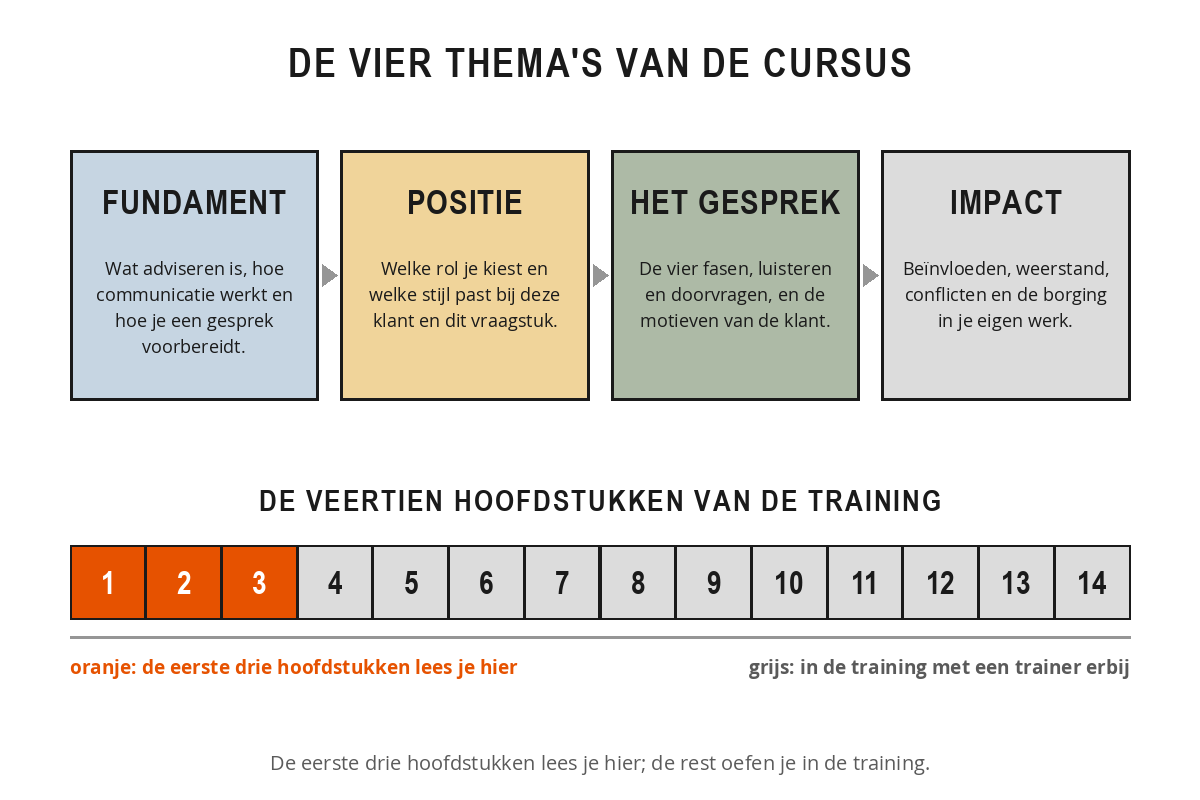
This free course contains the first three chapters: the orange part of the bar above. At the bottom of chapter 3 you will find the full course.
What you will learn
You first gain insight into what advising actually is and why advice that is strong on substance can still fail. That comes with a formula you won't forget: effect is quality times acceptance. Next you choose your position. There are four ways to conduct an advisory conversation, from telling to going along with the other person, and the skill lies not in mastering one of them but in switching between them. In the third chapter you put a structure underneath this with the four phases of the advisory conversation: opening, analysis, advice and closing. The common thread: your advice is only worth something once the other person does something with it.
How the course is structured
The course follows four themes that build on one another. You start with the foundation: what advising is, how communication works and how you prepare for a conversation. Then you choose your position with the roles and styles available to an adviser. After that it deals with the conversation itself: the four phases, listening and asking follow-up questions, and the client's motives. You finish with impact: influencing, resistance, conflicts and embedding it all in your own work. Each chapter contains theory, a model, examples from practice and an exercise you apply to your own conversations.
Practical tips for use
- Keep one specific advisory conversation in mind while you read. A conversation that is coming up works best; one that got stuck is a good second choice.
- Actually complete the exercises. They only work once they contain names, figures and sentences from your own practice.
- Don't read it all in one go. One chapter a week, with a conversation in between, delivers more than an afternoon of reading straight through.
- After each chapter, choose one thing you will do differently in your next conversation. One change at a time delivers more than ten good intentions.
- After a conversation, take five minutes to write down what struck you. Without that fixed moment, every learning objective fades away.
Each chapter ends with a short knowledge check of three questions: answer them correctly to mark the chapter as completed. Your progress is saved automatically in your browser.
Enjoy reading, and above all: enjoy the next conversation in which you try it out.