


1. Why good advice ends up in a drawer
Everyone who advises has experienced it. You have done the research, your reasoning holds up, you present it neatly, and nothing happens. No argument, no counterargument, just a polite nod and then silence. That is rarely a matter of insufficient knowledge. Usually something went wrong along the way with the other person.
After this chapter:
- You know what advising is and how it differs from telling, executing and deciding for someone else.
- You recognise the three parties sitting at the table in every advisory conversation.
- You understand why the quality and the acceptance of your advice are two separate things.
- You can use Maier's law to explain why half an advice that does land achieves more than a perfect advice that does not.
- You can formulate a personal learning objective that you can actually use in your next conversation.
Advising is more than giving a good answer
An adviser is often seen as someone with knowledge. Someone who knows how things work, puts forward the solution and says which route is best. That picture is only half right. Advising is helping someone reach a better decision or approach for an issue that remains his or hers. Note that last part. The issue stays with the other person. You provide insight, structure, experience and sometimes a mirror, but the decision and the implementation lie on the other side of the table.
That makes advising different from three things it is often confused with. It is not carrying out: you don't take over the job. It is not instructing: you do not explain how something should be done in a situation where there is no choice. And it is not a matter of deciding for someone else: however certain you are, the signature remains the client's. That sounds obvious, but in practice advisers slip into it easily. You hear a problem you recognise, you already have the solution ready, and before you know it you are defending a plan the other person never asked for.
Marieke is an HR adviser. A team leader calls: an employee keeps arriving late, what sanction may he impose? Marieke could be done within two minutes with the staff handbook to hand. Instead, she asks further questions. How long has this been going on? Four months. What has he already tried? Two remarks in the corridor. What does he think the cause is? Silence, and then: "To be honest, it started when she was put on that other project." In the end the advice is not about sanctions, but about a conversation that has never taken place. That advice does get followed up, because it deals with the problem the team leader actually has.
The advisory triangle: three parties in every conversation
In every piece of advice there are three parties present, even when there are just two of you at the table.
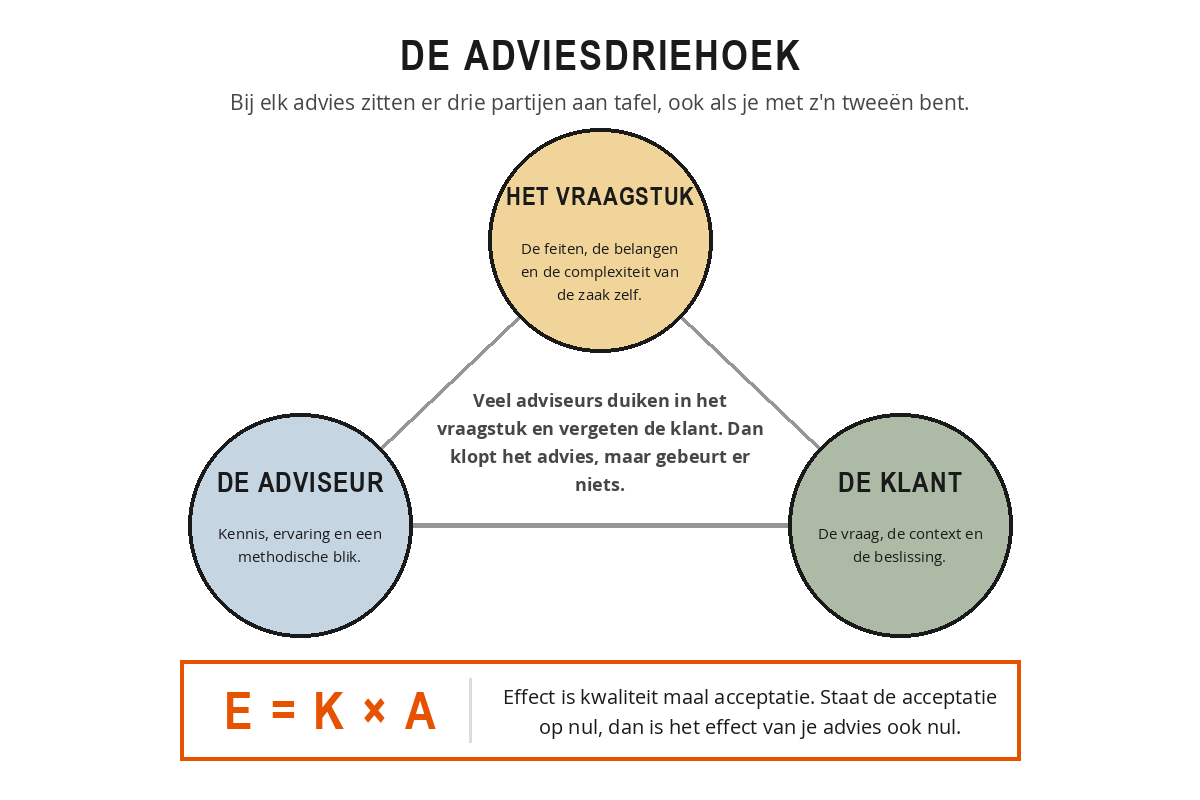
The first party is you, the adviser. You bring knowledge, experience and a methodical view, as well as your own preferences and blind spots. The second party is the client: your client or colleague, with a question, a context, a history and the authority to decide. The third party is the issue itself, with its own facts, interests and complexity. That issue is not a neutral thing. It has a history, there are people with an interest in keeping it as it is, and there are figures that nobody mentions out loud.
Many advisers focus mainly on themselves and on the issue. They dive into the content, carry out a thorough analysis and formulate strong advice. The client gets less attention: his experience of it, his doubts, his position in the organisation, what he has to explain to his own boss. The outcome is predictable. Sound advice on content that is not adopted. If you notice that during your preparation you have only been working on the content, that is a signal: you have skipped one corner of the triangle.
Maier's law: effect equals quality times acceptance
Whether your advice has any effect depends on two things at once. The quality of what you say, and the extent to which the other person accepts it. This is known as Maier's law: E = Q × A. Effect is quality times acceptance.
The most important part of that formula is the multiplication sign. It is not an addition. With an addition you can make up for low acceptance with extra quality: another analysis, another appendix, another chart. With a multiplication that doesn't work. If acceptance is zero, the effect is zero, however good your advice. And the same applies the other way round: advice that goes down easily but doesn't hold up on content gets nobody any further. You need both.
Two advisers look at the same department. Joost delivers a forty-page report with a thoroughly worked-out reorganisation. On content, a 9. But he has dismissed the director's objections as resistance, and the director feels bypassed. Acceptance: a 1. Effect: 9 x 1 = 9. His colleague Nadia comes up with a simpler proposal, a 6 on content, but she has phoned the director twice along the way and has written his biggest concern into her proposal word for word. Acceptance: a 7. Effect: 6 x 7 = 42. Almost five times as much result, with the weaker story on content. Joost was proved right and achieved nothing.
In practical terms this means distributing your time differently. If you put eight hours into a piece of advice and seven of them go into the analysis, chances are you are optimising the wrong side of the equation. The question "how do I make sure this is correct?" is no more important than the question "who has to say yes to this, and what do they need in order to do so?"
Before your next piece of advice, put two scores on paper: how many points do you give yourself for quality, and how high do you rate acceptance with the person who has to decide? If the second is below five, an extra analysis is a waste of your time. A phone call is worth more.
How can you tell that acceptance is low?
Acceptance is harder to measure than quality, but there are signals. The client asks not a single critical question; that may seem pleasant, but anyone who is about to commit to something normally wants to know the details. Or they agree to everything and do not ask about the consequences. Or you hear "I will need to look into that internally" without a name or a date attached to it. Or at the end they ask something you have already explained three times: in that case their mind has been elsewhere, and that is rarely laziness but usually doubt.
The most useful test is a question that makes the other person calculate rather than judge. "What do you think of it?" produces a social answer. "Who at your organisation would be the first to object to this?" produces information: about the resistance that is still there, and about what you still need to resolve before your advice lands anywhere.
A learning objective you can actually use
You don't develop advisory skills by reading a book, but by paying attention to one thing in real conversations. For that you need a learning objective sharp enough to keep in mind during a conversation. One workable form is: I want more or less (X) in situation (Y). That wording forces you to get two things clear: which behaviour do you want to show or stop showing, and when and with whom does that play out?
Compare: "I want to advise more convincingly" says nothing. You don't know what to pay attention to, and afterwards you don't know whether you managed it. "In the first meeting with a new client, I want to be less quick to go along with his solution, so that I keep room to probe for the real problem" tells you exactly what you are going to do and when.
Three things often go wrong. Too many objectives at once: two or three sharp objectives achieve more than a list of ten. Only outcome objectives: "clients are satisfied" is an outcome, not behaviour that you control. And no moment of reflection: a learning objective without a fixed moment to look back evaporates within two weeks. Five minutes after a conversation is enough.
Take an advisory conversation that you have scheduled in the coming weeks.
- Draw the triangle and fill in the three corners: what do you bring, what do you know about the client, and what is the issue really?
- Give yourself a mark for the expected quality and a mark for the expected acceptance. Multiply them.
- Is acceptance the lower score? Then think of one thing you can do before the conversation to raise it: a phone call, a question in advance, someone else to look over it.
- Formulate one learning objective along the lines of "I want more or less (X) in situation (Y)" and write it down somewhere you will see it again before the conversation.
Summary
- Advising is helping someone reach a better decision on an issue that remains theirs. It is not carrying out, instructing or deciding for someone else.
- Every advisory conversation involves three parties: you, the client and the issue itself.
- Anyone who looks only at themselves and the issue delivers advice that adds up but is never carried out.
- Effect is quality times acceptance: E = Q × A. A multiplication, so acceptance of zero means an effect of zero.
- You recognise low acceptance by the absence of critical questions and by commitments without a name or a date.
- Test acceptance with a question that makes people work it out: "who would be the first to object to this?"
- A workable learning objective describes behaviour in a situation: "I want more or less (X) in situation (Y)".
Your advice scores an 8 on quality, but the manager who has to decide feels bypassed and is at a 1 on acceptance. What does Maier's law say about this?
Which corner of the advisory triangle, according to this chapter, usually receives too little attention from advisers?
Which learning objective meets the requirements from this chapter?