


2. What aggression does to you
"I knew exactly what I should have said, but at the time it just would not come out." Almost everyone who has been through an incident says this afterwards. That is not a failure and it is not a matter of character either. It is biology. Before you have had a chance to think, your body has already made a decision for you.
After this chapter:
- You recognise the three stress responses of fight, flight and freeze, and you know which one comes up first for you.
- You understand why you cannot think clearly at that moment, and what you can do about it.
- You know how to bring the tension down through your posture, your distance, your voice and your pace.
- You know the two axes of Leary's Rose and the four quadrants that follow from them.
- You can predict which behaviour your own behaviour draws out in the other person, and which position fits which form of aggression.
Fight, flight or freeze
When someone snaps at you, your heart rate shoots up, your breathing speeds up, your muscles tense and the blood drains from your head towards your arms and legs. That is a primitive response from a time when a threat usually had four legs. Your brain makes no distinction between a wild animal and a client swearing at you: the alarm goes off and you switch into survival mode. The problem is that in that mode you cannot think clearly, cannot listen properly and certainly cannot de-escalate calmly.
The reaction comes in three varieties. With fight you feel the urge to hit back with words. You talk louder, faster and fiercer, you go on the defensive or on the attack, you want to be proved right or have the last word. Inside, it feels as if you have no choice. With flight you want to get out of the situation. Literally, by taking a step back or cutting the conversation short, or figuratively, by referring the other person to a colleague, another department or a form as quickly as possible. You give away something you did not really want to give, just to be rid of the discomfort, and afterwards you regret it. With freeze you are lost for words. Your mind is blank, you hear the words but they do not land. This is the most underestimated reaction, because the outside world mistakes it for calm while inside you are completely overwhelmed.
None of the three is a sign of weakness, and you cannot unlearn them either. What you can learn is to recognise which one comes up first for you. Only when you know what is happening to you can you do something about it.
Sanne works on the reception desk of a town hall. A man bangs his fist on the counter because his appointment has been moved. Sanne notices that she immediately starts smiling, says "sorry" twice and meanwhile is already scrolling through the system to get him on his way as quickly as possible. Only in the car on the way home does she see what happened: this was flight. She gave in to his tone instead of calmly setting a limit on the situation. What she resolves to do is small and achievable: next time, breathe for three counts before she says anything.
Her colleague Bram has exactly the opposite reflex. Faced with the same man, he hears himself say: "Sir, there is no need to hit anything here." A little louder than necessary, a little faster than necessary. The man jumps straight on it: "So now it is my fault?" Fighting, in other words. From that moment on, the conversation is no longer about the appointment, but about who is right.
Why you cannot think your way out of this
The moment the stress hormones go through your body, the part of your brain that weighs things up and formulates words works less well, and the part that drives fast survival responses takes over. So you cannot reason your way out of it while it is happening. What you can do is give your body a few seconds to recover. Breathe in through your nose and out through your mouth, with a longer out-breath than in-breath. Plant your feet firmly on the floor. Allow a short silence before you say anything back. That sounds like nothing, but it is exactly enough room to let your head join in again.
The first few seconds: what you convey
Someone coming at you worked up scans you in a fraction of a second. Are you standing rigidly, are you raising your shoulders, are you talking loudly back? Then you confirm that a fight is coming. An open, calm posture is not a trick but a collection of small choices that together send out a single message: I am here, I am listening, I am not a threat, and I am not going to be chased away either.
- Posture. Upright but not stiff, shoulders loose, arms by your sides or lightly in front of your stomach. No crossed arms, no hands on your hips: that reads as defensiveness or as dominance.
- Hands visible. Open palms, no fists, no hands in your pockets. Visible hands say, subconsciously: I am not attacking you.
- Feet. Feet shoulder-width apart, one foot slightly back. That keeps you stable if someone comes closer. Stand slightly at an angle rather than nose to nose, because standing directly opposite someone feels like a challenge.
- Face. Neutral and alert. No frowning, and no smiling either, because a smile can come across as mockery. Relax your jaw: a tense jaw can be heard in your voice.
- Distance. An arm's length plus half a step. Close enough for contact, far enough to be safe.
- Eye contact. Soft and regular, looking away briefly now and then and coming back. Staring is a signal of aggression.
And then your voice. If you talk fast, the other person will talk faster. If you talk loudly, the other person will talk more loudly. In the heat of the moment you almost always forget this, because your voice follows your adrenaline. Deliberately slowing down works: speak a touch more slowly than the other person, keep your volume just below theirs and allow silences between your sentences. It is one of the most powerful things you can do, precisely because it seems so small. Nobody can keep up their own pace indefinitely if the other person does not go along with it.
Leary's Rose: behaviour calls up behaviour
In the 1950s, psychologist Timothy Leary studied how people relate to one another in a conversation. His finding was simple: behaviour never stands on its own. What you do predictably provokes something in the other person, and the other way round just as much. He summarised this in a circular model with two axes.
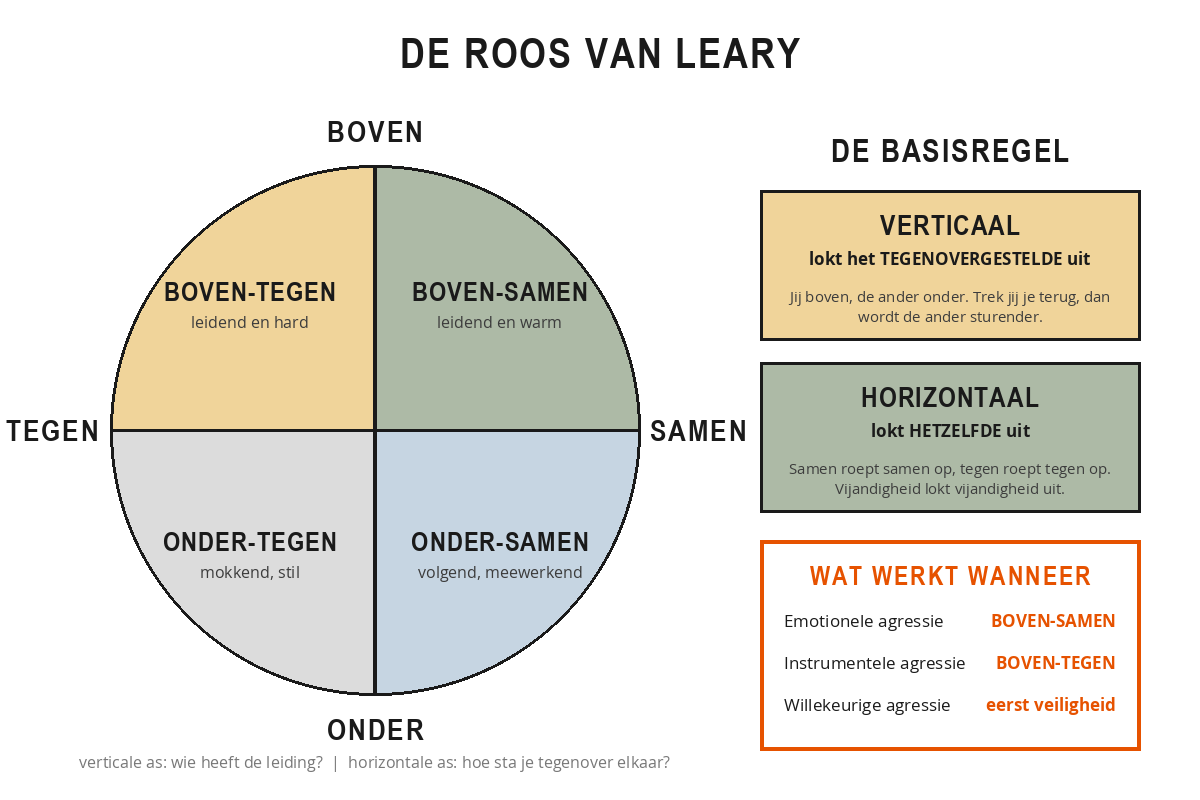
The vertical axis is about the question of who is in charge. Above behaviour is directive and decisive: you take up space, give direction, say what is going to happen. Below behaviour is following and waiting: you adapt, ask for direction, look to the other person. The horizontal axis is about the relationship. Together behaviour is cooperative and involved: you show that you are on the same side. Against behaviour is distant, critical or hostile, either openly (attacking, insulting) or in a closed way (staying silent, looking away, holding off). None of the four is right or wrong. Above is not better than below, and a bit of against behaviour is sometimes exactly what you need to guard your boundary.
Together the axes produce four positions. Above-together is leading and warm: "I am going to help you, and I know what we are going to do." Above-against is directive and hard: "I am not accepting this, this conversation stops here." Under-summarising is following and cooperative: "What would you like me to do?" Under-versus is withdrawn or sulking: staying silent, looking away, muttering that there is no point anyway.
The core of the model comes down to a single rule, and it is worth remembering. On the vertical axis, behaviour elicits the opposite : above elicits below, below elicits above. If you take the lead, the other person steps more easily into the following role. If you withdraw, the other person automatically becomes more directive. On the horizontal axis, behaviour elicits the the same : together elicits together, against elicits against. Friendliness elicits friendliness, hostility elicits hostility.
That is why conversations get stuck in a fixed pattern. Aggression almost always comes from the against half: attacking and threatening (against-above) or obstructive and sulking (against-below). Your natural inclination is to jump into that same half, and then you have two people firing at each other. Or you shoot the other way, to below-against: you freeze, say nothing more and hope it will pass. That rarely helps. The good thing about Leary is that you do not have to accept the invitation.
A visitor lashes out at Karim, an employee at a health insurer, as he comes in: "I have been sitting here for an hour now, you lot are hopeless!" That is against-above, attacking. Karim has three options, and all three end up somewhere different.
If he says "Look here, I won't be spoken to like that", he is moving into above-against himself and the battle is on: against provokes against. If he says "Er, sorry, I don't know either, I'll have a look", he moves to below, and because the other person does not feel taken seriously, they escalate. If he says "I hear that you have waited an hour and that that is frustrating. I am going to see what I can do for you now", he chooses above-together: he acknowledges the emotion and takes charge at the same time. Above invites below, together invites together, and the other person ends up in below-together: cooperative and calmer.
Which position suits which form
Which move works depends on the form of aggression from chapter 1. With emotional aggression you choose together. The other person is flooded with frustration and needs acknowledgement, not opposition. Above-together works best there: warm and directive at the same time. With instrumental aggression you choose above. Going along with together is read as weakness, and then the pressure increases. Above-against is the place to be here: businesslike and limit-setting, without starting to shout yourself. "This is what I can do and this is what I am not going to do." With random aggression Leary's Rose is of no use, because the other person cannot be reached. There, distance and help apply, and only once the first explosion is over do verbal techniques work again.
Think of a recent conversation that was difficult. Answer for yourself:
- Which position did the other person take: above or below, together or against?
- Which position did you take, and does that match the rule (vertically opposite, horizontally the same)?
- Which other position could you have chosen, and what would that probably have elicited?
- Which of the three stress responses was underneath it for you: fight, flight or freeze?
Finally, write down one sentence you could use in such a conversation to move into above-together. Learn that sentence by heart; in the moment itself you will not come up with it.
Summary
- Your body reacts before your head does: fight (becoming fiercer), flight (getting away or giving in) or freeze (shutting down).
- At that moment you cannot think your way out of it. What you can do is breathe, feel your feet and allow a silence.
- Your posture, your hands, your distance and your eye contact say something before you have said anything.
- Speak a touch more slowly and softly than the other person. That is one of the most de-escalating things you can do.
- Leary's Rose has two axes: above-below and together-against, making four positions in all.
- Vertically, behaviour elicits the opposite; horizontally, the same. So against elicits against.
- With emotional aggression, above-together works; with instrumental aggression, above-against. With random aggression, safety comes before the conversation.
A colleague snaps at you in a meeting and you say nothing for the rest of it. Which stress response is that, and which position in the Rose goes with it?
What does Leary's Rose predict if you make yourself small in a conversation and ask for direction?
Someone is calmly and deliberately building up pressure in order to get an exception. According to this chapter, which position is most effective here?