


Introduction
A signature on a contract seems a small moment, but it sets a whole legal machinery in motion. From that point on, rules apply that you have partly agreed yourself and partly not at all. Legislation, collective labour agreements, staff regulations and years of case law together determine what an employer may ask and what an employee may expect.
You usually only notice this when something starts to chafe. The self-employed contractor who has been on the roster for two years and suddenly calls in sick. The non-competition clause that the subdistrict court strikes down in two sentences. The study costs clause that is of no use to anyone because the training was mandatory. In this course you learn to separate out those layers, so that you see the question coming before someone else asks it.
This course gives general information about employment law, based on the syllabus of the course. It is not legal advice and no rights can be derived from it. A CAO, a staff handbook or an individual contract may contain different or stricter arrangements that take precedence. Employment law also changes regularly, both through new legislation and through court rulings. If you are dealing with a specific situation, put it to a lawyer or an employment law solicitor before you take a decision.
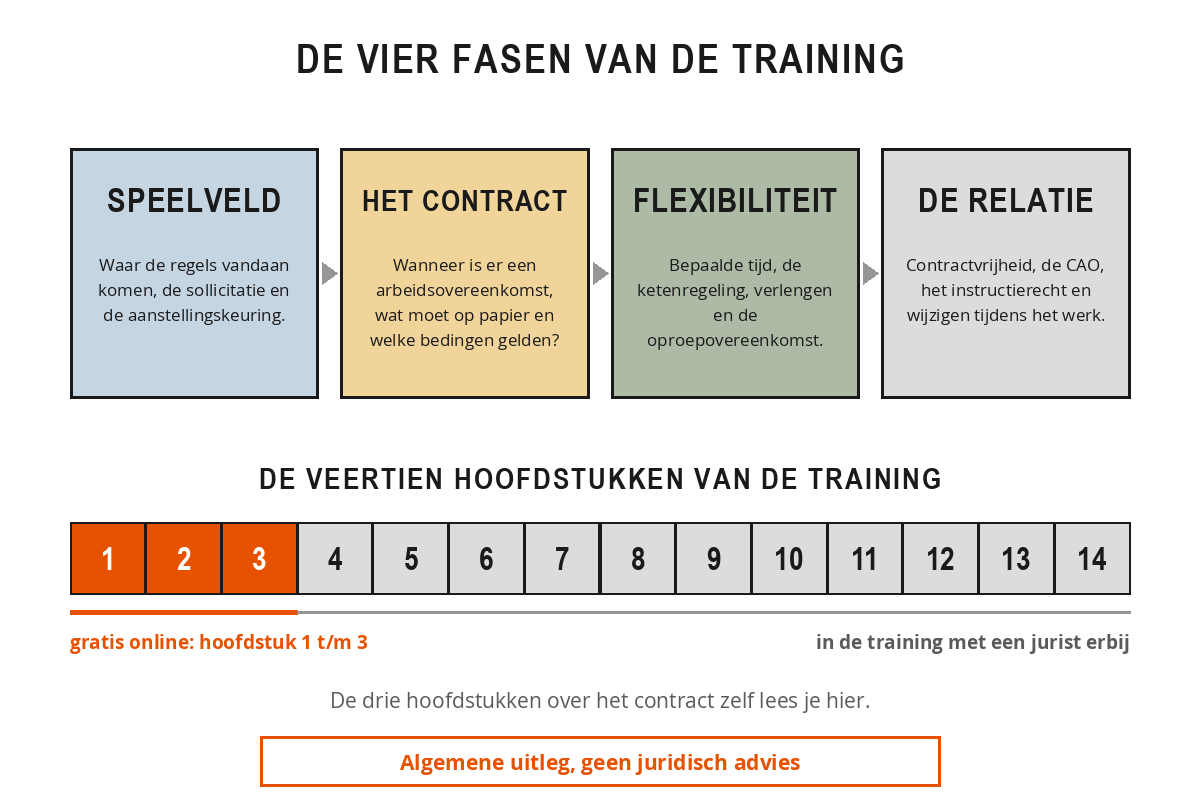
The course follows the life cycle of an employment relationship, from the job advertisement to a change after ten years of service. This free course takes the heart out of it: the three chapters that deal with the contract itself. These are chapters 4, 5 and 7 of the syllabus, renumbered here as 1, 2 and 3. At the end of chapter 3 you will find the full course.
What you will learn
In chapter 1 you learn to recognise an employment contract by the three statutory elements of work, pay and authority. You will see which signals indicate a relationship of authority, where the boundary lies with the contract for services, what false self-employment can cost an organisation and how the two legal presumptions in the Dutch Civil Code shift the burden of proof.
Chapter 2 is about the paperwork. An employment contract is not subject to any formal requirements, but there are five clauses that simply do not exist unless they are set down in writing. You will learn the difference between fixed-term and permanent contracts and all the consequences of that, you will see what an incorporation clause does, and you will go through the standard provisions that have been assessed differently since 2022.
Chapter 3 deals with the clauses that cause the most discussion after an employee leaves: the non-competition and non-solicitation clauses, the ancillary activities clause, the penalty clause and the study costs clause. For each clause you will see which requirements apply and what a court can do with it.
Who this course is for
You do not need any prior legal knowledge. Where legal concepts come up, they are explained in plain language. Statutory provisions are included so that you can look them up yourself later, but you do not need to know them by heart. What matters is recognising the situation and knowing which question to ask, and to whom.
Practical tips for use
- Place your own organisation's standard contract next to it. The exercises only work if you apply them to a real document.
- For each chapter, keep one specific situation in mind: your own contract, that of a colleague or a file from your department.
- Don't read it all in one go. Legal knowledge only sticks once you apply it to a situation in which the facts are messy.
- Note down for each chapter which question you would want to put to a lawyer. That list is worth more than a summary.
- For every topic, check whether the CAO for your sector says anything about it. In many cases it takes precedence.
Each chapter ends with a short knowledge check of three questions: answer them correctly to mark the chapter as completed. Your progress is saved automatically in your browser.
Enjoy the read. And if halfway through you find yourself thinking "our contract says the same thing": then this course is doing exactly what it should.