


1. Recognising the employment contract
Article 7:610 of the Civil Code sums up the employment contract in a single sentence. Break that sentence down and you are left with three conditions. If all three are present, there is an employment contract, whatever the contract itself says. That is the most important sentence in this chapter, and at the same time the sentence that most often causes surprises in practice.
After this chapter you can:
- Identify and recognise the three statutory elements of work, pay and authority in a concrete situation.
- Explaining what a relationship of authority involves and the signals by which you recognise it.
- Substantiating the difference between an employment contract and a contract for services.
- Assessing whether there is false self-employment and what risks this entails.
- Applying the legal presumptions of Articles 7:610a and 7:610b of the Dutch Civil Code.
This chapter gives general information, not legal advice. Whether a particular working relationship is an employment contract depends on all the circumstances of the case. A collective agreement may also set its own rules. If you are in doubt about a specific engagement, put the situation to a lawyer before drawing conclusions or changing the collaboration.
The three statutory elements
The law speaks of an agreement whereby one party undertakes to perform work in the service of the other party for pay for a certain period of time. You work through that formulation element by element in every case of doubt: is there work, is there pay, and is there authority?
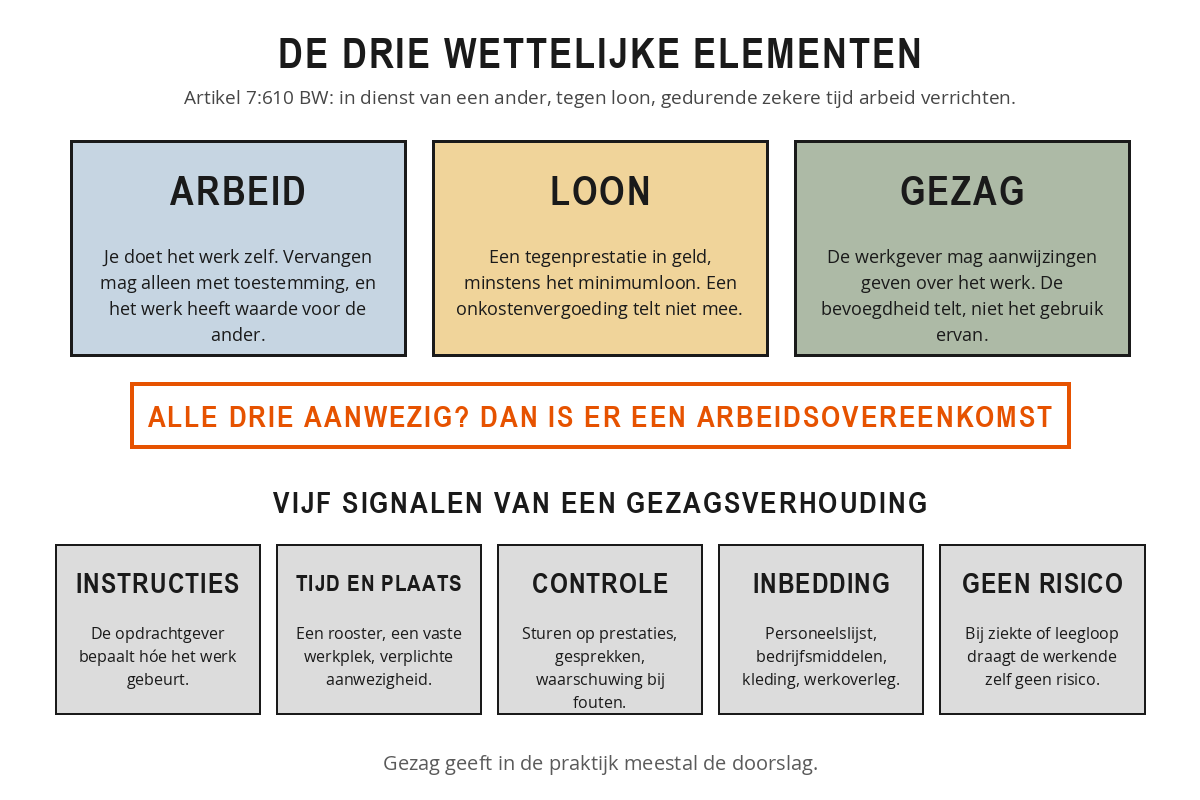
Work means that someone performs the work themselves. The obligation is personal: an employee cannot simply send his neighbour because the day does not suit him. Replacement is usually possible, but only with the employer's permission and within the limits he sets. Whether the work is physical or mental makes no difference, nor does whether it generates much income. The work must, however, have some value for the other party. A trainee who mainly learns and hardly contributes to production is not performing work in the legal sense. If that same trainee is fully part of the rota after two weeks, that picture shifts quickly.
Pay is the remuneration for the work performed. In essence it is about money, and at least about the statutory minimum wage. Payments in kind may be added, such as housing or meals, but they may not replace the monetary amount. An expense allowance is not pay: someone who only receives a mileage allowance and a sandwich is working as a volunteer, not as an employee. As soon as the compensation clearly exceeds the actual costs, that assessment shifts. Tips only count if the employer distributes or settles them.
Authority is the element that proves decisive in practice. There is authority if the employer can give instructions about the work and the employee has to follow them. The fact that the employer rarely uses their right to give instructions is irrelevant: it is the power that counts, not the use of it.
Five signs of a relationship of authority
You recognise authority by a series of concrete signals. The first are instructions on the content: the client determines how the work is carried out, not just what the end result must be. The second is control over time and place: there is a roster, a fixed place of work or compulsory attendance during office hours. The third is supervision and correction: there are appraisal interviews, performance is managed and mistakes are followed by a warning. The fourth is embedding in the organisation: the person appears on the staff list, uses company resources, wears company clothing and takes part in work meetings. The fifth is the absence of entrepreneurial risk: in the event of illness, downtime or a job that falls through, the worker bears no financial risk themselves.
A gym hires Yara as a self-employed instructor. She teaches three fixed classes a week at times the gym schedules, wears a shirt with the logo, uses the company's equipment and receives a fixed amount of 1,400 euros per month. If she is ill, the gym arranges cover itself and Yara loses no income. On paper, Yara is an entrepreneur. If you run through the three elements, you see work (she teaches the classes herself), pay (a fixed monthly amount, well above an expense allowance) and authority (schedule, company clothing, company resources, no risk). All three are present, so there is an employment contract, whatever the contract is called.
Bogus self-employment
Not everyone who works for an organisation is an employee. Alongside the employment contract, the Dutch Civil Code recognises the contract for services, governed by Article 7:400 of the Civil Code. The contractor undertakes to carry out work outside an employment relationship. The crucial phrase is "outside an employment relationship": there is no relationship of authority. The contractor decides for themselves how to achieve the result, invoices with VAT, bears their own business risk, insures themselves against incapacity for work and accrues no pension through the client.
A self-employed person without staff who supervises a migration project for three months works on the basis of a contract for services. An interim controller who sits in the same chair four days a week, performs the same tasks as her salaried predecessor and attends the team meeting every Monday at nine o'clock probably does not.
False self-employment is the situation in which the parties have signed a contract for services, while the actual working relationship has all the characteristics of an employment contract. The label says self-employed, the reality says employee. This more often stems from convenience than from intent: the client wants to avoid the rules on successive fixed-term contracts and the risk of dismissal, the contractor wants a higher hourly rate and tax advantages. Both parties are satisfied, until a third party comes knocking.
The intention of the parties is not decisive. Since the Deliveroo ruling, the court weighs all the circumstances of the case, and the label on the contract is only one of them. It looks at the nature and duration of the work, at the embedding in the organisation, at the freedom in carrying it out, at the way of remunerating, at the commercial risk and at entrepreneurship outside this one relationship.
What false self-employment costs
The bill rarely comes from the contractor themselves, and that makes the risk deceptive. In the event of reclassification, the Tax Administration can levy additional payroll taxes over the elapsed period, with a fine and interest. A pension fund can claim contributions retroactively if the role falls under a mandatory fund. And the contractor themselves can, for example after the collaboration ends or they fall ill, still go to court with a wage claim, an appeal to dismissal protection or a claim for continued payment of wages during illness.
As an HR employee, you often only come into the picture once the collaboration is already up and running. For every new engagement lasting longer than three months, ask for three facts: how many other clients this person has, who sets the rate and who decides on working hours. With those three answers you usually already have a good picture of the risk.
Two legal presumptions
The party making a claim bears the burden of proof. For a worker who suspects that he is in fact an employee, that is a tall order: the records, the contracts and the rosters are all held by the employer. The legislator has resolved this with two legal presumptions.
The first concerns the exist of the contract. Article 7:610a of the Civil Code states that anyone who, over three consecutive months, performs work for another party for remuneration either weekly or for at least twenty hours a month is presumed to do so on the basis of an employment contract. The worker only needs to demonstrate that pattern of work and remuneration. They do not have to prove the relationship of authority.
The second concerns the scope. If the employment contract has lasted at least three months, the agreed work is presumed under Article 7:610b of the Dutch Civil Code to be equal to the average over the past three months. If the contract states six hours a week while eighteen hours are structurally worked, then eighteen hours is the starting point. That has consequences for pay, for holiday accrual and for continued payment during sickness.
Both presumptions are rebuttable. The employer may provide counter-evidence and show that there was no authority, that there was no obligation to perform the work personally, or that the amount paid was not pay. As regards the number of hours, the employer can argue that those three months do not give a representative picture, for example because the branch relocated or because of a peak around the holidays. If the counter-evidence fails, the employment contract is established, with all the consequences that entails.
Youssef has been working as a freelance courier for a meal delivery service since February. He is sent a rota every week, wears company clothing and receives a fixed amount per delivery set by the company. In June he is out of action with a broken hand and payment stops. Youssef invokes Article 7:610a of the Dutch Civil Code. With his invoices and rotas he demonstrates that he worked every week for four months in return for payment. That establishes the presumption of an employment contract. The company now has to make it plausible that there was no authority, while it drew up the rotas and set the rates itself. That will be a difficult case to make.
Working without a contract on paper
An employment contract is formed by offer and acceptance. There is no statutory form requirement: a verbal agreement, a text message or simply starting work is enough. Paper is evidence, not a condition.
If a contract is missing, the agreement does exist, but it is not established what exactly was agreed. You then fill in the content from the top down. The law provides the mandatory part: pay, holiday, notice periods and continued payment of wages during illness. An applicable collective agreement provides the job grading, the salary and the allowances. Whatever remains open you fill in with what the parties actually did: the hourly wage paid out, the schedule worked, the emails about the start date. If there is doubt about the duration, the contract applies in principle for an indefinite period, because an end date is a deviation from the main rule that you must be able to demonstrate.
In addition, the duty to provide information under Article 7:655 of the Dutch Civil Code continues to apply. The employer must inform the employee in writing or electronically about the essentials of the employment relationship: the identity of the parties, the job, the place of work, the start date, the duration, the pay, the working hours, holidays and the rules on termination. If he fails to do so, he is liable for the resulting damage. In practice this mainly means that any lack of clarity is interpreted to the employer's disadvantage.
Choose an employee or hired worker in your own organisation whose status is not entirely clear. Work through the three elements and note your findings for each one.
- Work: who actually does the work, and may a substitute be sent?
- Pay: what amount is paid, and is that more than an expense allowance?
- Authority: which of the five signals do you recognise, with a concrete example for each?
- Conclusion: how many elements are present, and which element is the least clear?
- Follow-up question: which fact would you still need to establish in order to be certain, and to whom would you put it?
Summary
- An employment contract exists as soon as work, pay and authority are all three present, regardless of what the contract says.
- Work is personal labour with value for the other party; pay is consideration in money above an expense allowance.
- Authority is usually decisive. The five indicators are instructions about the content, control over time and place, supervision and correction, embedding in the organisation, and the absence of business risk.
- In a contract for services, authority is absent and the contractor bears their own business risk. If the paperwork says contract for services while the facts point elsewhere, there is bogus self-employment.
- Reclassification can result in additional assessments for payroll taxes, pension contributions and wage claims.
- Article 7:610a of the Civil Code presumes an employment contract after three months of weekly work or at least twenty hours a month for remuneration. Article 7:610b of the Civil Code presumes that the number of hours equals the average of the last three months. Both are rebuttable.
- Without a contract on paper, the employment contract still exists. You fill in the content with the law, the CAO and the actual conduct of the parties.
- This is general guidance. A specific case should be put to a lawyer, and the CAO may take precedence.
An organisation hires someone under a contract for services, but schedules him every week, gives him company clothing and pays a fixed monthly amount. What is decisive in legal terms?
Which element, according to this chapter, is usually decisive in practice, and why?
What does the legal presumption of Article 7:610a of the Dutch Civil Code do for someone who has already been working weekly for payment for months?