


2. The written contract
A signature does not make the employment contract valid, and the absence of one does not make it invalid. Even so, there are agreements that simply do not exist without paper. That sounds like a detail for lawyers, but it is precisely the difference between a clause you can rely on and a text that does nothing.
By the end of this chapter:
- You can explain why an employment contract is not subject to any formal requirements and which five arrangements must nevertheless be set down in writing.
- You will be able to identify the difference between a fixed-term and an open-ended contract and the consequences of each.
- You know what the notification obligation entails and when it applies.
- You can recognise an incorporation clause and know what it is for.
- You will be able to assess whether standard clauses on ancillary activities and study costs are still tenable.
This chapter gives a general explanation of the written-form requirement and of standard clauses. It is not legal advice. A collective labour agreement (CAO) may set its own or stricter rules on these points which take precedence, and legislation and case law change. If you want to amend your organisation's model contract, have the new text reviewed by a lawyer.
No prescribed form as the main rule
Employment law contains no general requirement that an employment contract be put on paper. It also comes into existence without any document ever having been signed, as soon as the three statutory elements from chapter 1 are met. Whether or not something is sitting in a drawer makes no difference to that.
That does not mean paper is superfluous. The main rule only states that the contract is valid without a document. Different rules apply to the content of that contract, and that is where freedom of form runs into limits. For a handful of specific agreements the legislator makes an exception, and those exceptions are strict.
Five clauses that do not exist without paper
For these clauses the law expressly requires them to be set down in writing. If that is missing, the clause is void. This is not an error you can put right later: the agreement never had any effect, even if both parties were in full verbal agreement about it.
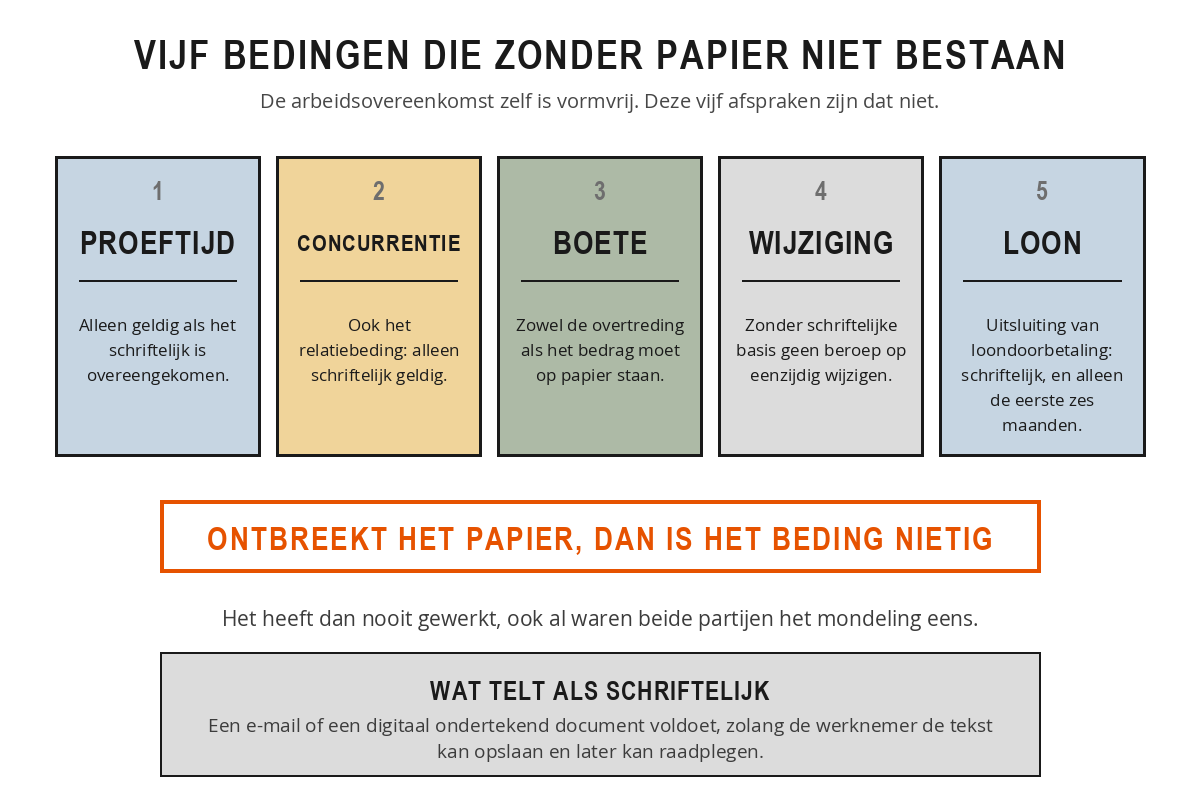
The first is the probationary period clause: only valid if agreed in writing. The conditions and the duration are covered in the full course. The second is the non-competition clause and the non-solicitation clause: these too are only valid if they have been agreed in writing, and in chapter 3 you will see which further requirements apply. The third is the penalty clause: both the description of the breach and the amount must be set out in writing. The fourth is the unilateral amendment clause: without a written basis, an employer cannot rely on it when changing terms of employment. The fifth is the exclusion of the obligation to continue paying wages: the agreement that no wages are paid for hours not worked is only valid in writing and only during the first six months.
A separate covering email with the contract, in which the employee is merely invited for their first working day, is not a suitable place for these clauses. They belong in the contract itself, or in an annex to which the contract explicitly refers and which the employee also signs. That way the link between agreement and signature remains visible.
In writing does not automatically mean on paper, in wet ink. An email or a digitally signed document will do, as long as the employee can save the text and consult it later. For most clauses a signature is strictly speaking not a statutory requirement, but it is your most important evidence that the employee agreed to the text. In a dispute, the burden of proof lies with the party relying on the clause, and that is almost always the employer.
Fixed term or indefinite term
A fixed-term contract runs until a moment laid down in advance. That moment is usually a date, but it can also be an event: the return of a sick colleague, the end of a project or the expiry of a subsidy. At that moment the employment ends by operation of law. No notice is required and no permission from the UWV or the subdistrict court. A permanent contract has no such end point and continues until one of the two parties terminates it or the court dissolves it.
That difference sounds simple, but it lies in the detail. An end date that is not objectively determinable, such as "until the work is finished", leads to discussion about exactly when the contract ends. So record when the event is deemed to have occurred and who determines this.
Notification of non-renewal for fixed-term contracts
If a fixed-term contract runs for six months or longer, the notification obligation under article 7:668 of the Dutch Civil Code applies. No later than one month before the end date, you must state in writing whether you will be continuing the contract and, if so, on what terms. If you forget, you owe compensation of one month's gross salary. If you give notification late, you pay pro rata: if you are twelve days late, that costs you twelve days' pay.
The payment is not a penalty for poor conduct but an automatic entitlement. Even if the employee had long known that the contract was coming to an end and had already found another job, the entitlement remains. The employee does have to claim it within three months of the end date.
Sanne has a one-year contract ending on 1 October; her gross salary is 3.200 euro per month. In mid-September her manager mentions in passing that she will "simply be carrying on". On 5 October Sanne is given a new contract to sign. The employment contract does continue, that much is correct, but the notification was never given in writing. Sanne can claim compensation of one month's gross salary, in this case 3.200 euro, up to three months after the end date. The verbal assurance does not count here.
Put the notification date in your diary the moment you draw up the contract, not later. Even more practical is to include the notification in the contract itself, for example: "this contract ends by operation of law on 31 March and will not be continued". That is permitted, and it covers the statutory obligation. The downside is that you commit yourself, so this only works for contracts where you are certain that renewal is not an option.
Early termination
A fixed-term contract cannot simply be terminated early. That option only exists if both parties have agreed an interim notice clause, and that clause must apply to both of them. If it is absent, you are in principle tied in until the end date. If a party nevertheless gives notice, compensation is payable equal to the salary for the remaining term.
With open-ended contracts the situation is different. Notice can always be given, but the employer needs a dismissal route for this: UWV for redundancy on business economic grounds and long-term incapacity for work, and the subdistrict court for the other grounds. The employee can give notice themselves, observing the notice period. How often you may extend a fixed-term contract before it becomes open-ended by operation of law is covered in the full training course under the chain rule.
The incorporation clause
Most model contracts contain a series of provisions that have been in there for years and that hardly anyone still reads. That is precisely where the risks lie, because legislation changes and standard texts travel from one organisation to the next.
With an incorporation clause, you declare in the employment contract that another document applies to the employment relationship. Usually this is a collective labour agreement, sometimes a staff handbook, a code of conduct or a working-from-home policy. A common formulation is: "This employment contract is governed by the Metaal en Techniek collective labour agreement, as it currently reads and as it will read in the future."
That last addition is the dynamic variant: changes to the underlying document take effect automatically. Without that phrase you have a static clause and the version that existed on the commencement date continues to apply. That may look like a detail, but it determines whether a new salary scale or an amended leave arrangement applies to this employee without any further action.
In 2021 Marcel signs a contract with an incorporation clause that does not include the words "and as it will read in future". Three years later, employers and trade unions agree a new CAO with an extra day of leave and an amended allowance scheme. For his 240 colleagues this applies automatically. Not for Marcel: his clause is static, so the 2021 version still applies to him. If the employer wants to bring him under the new CAO, that has to be done through a separate agreement. Two words in a standard sentence, and the HR administration has another exception to deal with.
With a staff handbook there is an additional question: can you amend it unilaterally? If you refer dynamically to a handbook that you write yourself, you are in effect giving yourself the authority to change terms of employment. Courts take a critical view of this. So keep primary terms of employment out of the handbook, and limit the dynamic reference to arrangements of a practical nature.
Clauses due for revision
Three standard texts deserve extra attention, because the law has taken a different view of them since August 2022. The secondary employment clause first: a ban on work outside the employment relationship is only valid if you can justify it on objective grounds, such as protecting confidential information, the employee's health and safety, or preventing breaches of the Working Hours Act. A bare ban without any substantiation will not hold up.
Then the study costs clause: training that is mandatory under the law or the collective labour agreement must be paid for by the employer. You cannot reclaim those costs when the employee leaves. For non-mandatory training, repayment remains possible, provided the amount decreases over time and the arrangement is reasonable. And finally the unilateral amendment clause: this allows you to retain the option of changing a term of employment without consent. The clause must be agreed in writing and still does not give you carte blanche. Chapter 3 looks at the first two in more detail.
Take the standard contract your organisation uses for new employees and check it against the five clauses that must be in writing.
- Clause: is it in there, yes or no?
- Location: in the contract itself, in an appendix, or only in the staff handbook?
- Risk: what happens if you want to rely on this and the employee disputes it?
- Incorporation clause: does it say "and as it will read in future", or is it static?
Then note which two points you would change first, who in your organisation decides on that, and which question you would put to a lawyer before the new text goes out.
Summary
- An employment contract is not subject to any form requirement. The paper does not establish the contract itself, but it does provide the evidence of it and the clauses that are only valid in writing.
- Five clauses are void without a written record: the probationary period clause, the non-competition and non-solicitation clause, the penalty clause, the unilateral amendment clause and the exclusion of the obligation to continue paying wages.
- In writing may also mean digitally, as long as the employee can save the text and consult it later. The burden of proof lies with whoever relies on the clause.
- A fixed-term contract ends by operation of law; an open-ended contract continues until notice is given or the contract is dissolved. An end date must be objectively determinable.
- For a contract of six months or longer, the notification obligation of Article 7:668 of the Dutch Civil Code applies: you must state in writing at least one month in advance whether you will continue the contract, on penalty of one month's gross salary, pro rata if you are late.
- Early termination of a fixed-term contract is only possible with a clause that applies to both parties.
- A dynamic incorporation clause allows changes to the collective labour agreement or the staff handbook to take effect; a static clause does not.
- The rules on ancillary activities and study costs have been tightened since 2022. This is general guidance: have an amended model contract reviewed by a lawyer, and check whether the CAO provides otherwise.
The employer and employee agreed a probationary period verbally, but the contract says nothing about it. What is the position?
A one-year contract ends on 1 July. The employer only gives written notice on 20 June that it will not be continued. What is the consequence?
Why does it matter whether an incorporation clause contains the words "and as it will read in the future"?