


2. Leary's Rose: behaviour calls forth behaviour
You know how it goes: with one colleague you are quick and clear, and with another you hear yourself agreeing within two sentences to something you do not want. That is not down to your character, because you bring that to both conversations. It is down to the pattern the two of you have built up together. Leary's Rose makes that pattern visible, and shows you where you can step out of it.
After this chapter:
- You can name the two axes of Leary's Rose and explain how they form positions together.
- You apply the core law "behaviour calls forth behaviour" to a conversation from your own practice.
- You recognise above-behaviour and below-behaviour by concrete signals in language, voice and posture.
- You know what happens when two people take the above position or the below position at the same time.
- You can shift your own position by one segment to change the other person's response.
Two axes, eight positions
The American psychologist Timothy Leary reduced people's behaviour in relationships to two questions. How much influence do you take in the contact? And how much connection do you seek with the other person? The first question produces the vertical axis, from above to below. The second produces the horizontal axis, from together to against. Cross those two axes and you get four quadrants, each split again into two segments. That gives you the eight positions in the rose.
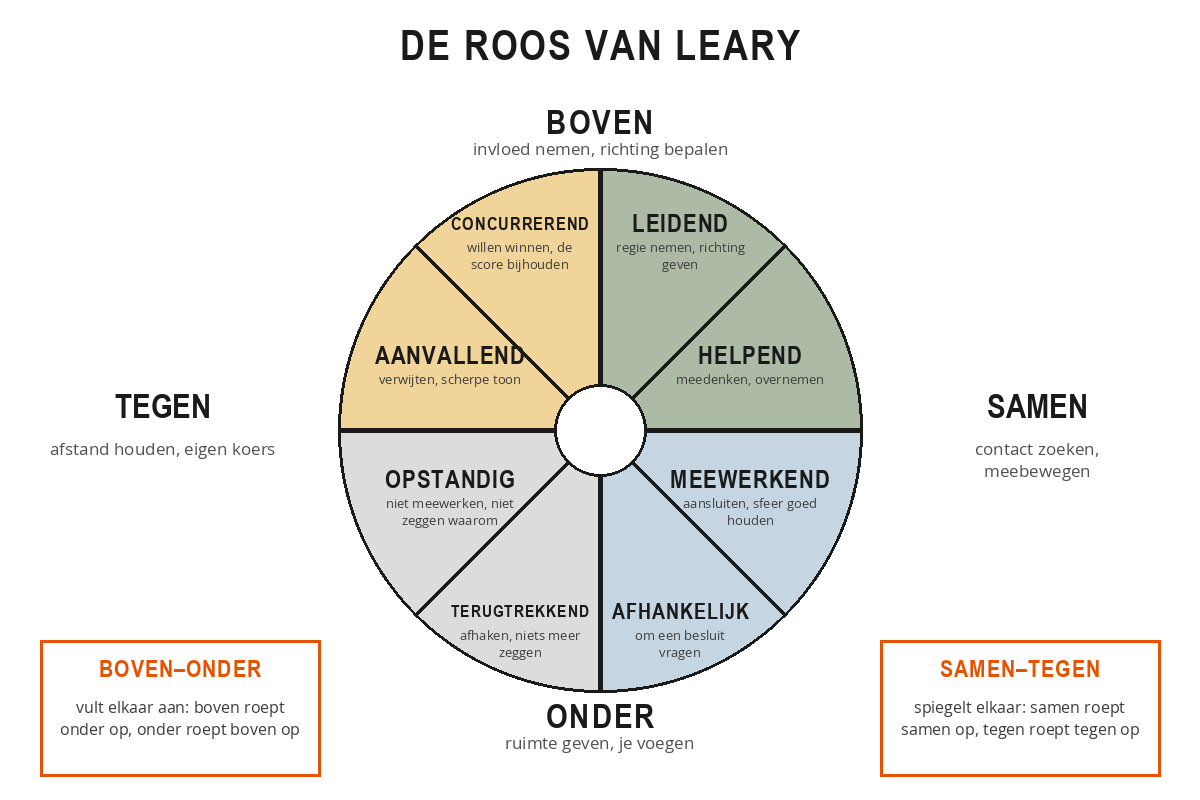
What matters is what the model does not does: it does not pin you down as a type. Your position in the rose describes behaviour in a situation, not your character. The same person is leading in a project meeting in the morning and following at the dentist in the afternoon. Almost everyone does, however, have a preferred segment that they automatically move towards under pressure.
The core law: behaviour calls up behaviour
The model is not a map but a prediction. Every position draws a particular answer from the other person, and that happens according to two fixed rules.
On the axis above–below behaviour works in opposite directions. Whoever moves above pushes the other below. Whoever moves below invites the other to move above. On the axis together-against behaviour actually works in the same direction. Connection calls forth connection, distance calls forth distance. Whoever obstructs gets obstruction in return.
That isn't always accurate down to the millimetre, but the odds are high. And that is precisely where the value for assertiveness lies. You cannot change the other person. You can change your own position in the rose, and with that the invitation the other person receives changes.
Above and below: who sets the direction?
Above and below say nothing about hierarchy, job title or salary. An intern can be above and a director below. It is about the question of who sets the direction in this conversation and who falls in line with it.
Above-behaviour takes up space. You hear it in short, decisive sentences: "this is how we'll do it", "I suggest you start on Monday", "that won't work, and I'll explain why". You see it in an upright posture, calm eye contact, broad gestures and a pace that gives the other person little opportunity to come in. Advising, explaining and helping are also above-behaviour, even when they sound friendly. Anyone who explains how something should be done without being asked puts the other person in the pupil's seat.
Below-behaviour gives away space. In words that sounds like "you decide", "I don't know whether this is a good idea, but maybe...", "sorry to ask again". You see smaller gestures, raised shoulders, a gaze that darts away and a voice that rises at the end of the sentence, turning a statement into a question. Going along with things, agreeing and waiting also belong here.
Neither position is better. Above is needed when someone has to make a decision, below is needed when you want to learn or want to let someone else take the lead. The problem starts when you can only choose one side.
For the third time that week, Sanne has a task pushed her way with the words: "You can do this much faster than I can." She sighs and says: "Yes, fine, I'll have a look at it." Her colleague no longer has to do anything. He is above, she steps below, and that division has become so fixed that he no longer even asks whether it suits her.
That is the point of the core law: Sanne's agreement is the invitation that keeps his behaviour in place. He has not changed since last year. The pattern between them has changed, and she holds half of it in her hands.
Twice above or twice below
Because above and below complement each other, a conversation gets stuck as soon as both parties choose the same side. Twice above produces a power struggle: both deciding, both explaining, nobody listening. The content disappears and the conversation becomes about who is right. Twice below produces the opposite picture: standstill. Both waiting, both asking what the other thinks, and nobody taking the decision. You recognise such a pattern by a meeting that is postponed three times without anything changing.
Together and opposed: how much contact do you seek?
Alongside the distribution of influence, a second axis runs through the rose: the extent to which you are focused on the other person or keep your distance. On the togetherside you seek contact. You show interest, you move with the other person, you look for agreement and you keep the relationship warm. On the againstside you choose distance. You stick to your own course, you dig your heels in, you show little of what you feel, or you go directly against what the other person wants.
So this axis works exactly the other way round from the first. Above and below complement each other, together and against mirror each other. Friendliness calls forth friendliness, resistance calls forth resistance. That explains why a discussion that has once become heated rarely softens of its own accord: every countermove confirms the previous one.
Two department heads are discussing a shared budget of 80,000 euros. The first head opens with: "I assume your share can be a bit smaller this year." That is a move in the above-against segment: taking influence and keeping distance. The second head replies: "Then I'll assume you'll solve the extra hours yourselves." Also above-against. They are now standing side by side in the same segment, pushing, and after twenty minutes there is no division of the budget but there is a conflict.
If the second head instead says: "I want to know what you need, and then I'll set out alongside it what I need", the move shifts to above-together. The influence is just as great, the effect is different: the first person doesn't have to defend themselves and starts naming figures instead of positions.
The eight positions
The two axes produce four quadrants: above-together, below-together, below-against and above-against. Each quadrant falls into two behavioural patterns, bringing the total to eight. They are not personality types but positions you step into and out of, sometimes several times in the same conversation.
- Leading (above-together): you take charge, give direction, formulate the goal and divide up the work. This calls forth cooperative behaviour, as long as you take the other person seriously.
- Helping (above-together): you support, think along and offer to take things over. Pleasant to deal with, with the risk that you pull tasks towards you that are not yours.
- Cooperative (below-together): you go along with the other person's proposal and keep the atmosphere good. Constructive, unless going along becomes a habit that crowds out your own contribution.
- Dependent (below-together): you ask for instructions, confirmation or a decision from someone else. Sometimes sensible, but it invites the other person to decide about you.
- Withdrawing (below-against): you disengage, say nothing more, look at your screen. The other person only notices that something is not right and often pushes harder.
- Rebellious (below-against): you do not cooperate but you also do not say why. You put things off, grumble in the corridors and just miss a deadline. This calls up control.
- Attacking (above-against): you go at the other person head-on, with reproaches or personal remarks. You get a counterattack or silence in return, rarely a solution.
- Competing (above-against): you want to win, refute every argument and keep score. The other person will do the same and the content drops out of sight.
No position is wrong by definition. In an emergency, leading is exactly right, and with a colleague who is stuck, helping works better than competing. The problem arises when you only have one segment available.
Steering the interaction yourself
Because behaviour calls up behaviour, you can change the interaction by changing your own position. That works best in small steps. A jump from withdrawing to attacking is a diagonal across the rose and comes across to the other person as an outburst from nowhere. Shifting by one segment achieves more. Here is how you do that:
- Name for yourself where the other person stands, in one word from the rose.
- Establish which sector you are currently in, and which signal tells you so.
- Consider what you want to achieve in this conversation, not what you think of the other person.
- Choose the position that fits that aim and that is one corner away from where you are now.
- Take one concrete step: a question, a boundary or a proposal.
- See what comes back and adjust your position.
With someone who attacks or competes, contradicting them almost never works. Shift first to the together side with a question that is genuine: "What makes this so important to you?" As soon as the axis tips from against to together, you can take influence without it becoming a battle.
Work out a conversation you have coming up and are dreading.
- Situation: what is going on, in two factual sentences?
- The other person's position: which of the eight patterns fits best?
- Your automatic position: which pattern do you normally choose in this situation?
- Desired position: which sector is one step further and fits your goal?
- Opening move: the first sentence written out verbatim, in no more than twenty words.
- Signal: how can you tell that the other person is going along with you, or is not?
After the conversation, note down in two lines what the response to your opening move was.
Summary
- The rose describes behaviour on two axes: above-below is about influence, together-against is about contact.
- Above-below works complementarily: above calls up below and vice versa. Above twice gives a power struggle, below twice gives deadlock.
- Together–against works as a mirror: cooperation calls forth cooperation, resistance calls forth resistance.
- The four quadrants produce eight patterns: leading, helping, cooperative, dependent, withdrawing, rebellious, attacking and competing.
- No pattern is wrong, but one fixed segment limits you.
- Change your own position one segment at a time. A diagonal leap across the rose usually escalates things.
How do the two axes of Leary's Rose work according to this chapter?
In a meeting, two people are both in the below segment. What happens then?
A colleague attacks you in a meeting. According to this chapter, what is the most sensible move?