


Introduction
You influence people all day long, whether you realise it or not. You talk a colleague round, you align with a client, you come to an agreement with your neighbour about the fence. Sometimes that happens by itself. And sometimes you are faced with someone who does not budge, however good your case is, and you have no idea where it is going wrong. Persuasiveness is not about slick tricks or about talking more loudly. It is about seeing what matters to the other person and adjusting your approach accordingly.
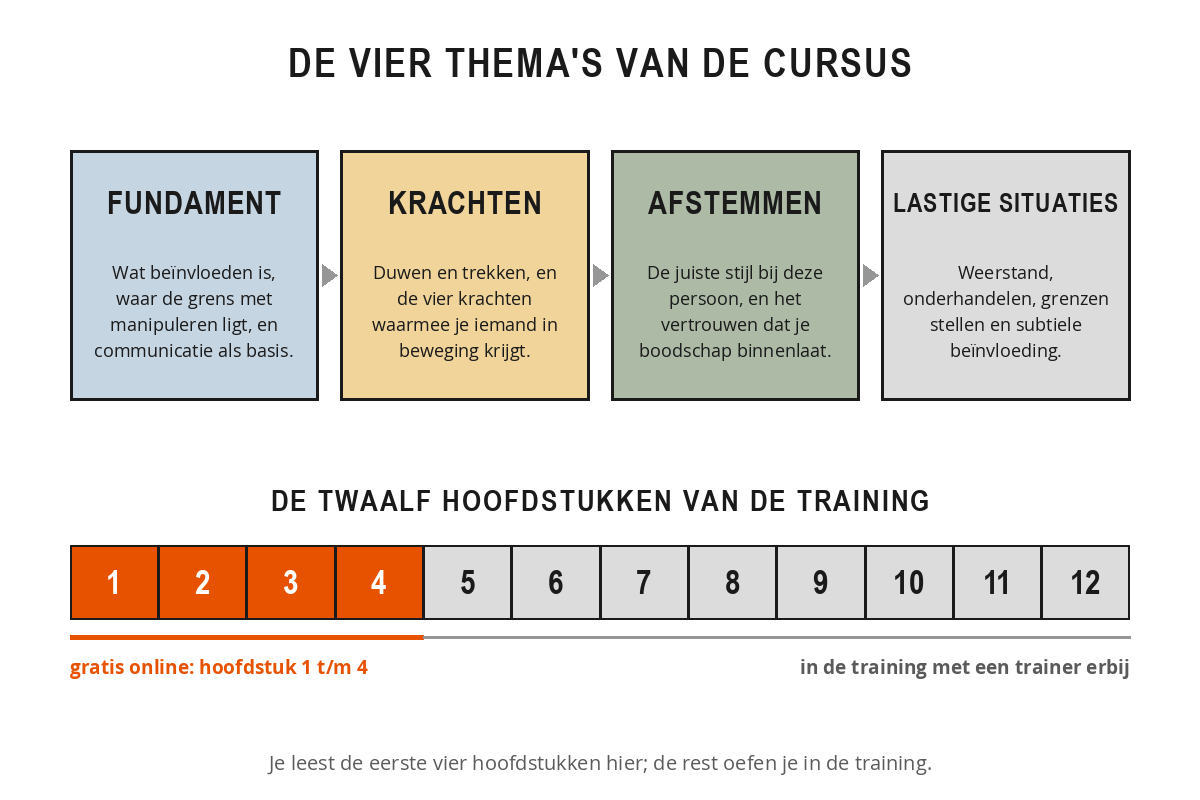
This free course consists of four chapters: the orange part of the bar above. At the bottom of chapter 4 you will find the full course.
What you will learn
You learn to see influencing as an interplay and not as a bag of tricks. You start with the two movements with which you steer every conversation: pushing and pulling. Then you get to grips with the four forces people use to move each other, and the skills that go with them. Next you learn how to choose which of those forces suits the person in front of you, and why trust determines whether your message gets through at all. You finish with the hardest part: recognising resistance before it hardens, and turning it into cooperation. The common thread: your effectiveness lies not in your strongest style, but in your ability to switch.
How the course is structured
The full course follows four themes that build on each other. You start with the foundation: what influencing is, where the line with manipulation lies, and how communication underpins it. Then come the forces: pushing and pulling, and the four ways of getting someone moving. After that comes adapting: the right style for this person, and the trust that lets your message in. And you finish with the difficult situations: resistance, negotiating, setting boundaries and the subtle side of influencing. Each chapter contains theory, a model, examples from practice and an exercise that you apply to your own work.
Practical tips for use
- Choose one situation from your own work in which influencing is currently difficult, and use it as a thread running through all the chapters.
- Do the exercises properly. Reading alone changes little; you learn to influence by doing it and noticing what happens.
- Experiment on a small scale. Try out a new skill in an ordinary conversation first, not straight away in the meeting where a lot is at stake.
- After a conversation, pay attention to the other person's reaction. That is your best learning material, and it is free.
- Don't read it all in one go. One chapter a week, with time to try it out, gets you further than reading through it in an afternoon.
Each chapter ends with a short knowledge check of three questions: answer them correctly to mark the chapter as completed. Your progress is saved automatically in your browser.
Influencing is a skill, not a talent. The more often you do it consciously, the more normal it becomes. Enjoy the read.