


1. Push energy and pull energy
In every conversation in which you want to get something done, two things are at play at once. There is your goal: where you want to get to. And there is the other person: the one on whom success depends. Those two give rise to two kinds of energy. One is directed at your goal, the other at the other person. Anyone who uses only the first gets stuck in a tit-for-tat argument. Anyone who uses only the second has a pleasant conversation but achieves nothing.
After this chapter:
- You know the two aspects that play a part in every influencing situation.
- You recognise push energy by concrete signals in language, posture and tone.
- You know when pushing works and when it turns against you.
- You recognise your pull energy and know where its pitfall lies.
- You can switch deliberately between pushing and pulling, based on what you observe in the other person.
Two aspects, always at the same time
An influencing situation arises the moment there is a difference between what you want and what the other person wants (so far). The playing field lies precisely in that difference. Without a difference you do not need to influence anyone, because you already agree.
That playing field has two sides. One side is your goal. You have an idea, a proposal, a result in mind. The clearer that goal is to you, the more focused your actions can be. The other side is the other person. They have their own frame of reference, their own interests and their own pace. You won't bring someone along simply by pulling hard towards your own goal; you also have to connect with what moves the other person.
The two do not exclude each other, they belong together. The skill lies precisely in combining them: you do not lose sight of your goal, and at the same time you keep an eye on the other person. If a conversation gets stuck, the most useful question you can ask yourself is: which aspect am I neglecting right now? Am I so focused on my goal that I am no longer following the other person? Or am I so occupied with the other person that my own goal has disappeared from view?
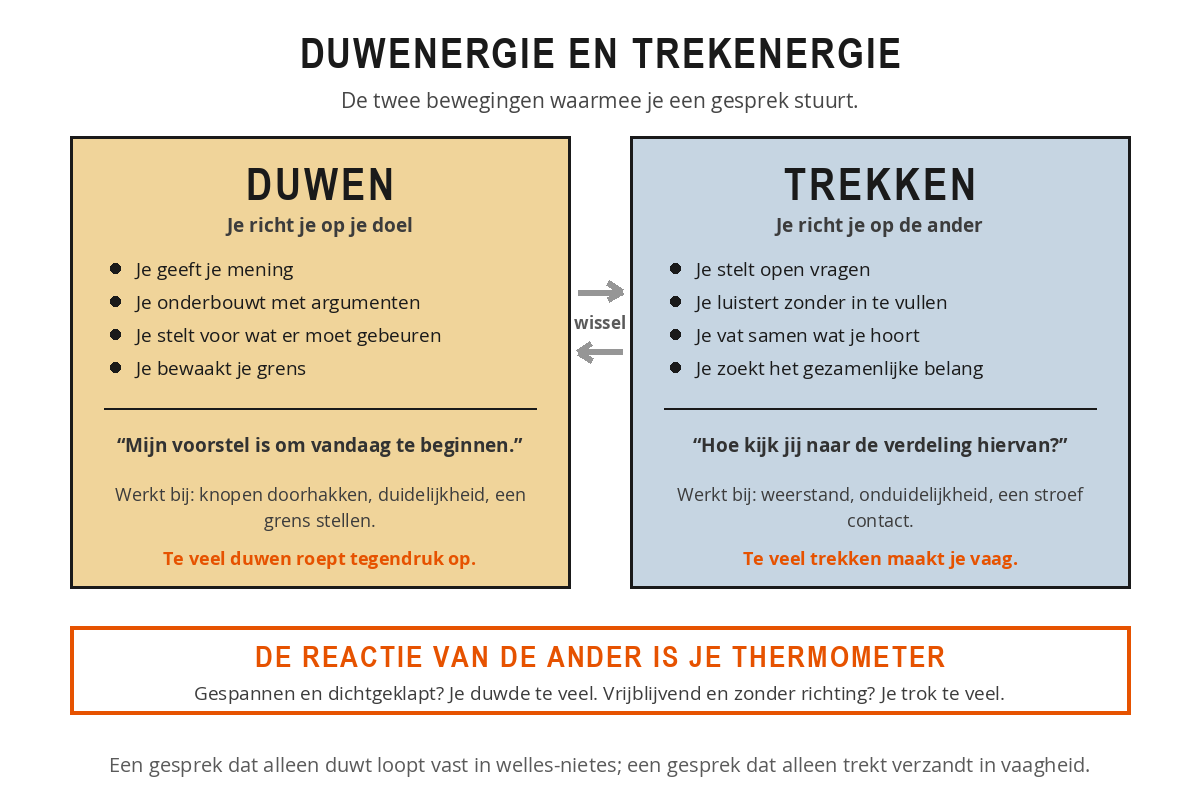
Push energy: you put something forward
Push energy is the energy you direct from yourself towards the other person. You bring something in, you put something forward, you push the situation in a particular direction. Everything you do starts from your goal and your point of view. You set the direction, and the other person either follows that movement or responds to it.
You can recognise push energy by four signals. You give your opinion, you back it up with arguments, you propose what needs to happen and you guard your limit. You hear that back in your language: "I think we should tackle this like this", "My proposal is to start today", "This is where the limit lies for me". You use I-statements, you are direct and you leave little doubt about where you stand.
Your posture and your tone reinforce that energy. You sit or stand upright, you make forward gestures, you maintain eye contact and your voice is steady. Having your words, your posture and your tone all point in the same direction does important work here: only then does your push energy come across as strong and credible. If you say in a hesitant voice that this is where your limit lies, the other person mainly hears the hesitation.
Pushing works well when the situation calls for clarity. You want to settle something, set a limit or reach a decision. And if you are enthusiastic about an idea and want to bring the other person along, pushing is exactly what you need. But there is a downside. Push too hard and the other person feels talked over or ambushed. The harder you push, the greater the chance that the other person pushes back. You notice it in objections, in a closed posture, or in a conversation that gets stuck going back and forth.
Wouter is a team leader and wants his team to switch to a shared planning board. In the team meeting he states it firmly: "From Monday we all work with this. I've looked into it, it saves us at least three hours a week in duplicated work." He is clear, he backs it up and he leaves no room for doubt. Two weeks later, four of the seven team members are using the board and the rest are keeping their own lists. Wouter said nothing wrong. He simply pushed for three quarters of an hour and pulled for zero minutes, which is why he still doesn't know why those three aren't joining in.
Pull energy: you draw something out
Pull energy is the counterpart. Where pushing puts your own position forward, pulling focuses on the other person. You invite, you ask follow-up questions and you listen. Instead of transmitting, you draw out what is going on with the other person.
You use different tools for that. You ask open questions to find out what the other person wants and why. You listen without immediately countering with your own opinion. You summarise what you hear, so that the other person can tell you understand them. And you look for the shared interest: the point where your wish and the other person's meet.
Pulling works well when the other person is not yet moving with you, when there is resistance, or when you do not actually know yet what is going on. By pulling you create room. The other person feels heard and is therefore more willing to listen to you in turn. You build the relationship and the trust you need to reach a solution together.
Pulling has a downside too. If all you do is ask and listen, at some point it becomes unclear what you actually want. The other person starts to think you have no opinion, or that you will agree to anything. Too much pulling makes you vague, because you no longer name your own goal. And with that the playing field disappears from view, because there is no visible difference left to bridge.
Nadia wants her colleague Ravi to take over the financial part of their project. She could demand that he do it. Instead she opts for pulling: "How do you see the division of this project? I notice I'm getting stuck on the numbers side and I'm curious to know what gives you energy." Ravi says he actually enjoys working with figures and has been wondering for weeks why Nadia had taken on that part. The task moves to the right place of its own accord, without anyone feeling ambushed. Two open questions achieved more than half an hour of persuading.
Switching between the two
Pushing and pulling are not opposing camps you have to choose between. They are two kinds of energy that you alternate within the same conversation. The skill lies in switching: knowing when to state your own position and when to make room for the other person.
A conversation that stays entirely in pushing gets stuck in tit for tat. A conversation that only pulls bogs down in vagueness. The movement between the two is what gets you forward. A workable order: you open by pulling and ask how the other person sees the situation. Once you have drawn out enough, you switch to pushing and say clearly what you want. If you notice the other person pushing back, you fall back on pulling to understand where that resistance comes from.
Use the other person's reaction as your thermometer. Does the conversation feel tense and closed? Then you have probably pushed too hard; start pulling. Does it stay non-committal and without direction? Then you have pulled too much; give a clear push by saying what you want.
Choose a conversation you have coming up and prepare for it:
- Goal: what exactly do you want to achieve? That is your push element.
- The other person: what do you want to find out about what the person you are talking to wants? That is your pull element.
- Opening question: which open question will you start the conversation with?
- Switching point: at which point do you want to move to pushing and make clear what you want?
Look back afterwards: was your switching point right, or were you ten minutes off?
Summary
- Two aspects play a part in every influencing situation: your goal and the other person. When a conversation gets stuck, you are usually neglecting one of the two.
- You recognise push energy by four things: giving your opinion, backing it up with arguments, proposing what needs to happen and guarding your limit.
- Pushing works when you need to cut through a knot, create clarity or set a boundary. Pushing too hard invites resistance.
- You also recognise pull energy by four things: asking open questions, listening without filling in the gaps, summarising and looking for the shared interest.
- Pulling works when you meet resistance, vagueness or an awkward rapport. Pulling too much makes you vague, because your own goal disappears from view.
- Effective influencing means switching between the two, using the other person's reaction as your thermometer.
You have spent half an hour explaining and substantiating your proposal. The other person sits with their arms folded and comes up with one objection after another. What does this chapter say you should do now?
According to this chapter, what is the pitfall of too much pull energy?
According to this chapter, where does an influencing situation arise?