


2. The four influencing forces
Influencing is not a matter of one trick that always works. Behind everything you do to bring someone along lies one of four forces. You focus on what the other person will, on what the other person thinks, on what the other person feels, or on what the other person believes. Each force addresses a different layer, and each force has its own way of working.
After this chapter:
- You know the four forces with which you exert influence: wanting, thinking, feeling and believing.
- You know which skill belongs to each force and on which side of pushing and pulling it sits.
- You can recognise and apply asserting and persuading, and you know the pitfall of each.
- You can explore by listening, summarising and asking follow-up questions.
- You know how inspiring works and why a deliberate silence sometimes achieves more than anything you could say.
The model in brief
The model connects four things. There is the process: influencing is not a snapshot but a movement that unfolds over time. There is the focus: do you put the emphasis on yourself and your own goal, or on the other person? That is where the pushing and pulling from the previous chapter comes back. Pushing goes with a focus on yourself, pulling with a focus on the other person. There is the intensity: you can apply each force lightly or firmly. And there is the force itself: which layer in the other person you address.
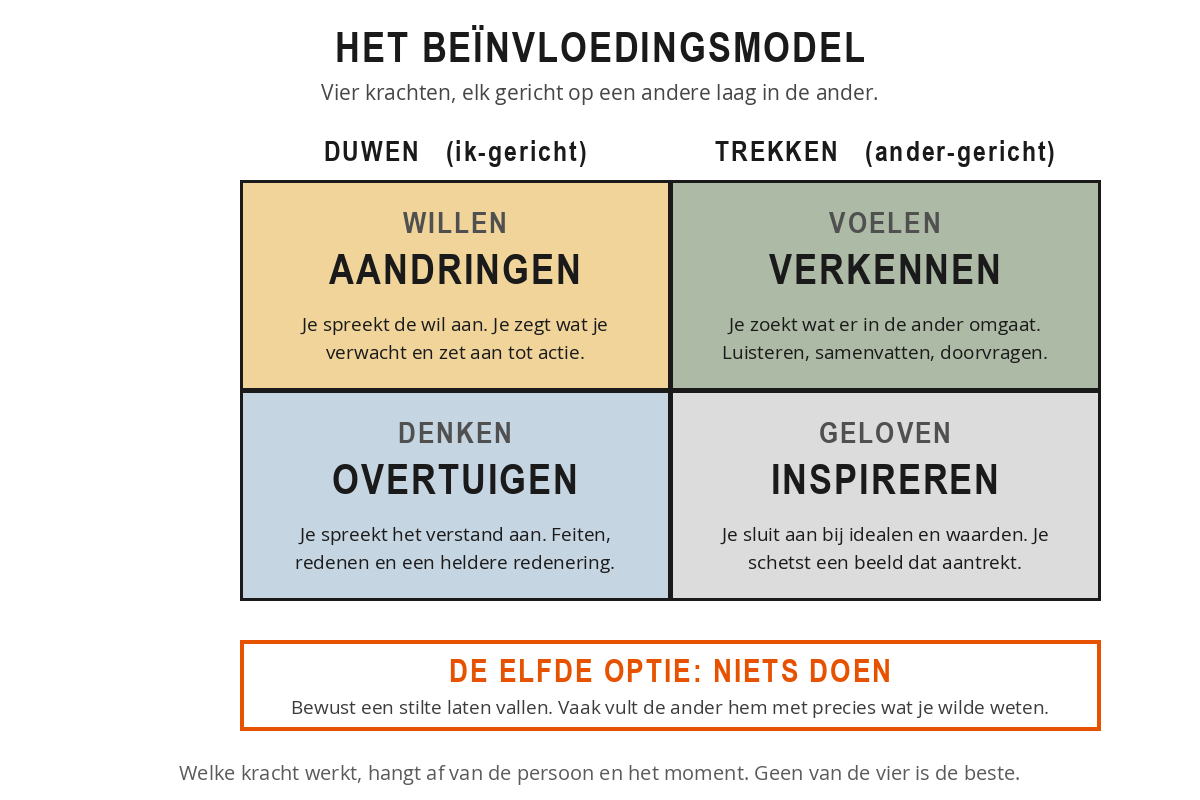
These are the four forces. Wanting: you focus on the other person's will, you prompt action and make clear what you expect. The accompanying skill is called asserting. Thinking: you address the intellect, you build an argument and let the facts speak. That skill is called persuading. Feeling: you focus on what is going on inside the other person, you put yourself in their position and look for what drives them. That skill is called exploring. Believing: you focus on ideals and values, you sketch a picture of the future and connect your message to something bigger. That skill is called inspiring.
Wanting and thinking are on the push side: you bring something towards the other person. Feeling and believing are on the pull side: you draw the other person towards you. That does not mean one is better than the other. What works depends on the situation and on the person in front of you. In chapter 3 you will see how to make that choice.
Suppose you want a colleague to take over a case from you. Do you opt for wanting, you say: "I want you to complete this file this week." If you choose thinking: "If you take this on, we'll meet the deadline and avoid the four thousand euro fine." If you choose feel: "What do you need to get this finished by Friday?" And do you opt for believing: "This case will make the difference to the way our clients see us." The same question, four times, with four different forces.
Asserting: the power of wanting
Insisting is the skill with which you address the other person's will. You make clear what you expect and you prompt someone into action. You don't wrap your message in hints and you don't wait to see whether the other person picks it up. You say what needs to happen.
Asserting leans heavily on push energy. You put something forward, you make a statement, you steer the situation in one direction. Short, active sentences. Daring to say "I want". It works well when time is short, when expectations need to be clear, or when the other person needs clarity. It works badly with someone who is already motivated and mainly wants room to move, because then asserting quickly feels patronising.
Do you notice that you soften your assertiveness with words like "actually", "maybe" or "if it works out"? That takes the force out of it. Asserting thrives on clarity. Say what you want and leave out the softeners.
Persuading: the force of thinking
Persuading is the second force on the push side. Where insisting addresses the will, persuading focuses on the intellect. You build an argument and let the other person arrive at the conclusion themselves through logic and facts.
Persuading also works from push energy, but more calmly. You don't steer with "I want", but with "look at these figures". You lay out your arguments, you back them up and you show why your proposal makes sense. Strong arguments are concrete, verifiable and relevant to the other person. Persuading works well with someone who is open to arguments and wants to understand for themselves why something is a good idea. It works badly when the objection is not in the head but in the feelings. You then pile argument upon argument while the real hesitation comes from somewhere else.
Ilse is advising a client who is hesitating about an eighty thousand euro investment in a new machine. She says: "This machine pays for itself within eighteen months. After that it saves you around twenty thousand euros a year in maintenance. And the downtime you have now, on average three days per quarter, almost completely disappears." Ilse pushes with facts and figures and lets the client do the sums themselves. Nowhere does she say "you have to do this".
More arguments do not make your case stronger. Three good arguments are more convincing than ten weak ones, because every weak argument gives the other person an easy target. Choose your two or three best points and work them out properly.
Exploring: the force of feeling
On the push side you put something forward. On the pull side you do exactly the opposite: you focus on the other person and try to understand what is going on. Exploring is the force with which you sense what the other person wants, thinks and feels. That sounds soft, but it is a powerful skill. Someone who feels understood is far more open to what you bring to the table.
The tools of exploring can be summed up in three steps that you go through again and again. Listening: you give the other person your full attention and hold back your judgement for a moment. You don't interrupt and you don't fill in beforehand what you think the other person is going to say. Silence is your friend here. Summarising: you give back in your own words what you have heard. That shows you are listening, and it immediately checks whether you have understood correctly. The other person can correct you if you miss something. Asking follow-up questions: you dig deeper with open questions. Questions that begin with what, how or why yield more than questions the other person can only answer with yes or no.
Together those three steps make sure you do not stay at the surface. You get to the other person's real interest, and you will need that interest later when you look for an outcome that benefits you both.
Probing often fails because people ask leading questions. "You think this is a good idea too, don't you?" is not exploring, that is pushing in disguise. Ask your question genuinely openly, and be prepared to hear an answer you hadn't expected.
Inspiring: the power of believing
The fourth force is inspiring. Where exploring focuses on what the other person wants, inspiring addresses what the other person believes. You connect your message to a bigger whole: a vision, a value, a shared ideal. You don't draw the other person forward with questions, but with a picture of the future that appeals. People then start moving because they want to themselves, not because you are pushing.
Three things make inspiring powerful. Firstly, a clear picture of the future: you set out concretely what the situation looks like if it works. A vague "things will improve" touches no one; a picture the other person can see does. Secondly, connecting to values: you connect with what the other person considers important. If someone values craftsmanship, you link your proposal to that. Thirdly genuine enthusiasm: your own conviction is infectious. The fact that your words, posture and tone match is what makes the difference here. Anyone who doesn't believe what they are saying inspires no one.
Tarik is leading a project that has overrun and his team has had enough. He could press for more hours, or persuade with a schedule. Instead he says: "I can see us being the first team in six months' time to pull this off. Not because we have to, but because we show that it can be done. That is exactly the kind of work we are good at." He does not insist and he does not argue; he sketches a picture the team wants to commit to.
The eleventh option: doing nothing
Around the four skills sit another six supporting techniques, such as listening, summarising and probing, and together these make up the ten influencing skills. But there is one more choice that most people forget: doing nothing. Deliberately holding back your energy and letting the silence do the work.
A strategic silence is not a weakness and not a lack of an answer. It is an active choice to say nothing for a moment and leave the space to the other person. After a question, after a proposal or after an awkward remark, silence gives the other person the chance to move of their own accord. Often they fill that silence with exactly the information you needed. Doing nothing also means not answering every push with a counter-push. If someone puts you under pressure and you don't react immediately, you take the tension out of the game and you decide yourself when and how you respond.
Silence feels longer than it is. Three seconds seem like an eternity, but for the other person it is simply a pause. Calmly count to three in your head before you give in to the urge to fill the silence.
Choose a conversation from your own practice in which you wanted to get something done. Go through the four forces and briefly write down for each force how you could have used it:
- Asserting: which wish could you have expressed directly and concretely?
- Persuading: which argument could have struck a chord with the other person?
- Exploring: which open question would have brought the real interest out into the open?
- Inspiring: which shared picture or which value could you have appealed to?
Then think of one moment when doing nothing would have been the better move. Describe the situation and what the silence could have gained you.
Summary
- The four forces are wanting (asserting), thinking (persuading), feeling (exploring) and believing (inspiring).
- Asserting and persuading are on the push side. Asserting appeals to the will with short, clear sentences; persuading appeals to reason with facts and arguments.
- Exploring works from pull energy. Through listening, summarising and asking follow-up questions you get to the other person's real interest.
- Inspiring addresses what the other person believes: a clear picture of the future, alignment with their values and genuine enthusiasm.
- Persuading does not work when the objection lies in the feelings; you are then stacking arguments on the wrong layer.
- Alongside the ten skills there is an eleventh option: deliberate silence. That gives the other person room to move and takes the tension out of the conversation.
A colleague nods at all your arguments and then says: "It all sounds logical, but I would rather do it my own way." Which force have you probably chosen wrongly?
Which three steps does this chapter link to exploring?
A colleague asks a pointed question in the meeting and looks at you challengingly. According to this chapter, what is the eleventh option?