


1. Attention and concentration
Without attention, information does not come in, and what does not come in cannot be retrieved later. Attention is therefore the first link in everything to do with remembering and thinking. This chapter is about that link: how it works, where it leaks away in an ordinary workplace, and how to deliberately set it on one thing a few times a day.
After this chapter:
- You know why much "forgetting" is in reality never-stored.
- You know the difference between registering and perceiving.
- You can explain why suppressing distraction costs you capacity.
- You recognise the five sources of distraction in your own workplace.
- You can build a block of attention that you actually finish.
Perceiving is not the same as registering
Someone introduces themselves, and thirty seconds later you have lost the name. Most people put that down to their memory. Yet that was not where the problem lay. At the moment the name was mentioned you were busy with your own opening line, with the question of whether you were shaking hands correctly, with the email still open on your phone. You heard the name, but you did not perceive it. Nothing was ever stored, so there is nothing to retrieve.
Your senses register on their own. Perceiving means that your attention has rested on something for a moment, long enough to do something with it. That "something" need not be large. Repeating the name once in your first sentence is already enough to start a trace.
If you want to know whether something has come through, do not check whether you heard it, but whether you can retell it. Close a meeting with one sentence for yourself: what has just been agreed here, and what is my first action? If you cannot complete that sentence, you have been looking on without perceiving.
Jasper sits in a project meeting lasting an hour and a half and scrolls through his diary in between. Afterwards he knows that the planning was discussed, but not what was decided. His colleague Nadia put her phone face down and wrote two words down at every decision. She can still recount the meeting the next day. They spent the same amount of time in the same room. The difference is not in their memory, but in what their attention let through.
Your attention is a beam, not a pie
Selective attention is your ability to follow one stream of information and actively suppress the other streams. The word "actively" is the key. Ignoring distraction does not happen by itself; your brain uses capacity to keep the competition outside the door.
The familiar example is a busy party. You follow the conversation with the person opposite you, while ten conversations are going on around you at the same time. That works, and yet you hear it when someone behind you says your name. So the streams you are not following are not switched off, but scanned along at low volume. Anything personally relevant still pulls the gate open.
Attention behaves like a narrow beam of light, and three practical properties follow from that. The bundle is narrow: you can follow at most one meaningful stream closely. Following two conversations at once does not work; you jump back and forth and miss parts of both. Focusing costs energy: the more competition there is outside the bundle, the more capacity leaks away into suppressing it. In a noisy room you work on the same task with less room in your head than in a quiet room. And outside the beam, nothing lasting happens: what you suppress is not stored. You cannot fall back afterwards on "it was there".
That third property makes multitasking untenable as a solution. You do not split your attention into two half beams, you move one, over and over again. Every jump costs you the state of where you were, and you have to rebuild it. In chapter 2 you will see exactly what that does to your working memory.
Five sources of distraction
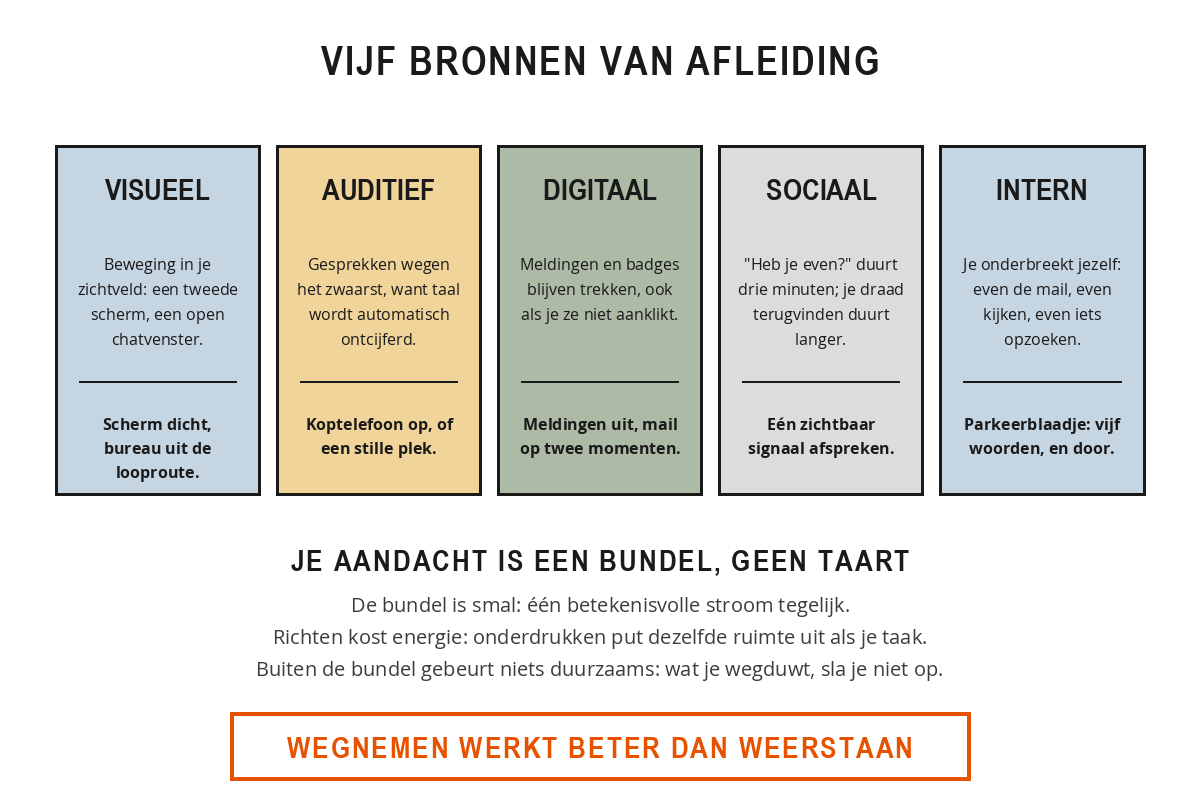
In an average workplace, stimuli come in through five channels, and they do not all ask the same of you.
- Visual: movement in your field of vision pulls your attention open. Colleagues walking past, a flickering second screen, a chat window left open in the corner.
- Auditory: conversations are the heaviest category, because language is deciphered automatically. Noise without words, such as a fan, drops out of your awareness after a minute.
- Digital: notifications are designed to score on personal relevance and change. A badge with a number in it keeps tugging at you, even if you do not click on it.
- Social: a colleague who asks "have you got a minute?" interrupts you at a moment you did not choose. The question takes three minutes, finding your thread again takes longer.
- Internal: a large share of the interruptions comes from yourself. You open your mail for no reason, you remember something you still had to arrange, you check whether that one reply has come in yet.
That last one is the largest for most people, and at the same time the least visible.
Sanne, an adviser at a local authority, kept track for three working days of when she strayed from her task. She arrived at 41 interruptions: an average of fourteen a day, so roughly one every half hour. Of those 41, 9 came from a colleague at her desk, 7 from notifications and 25 from herself: opening the mail for a moment, checking whether a reply had come in, looking up something that had nothing to do with her task. She had already set her chat programme to silent and thought that had taken care of it. When she closed her mail programme completely during two blocks a day and put a sheet of paper beside her for stray thoughts, she went down to 23 interruptions the following week.
Removing works better than resisting
Every stream you push away draws on the same capacity as the task itself. Resisting distraction therefore costs you exactly what you need for your work. Removing distraction costs one action, once.
External sources are solved with a one-off measure of this kind: notifications off, mail programme closed, headphones on, your desk turned a quarter so that you are not looking at the walkway. Internal sources are solved differently, namely by giving them a place. Whatever comes up and does not belong now goes onto a sheet of paper beside you in five words, and thereby leaves your head. That sheet is not a task list, it is a parking space; you clear it at the end of the day.
Agree on one visible signal with your team to show that you are in a block: a sign, a colour in the diary, a status in the chat. A signal everyone knows saves you the awkwardness of explaining each time that you are busy.
Working in attention blocks
An attention block is a period with a beginning and an end during which you work on one task chosen in advance and keep all the entry points closed. It is not a good intention but an appointment with a time attached. Twenty minutes that you see through to the end yield more than an hour you interrupt five times.
- Choose the task before the block begins and write down in one sentence what has to be finished by the end.
- Place the block in the part of the day when thinking work comes most easily to you.
- Close everything that can produce a notification and put your parking sheet ready.
- Set a timer for a duration you are sure you can sustain. Twenty to twenty-five minutes is a realistic start.
- Finish with a single line: where do you stand, and what is the next action? That line is your starting point for the next block.
- Only extend the duration once three blocks in a row have worked, and then by five minutes at a time.
Between the blocks there should be recovery, and that requires a low stimulus load. Scrolling through your news or your chat feels like a break, but demands exactly the same selective attention as your work. Recovery comes from something else: looking outside for a moment, taking a walk, fetching coffee without your phone, two minutes with your eyes closed. Five to ten minutes after a block is usually enough, and after three blocks a longer interruption helps.
Design your block day for tomorrow, and write it down before the day begins:
- Between which times does thinking work come almost by itself for you?
- Block 1 and block 2: task, start time, duration, and the result in one sentence.
- Which three entry points do you switch off or close before you begin?
- What do you do in the break after each block, without a screen?
- At which two points in the day do you bundle your email and chat?
Look back at the end of the day: which blocks did you manage, and what broke the block that failed? That last question usually produces the intervention for the following week.
Summary
- What you do not perceive is not stored. Much of what we call "forgetting" never came in at all.
- Your senses register on their own; perceiving requires your attention to rest on it for a moment.
- Attention is a narrow beam that you move, not something you divide. Suppressing costs capacity from the same space as your task.
- Distraction comes from five directions: visual, auditory, digital, social and internal. The last of these is usually the largest.
- Removing works better than resisting: external sources you shut off, internal sources you park on paper.
- An attention block is one task, a timer, all entry points closed, and a closing line. Build up the duration step by step.
- Recovery requires a low stimulus load. A break with a screen restores nothing.
Within half a minute you have lost the name of someone who has just introduced themselves. According to this chapter, what is the most likely explanation?
Why does working in a noisy room cost you more than working in a quiet room, even if you ignore the noise?
You notice that you keep opening your email yourself while working on a report. What is the approach that matches this source of distraction?