


2. Working memory
What you heard half a second ago is already gone, unless it came through the gate of your attention. What happens next to those few chunks of information determines how much you retain of a conversation, an instruction or a calculation. This chapter is about that small space in which you hold several things at once, and about why it fills up so quickly.
After this chapter:
- You know the difference between passively holding on and actively processing.
- You know how long information sticks without repetition.
- You recognise the capacity limit of a handful of units in your own work.
- You can explain how displacement occurs and which situations trigger it.
- You have six ways to lighten the load on your head, and you know which one suits you.
The first place where you notice that you know something
Your short-term memory is the first place where you notice that you know something. Everything that comes before that happens outside your awareness, but as soon as information has passed the gate it ends up in a space where you can hold on to it and where you can also lose it. Someone gives you a telephone number, you repeat it under your breath, and ten seconds later it is still in your head.
Without that repetition, that space holds information for some fifteen to thirty seconds. After that, the trace fades. You walk to the printer with a file name in your head, someone asks you something on the way, and at the printer you no longer know what you came to collect.
Short-term memory and working memory are not two separate systems, but two sides of the same space. The difference lies in what you do with the information. With holding on passively you keep the information as it came in: repeating a postcode back, parking a name for a moment, repeating a row of figures until you have typed them in. With working on it actively you hold on to the information and do something with it at the same time: you add up amounts in a table, you reverse a set of directions in your head, you compare what the speaker is saying now with what they claimed three minutes ago. That second one costs noticeably more, because processing takes up the same space you use to hold on. Anyone who tries to follow the discussion, take minutes and check the sum on the third sheet all at once in a meeting will find that something drops out.
Do you find yourself having to ask for an instruction to be repeated again and again? Usually that is not poor attention but a space that was full. Write down the first step as soon as you hear it. That takes it out of your head and makes room for the rest.
A handful of units, and whatever comes in pushes something out
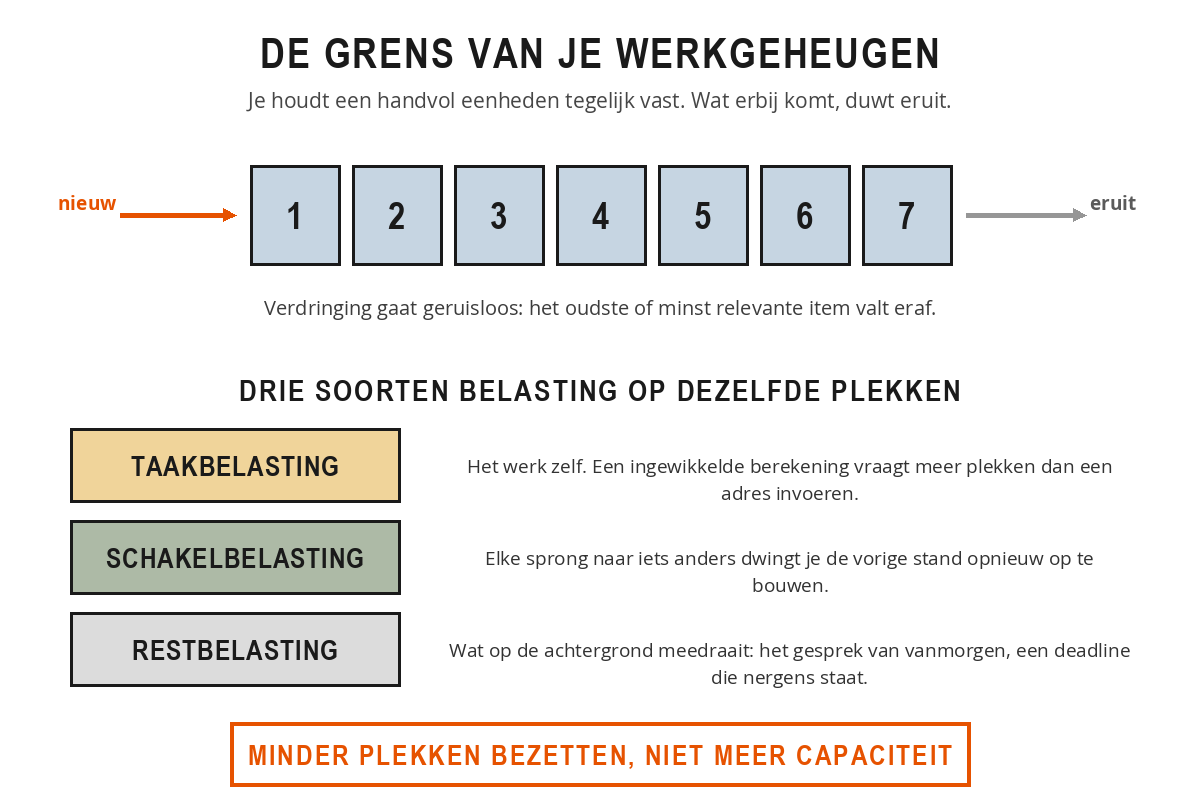
In classic research the limit came out at seven units, with a margin of two either way. More recent estimates put it at four to five. The exact number matters less than the order of magnitude: you hold on to a handful of things at once, not twenty.
A unit is not the same as a letter or a digit. The sequence 0-6-2-4-8-1-9 consists of seven units. If you recognise an area code plus four digits in it, there are only two. So how you group information determines how much fits in. That is precisely why a telephone number is written in blocks and not as a single string.
If that row is full and something new comes in, something else disappears. This is called displacement. There is no queue and no warning: the oldest or least relevant item simply drops out, and usually you only notice at the moment you need it. That is why interruptions are so expensive. You are in the middle of a calculation with five interim values in your head, a colleague asks a quick question about something else, and twenty seconds later you are back at your screen without those five values. You do not start where you left off, but a good way before that.
Jasper is checking an invoice line and is holding on to three things: the amount excluding VAT of 4,280 euros, the agreed rate of 95 euros per hour, and the question of whether the March hours had already been invoiced. Then a chat message comes in asking whether he can move Friday. He replies within twenty seconds. Back at the invoice, he still knows the amount but no longer the rate. The question about March has disappeared altogether, and it only resurfaces two weeks later when the client emails about it.
Three types of load in the same places
Your working memory gives no error message and does not slow down. It quietly discards whatever no longer fits, and you only notice when you need something that is no longer there. Three kinds of load fill those slots between them.
- Task load is the work itself. A complicated calculation demands more slots than entering an address.
- Switching load comes on top as soon as you jump back and forth. Every jump forces you to rebuild the previous state.
- Residual load runs in the background: this morning's conversation that was left unfinished, the deadline that is not written down anywhere, the chatter behind you. That can already have taken up a fair amount of your space before you even start your task.
You can recognise overload by a few signals that look harmless. You read the same paragraph three times and none of it sticks, because there is no free place in which to build up the meaning. You forget the attachment or skip a field in a form you have filled in a hundred times. You hear a name during an introduction and ten seconds later it is gone. You take the first solution that works instead of weighing up three options, because comparing takes up space that is not there. And small decisions keep being put off, because you cannot line up the consequences side by side.
Those last two show what makes overload expensive. You are not thinking less well because you are less able, but because your workbench is full.
You often notice overload most sharply in your mood. Becoming irritable over something small is frequently not a matter of character and not fatigue, but a full working memory. That is the moment to take something out of your head, not to push on harder.
Unloading: occupying fewer places
The limit cannot be stretched. What you can do is occupy fewer places. Anything that is reliably stored outside your head no longer has to be held in your working memory. Six ways, from light to heavier:
- One parking spot for stray thoughts. A notepad beside your work or an open notes file. Anything that comes up and does not belong now goes there in five words.
- Writing down intermediate results. If you are working on something with several steps, write down each intermediate result straight away. Displacement can then no longer do any harm.
- A ten-second landing spot. If you are interrupted, write down where you were and what your next action was going to be before you look up.
- Checklists for recurring work. A fixed list for your month-end close or your handover takes the whole procedure out of your head.
- One external place for all agreements. As long as you have to remember where something is, the residual load remains.
- Repeating spoken information back out loud. Repeat a name or arrangement back straight away: "So Tuesday before twelve, with Karin." You confirm it and you fix the trace.
Miriam does the month-end close of the accounts every month: eleven operations in a fixed order, spread across three systems. She did this from memory for years and would discover two or three times per close that she had forgotten something, usually only after a phone call from a colleague. She wrote the eleven steps down once and now ticks them off. The close does not take less time, but since that list she has not skipped a single step. The gain is not in time, but in the slots she no longer occupies with remembering where she was.
Draw up your own plan for lightening the load in the week ahead:
- What is constantly running in the background for you? Note down your biggest source of residual load.
- Where will you put stray thoughts? Name the notebook or the file.
- Which multi-step task are you going to do this week with the interim results on paper?
- Which recurring task will you write a checklist for?
- At what point in the day do you clear your parking list?
Alongside this, keep a record for one day of when you are interrupted, what you were working on, what you lost and how many minutes it took to get back. Add up those minutes at the end of the day. That figure is usually the most convincing argument for changing something.
Summary
- Without repetition, information stays for fifteen to thirty seconds.
- Holding and processing take place in the same space; processing costs more.
- The limit is a handful of units. Classically seven plus or minus two, more recent estimates four to five.
- A unit is whatever you recognise as one thing. Grouping increases how much fits in.
- Displacement is silent: whatever comes in pushes the oldest item out, without warning.
- Task load, switching load and residual load fill the same slots between them.
- You notice overload in rereading, careless mistakes, names that have vanished, taking the first solution that comes along and decisions that keep being put off.
- The way out is not more capacity but fewer occupied places: a parking list, intermediate results, landing spots, checklists, one external place and repeating things back out loud.
The sequence 0-6-2-4-8-1-9 contains seven units, but for someone who recognises an area code plus four digits in it, only two. What does that show?
What happens to your working memory the moment a colleague asks you a quick question in the middle of a calculation?
You notice that by late afternoon you keep rereading the same paragraph and making careless mistakes. What is the approach that fits this chapter?