


Introduction
You hear a name and thirty seconds later it is gone. You read the same paragraph for the third time and none of it sticks. You are in the middle of a calculation, a colleague asks something small, and afterwards you have to go back a fair way. That feels like a poor memory, but usually it is something else: your attention was elsewhere, or your working memory was full.
This free course is about those two things, and about what you do about them. Not about more hours or a tighter schedule, because that is what our free time management course is about. Here it is about what comes in, what you hold on to and what you retrieve.
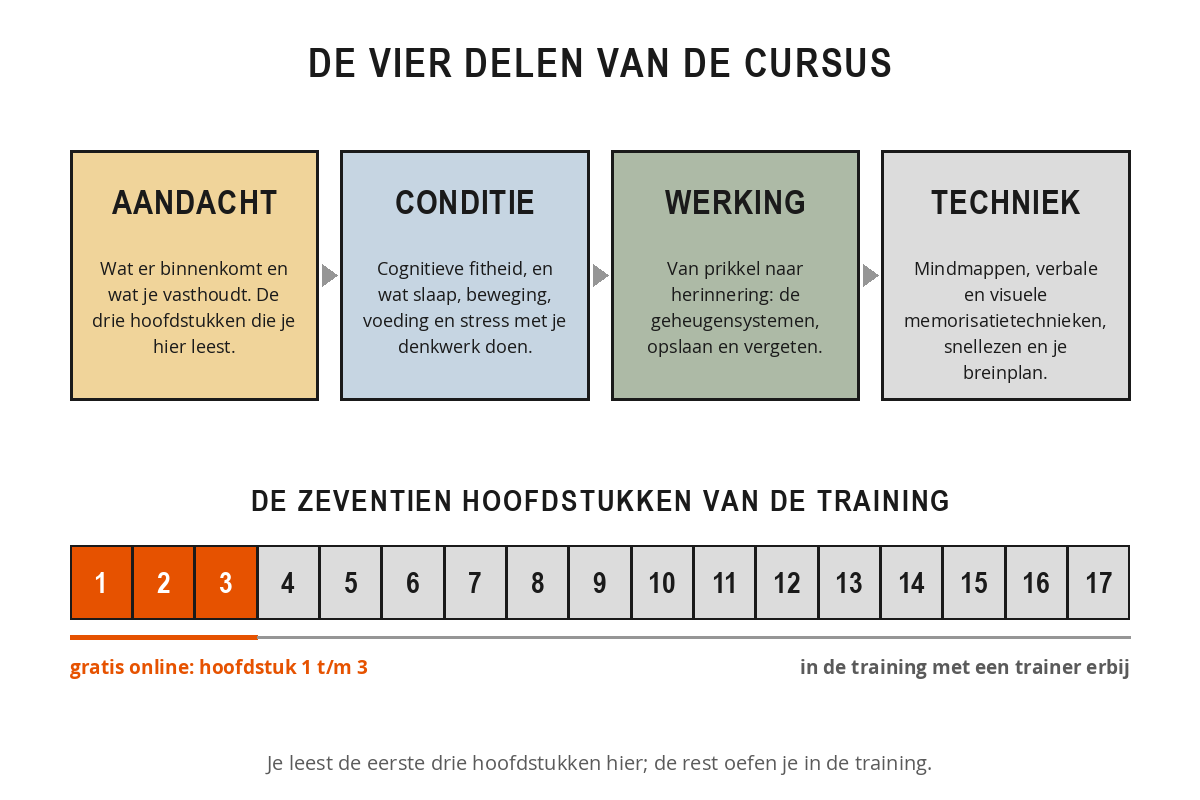
This free course contains three chapters: the orange part of the bar above. At the bottom of chapter 3 you will find the full course.
What you will learn
In chapter 1 you look at attention. You read why you can only remember what you have taken in, where your attention leaks away in an ordinary workplace, and how to divide a working day into blocks that you actually finish. Chapter 2 is about your working memory: the small space in which you hold a handful of things at once, how that space fills up and how you keep it clear. In chapter 3 you are given a technique that is already two thousand years old: the Roman Room method, with which you remember a list of ten points by placing them in a room you know from the inside.
The common thread: your memory rarely fails because it is too small. It fails because too many things are competing for space at once, or because something never came in properly.
How the course is structured
The full course runs through four parts. You start with attention and memory in practice, the three chapters you are reading here. After that comes your brain in shape: cognitive fitness, and what sleep, exercise, nutrition and stress do to your thinking. Then how memory works: from the first stimulus to a memory that stays with you for years. And finally the techniques: mind mapping, verbal and visual memorisation techniques and speed reading, concluding with your own brain plan. Every chapter contains theory, a diagram, examples from practice and an exercise you apply to your own work.
Practical tips for use
- Keep a notepad or a blank document to hand. The exercises only work if you actually complete them.
- Apply everything to your own material. Remembering a shopping list from a book is nice enough, but your own presentation or professional literature yields more.
- Practise briefly and often. Ten minutes a day does more than two hours on a Saturday.
- Don't read it all in one go. One chapter a week, with time to try things out, sticks better.
- Note down what strikes you and what you want to try out. Those notes will form the basis of your own brain plan.
Each chapter ends with a short knowledge check of three questions: answer them correctly to mark the chapter as completed. Your progress is saved automatically in your browser.
Enjoy the read. And above all, do the exercises, because that is where the difference lies between reading about remembering and actually remembering better.