


Introduction
An invoice to a customer in Antwerp, a pallet to a wholesaler in Poland, a piece of advice for a Danish group. As long as you work within the Netherlands, the VAT question is short: which rate do I put on the invoice? As soon as a border comes into play, that question changes. First it becomes a matter of which country is allowed to tax, and of who accounts for the VAT. Only after that does the percentage come in.
Anyone who reverses that order and looks straight at the rate skips the step where most additional assessments arise. The annoying part is that you rarely notice it straight away. An invoice with 0% goes out, the customer pays, the goods arrive, and years later an inspector asks why there was no VAT on it. The answer then has to come from your file.
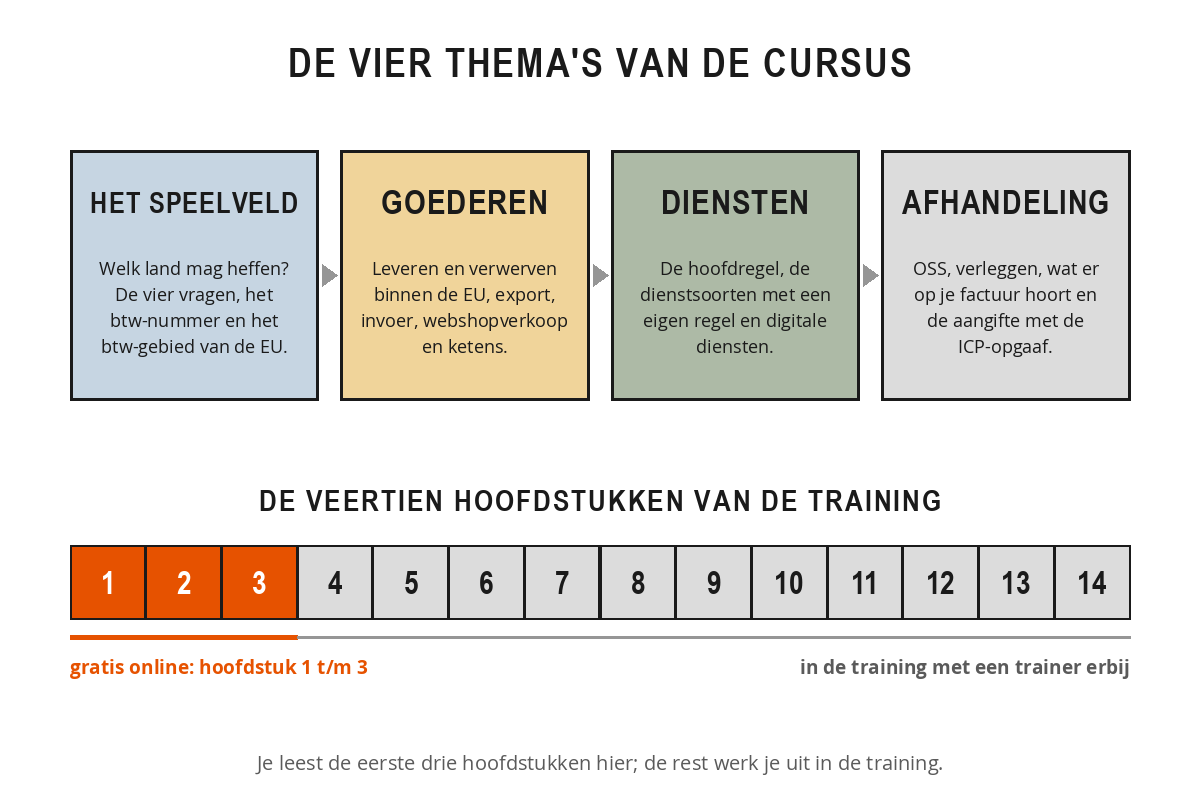
This free course contains the first three chapters: the orange part of the bar above. At the bottom of chapter 3 you will find the full course.
This course explains how to take a cross-border transaction apart. It is not tax advice. The rules differ from situation to situation, and what applies to one supply does not automatically apply to the next. Everything you read here is in the syllabus of the training course; no rates, thresholds or deadlines have been added to it. If you want to know what applies to your own invoices, put them to your tax adviser or to the Dutch Tax Administration.
What you will learn
You learn the four questions with which you take apart any cross-border transaction, in the order in which you ask them. You learn what the place of supply of goods and the place of supply of services mean, and why those two determine which country has the right to tax. You work through the four conditions under which you may invoice a supply to a business customer in another member state at 0%, and you see what happens when one condition falls away. And you get to know the general rule for services, with determining your customer's status as the pivotal point.
The full training course then goes on to cover the purchasing side, export and import, sales to private individuals in other member states, chain transactions, the types of service with their own rule, digital services, the OSS scheme, the reverse charge, what belongs on your invoice and the reconciliation between your general ledger, your return and your EC Sales List.
How the course is structured
The course follows four themes that build on one another. You start with the playing field: which country may levy the tax, and how you can tell. After that comes the movement of goods: supplies and acquisitions within the EU, exports, imports and chain transactions. Then the services, with the general rule as the starting point and the exceptions as a necessary addition. And finally the handling: the OSS scheme, the reverse charge, your invoice and your VAT return.
Every chapter follows the same structure. You get the rule, a worked example with specific countries and amounts, and an exercise in which you determine the place of supply or service yourself. The examples have been kept recognisable, so that you can set them alongside your own files.
Practical tips for use
- Keep a blank document to hand. The exercises only work if you really enter your own transactions in them.
- Take three transactions from your own practice as fixed examples. You go through them again in all three chapters, adding more detail each time.
- Don't read it all in one go. One chapter at a time, with time to set it alongside your own files, gets you further.
- Note down any questions that come up along the way on a separate list. That list will later be your agenda for the conversation with your adviser or with the trainer.
- For each chapter, check whether you can support the conclusion with a document. Where you can't, that is where your risk lies.
There is one question that unlocks almost every case: is your customer a business or a private individual? As soon as you answer that question, more than half of the possible rules drop away. For goods, a second question helps: where does the transport begin and where does it end?
Each chapter ends with a short knowledge check of three questions: answer them correctly to mark the chapter as completed. Your progress is saved automatically in your browser.
Enjoy the read, and above all: enjoy the files that add up afterwards.