


1. The four questions for every cross-border transaction
Every international VAT case breaks down into the same four questions. They come in a fixed order, because the answer to one question determines the next. That sounds laborious when you are in a hurry, but it is in fact the quickest route: after question two, more than half of the possible rules have usually already dropped away. This chapter sets out the four questions and shows which evidence you put in your file for each answer.
After this chapter you can:
- Name the four basic questions you ask for every cross-border transaction.
- Explain what the place of supply of goods and the place of supply of services mean and why they are decisive.
- Substantiating the distinction between a B2B and a B2C transaction with your customer's VAT identification number.
- Verifying a VAT number via VIES and describing what you do with the outcome.
- Identify which territories do and do not belong to the EU VAT area.
This chapter gives you an order of reasoning, not tax advice. The rules differ from one situation and one type of supply to another. Put your own transactions to your tax adviser or to the Belastingdienst before you send out an invoice without VAT.
The four questions, in this order
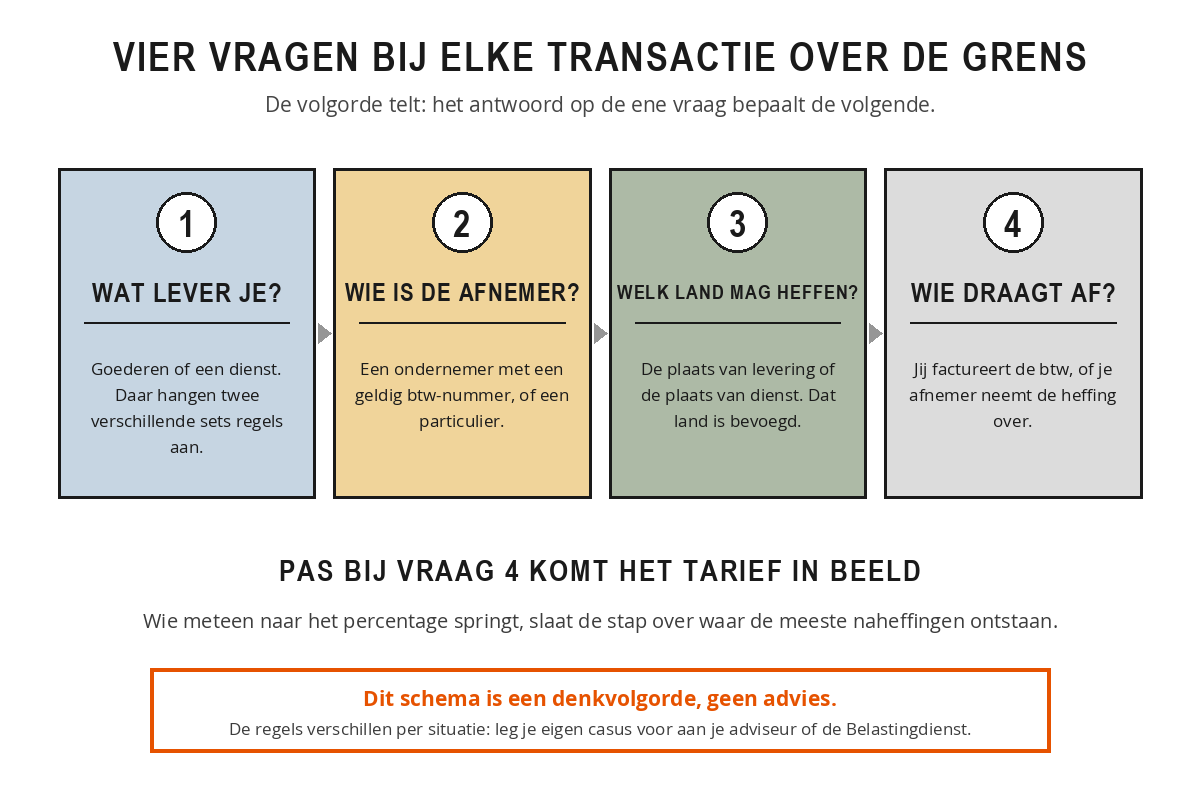
Question 1: goods or services? Different rules apply to goods than to services. A machine travelling from Rotterdam to Milan falls under the supply-of-goods rules. Maintenance on that same machine on site falls under the services rules. If you supply something that involves both, you determine which is the principal service.
Question 2: who is the customer? A business with a valid VAT identification number is treated differently from a private individual or a non-business. In practice you call that B2B and B2C. This distinction carries through into virtually all the follow-up questions, and it is the question that takes up the most time.
Question 3: what is the place of supply of the goods or services? That is the legal place where the supply is deemed to take place for VAT purposes. That country may levy the tax. It is emphatically not an address on a packing slip.
Question 4: who accounts for the VAT and at what rate? Only at this point does the rate come into play, together with the question of whether you charge the VAT or whether your customer accounts for it under the reverse charge.
Place of supply of goods and place of supply of services
The place of supply is a tax concept. It is the country that, under the law, has the right to levy tax on a supply of goods. For goods that are transported, that place is in principle where the transport begins. If the goods leave your warehouse in Tilburg, the Netherlands is the place of supply, even if the customer is in Portugal.
The place of supply works according to its own logic. For a service to a business, the main rule is that the service is taxed in the country where the customer is established. For a service to a private individual, it is in principle the country of the supplier. There are exceptions to both main rules per type of service; chapter 3 sets out the main rule and the course then goes into the types of service with their own place-of-supply rules.
Design studio Vier Hoog in Utrecht creates a corporate identity for a Belgian construction company, for an amount of € 14.000. The client is a business, so this is a B2B service and the place of supply is Belgium. Belgium has the right to levy the tax, not the Netherlands. A few months later, that same studio creates a corporate identity for a private individual in Antwerp, for € 2.400. Now the place of supply is the Netherlands and the studio charges Dutch VAT. The same work, the same city, and yet a different outcome. The only difference lies in the customer.
B2B or B2C: what the VAT identification number decides
The VAT identification number is the piece of evidence with which you demonstrate that your customer is acting as a business. It consists of a two-letter country code followed by a series of digits and letters. Each member state has its own format. A Dutch number consists of NL, nine digits, the letter B and two check digits. A German number has DE plus nine digits, a Belgian number BE plus ten digits.
In the Netherlands you have two numbers side by side, and they are regularly mixed up. You use the turnover tax number in your dealings with the Belastingdienst, for instance when filing your return. You use the VAT identification number externally: on your invoices, on your website and in cross-border transactions. If you accidentally put the wrong number on an invoice to a foreign customer, your customer cannot verify it and discussion arises about how the transaction should be treated.
A number that your client sends you by email is not evidence, incidentally. It is a statement. It only becomes evidence once you have verified it yourself and recorded that check.
Check via VIES
VIES stands for VAT Information Exchange System, the European Commission's verification service. You enter a country code and a number, and the system tells you whether that number is valid at that moment. For a number of member states you are also shown the name and address associated with the number, so that you can compare them with your customer's details.
This is how to record a check properly. You consult the number at the moment you accept the order, not only when drawing up the invoice. When making the enquiry you also enter your own VAT identification number, because that gives you a consultation number in return. You store that consultation number, together with the date and the details returned, in the customer file or with the order. For regular customers you repeat the check periodically, for example every quarter or with each new framework agreement. And in the event of a rejection you note down what you have done: made contact, received a new number, checked again.
The result of a check is a snapshot. A number that is valid today may have been withdrawn three months from now because the customer has ceased trading or been taken over. A single check when you enter into the relationship is therefore too thin if you supply on a monthly basis.
Build the VIES check into your sales process, not into your bookkeeping after the fact. A customer without a valid number at the moment of ordering is a commercial conversation. A customer who turns out to be missing one only at the quarterly return is a correction that costs money.
Wholesaler Terlouw has been supplying machine parts to a Spanish customer for two years, roughly EUR 9,000 per month. The VAT number was checked at the outset and never again after that. The Spanish company is absorbed into a sister company and the old number is withdrawn. Terlouw carries on invoicing to that old number for another eight months. At the next audit, the evidence for the B2B treatment turns out to be missing, even though the goods did indeed go to Spain. The discussion is then no longer about the facts, but about the record keeping. And that record keeping is not there.
The EU VAT area
The VAT territory of the EU does not coincide with the national borders of the member states. A number of territories belong politically to a member state, but fall outside the Union for VAT purposes. If you supply goods there, the export rules apply and not the rules for intra-Community trade, even though formally it concerns Spanish or Italian territory.
The best-known exceptions are the Canary Islands, Ceuta and Melilla, the Åland Islands, Livigno, Büsingen, Heligoland, Campione d'Italia and Mount Athos. The French overseas departments also have their own regime.
What makes this confusing is that the customs territory and the VAT territory do not fully overlap. The Canary Islands, for example, lie within the customs territory of the EU, but outside the VAT territory. A consignment can therefore be a domestic movement in customs terms and an export for tax purposes.
Who accounts for the VAT: the supplier or the customer
With a domestic transaction it is simple. The supplier puts VAT on the invoice, collects it from the customer and pays the amount over. As soon as a transaction crosses a border, that straightforwardness disappears and in many cases the charge shifts to the customer.
The underlying principle is the destination principle: VAT belongs in the country where the goods or services are consumed. That country can organise the charge in two ways. Under tax charged by the supplier the supplier registers in the country of destination, charges the local rate there and remits the VAT there. You mainly see this route with supplies to private individuals, because a private individual does not file a VAT return. With tax levied on the customer the supplier invoices without VAT and the business customer declares the VAT due in his own country.
That second route saves suppliers having to register in every country where they have customers. On the other hand, the burden of proof lies with the supplier. You must be able to demonstrate that your customer is a business and that the supply actually crossed the border. Without that evidence, the liability comes back to you. In chapter 2 you will see exactly how this works out for a supply of goods.
Take three transactions from your own practice, preferably to different destinations. For each transaction, work out:
- What is being supplied or performed, and is it goods or a service?
- Is the customer B2B or B2C, and on what basis?
- Has the VAT identification number been recorded, checked in VIES and documented, with the date and consultation number?
- Which country has the right to tax, and is the destination inside or outside the EU VAT territory?
- Does the liability rest with you or with your customer, and which document in your file supports that choice?
Then mark every transaction for which you cannot support the taxation route with a document. That list is your first concrete point for improvement. Keep the overview, because you will add to it in the following chapters.
Summary
- Four questions, in a fixed order: what are you supplying, who is the customer, which country may tax it, and who pays it over. The rate only comes up at question four.
- The place of supply is a tax concept, not an address. For goods that are transported, it is in principle where the transport begins.
- For a service to a business, the country of the customer levies the tax in principle; for a service to a private individual, the country of the supplier does.
- The VAT identification number is what distinguishes B2B from B2C. The Netherlands has two numbers side by side: the turnover tax number for the Belastingdienst and the VAT identification number for external use.
- A number that has been passed on is not proof. Check it in VIES, request a consultation number, record the date and the outcome, and repeat the check for regular customers.
- The EU VAT territory does not coincide with national borders. The export rules apply to territories such as the Canary Islands or Heligoland.
- The charge lies either with the supplier or with the customer. If you choose the second route, the burden of proof lies with you.
Why do you not begin a cross-border transaction with the question of which rate to apply?
A customer in another member state emails you their VAT identification number. What does that give you?
You ship goods to a customer in the Canary Islands. What does that mean for VAT?