


Introduction
Anyone who opens ChatGPT sees an empty input field and nothing else. The tool can do a great deal, but it doesn't tell you what it can do, nor does it mention when it is wide of the mark. That is why some users drop out again after two weeks: the answers come out quickly, but not in a way that makes you confident enough to use them for work that carries your name.
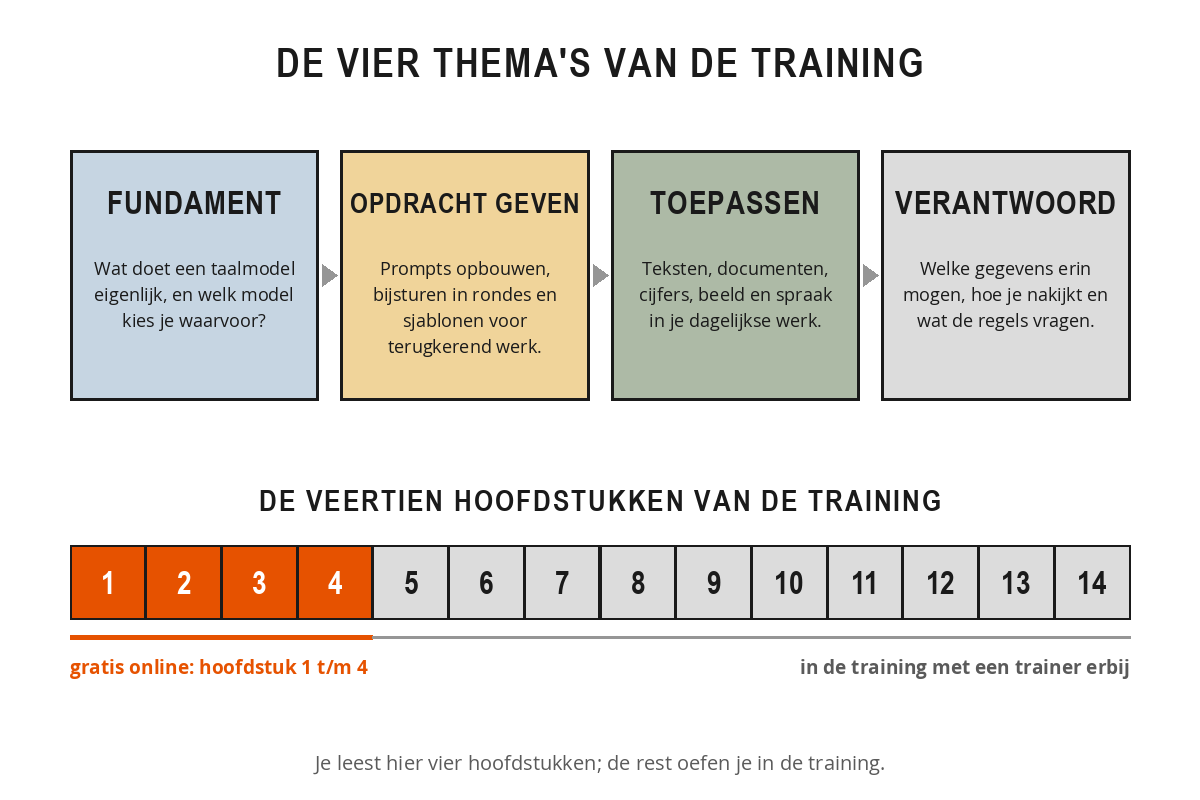
This free course contains four chapters from the course: the orange section of the bar above. At the bottom of chapter 4 you will find the complete course.
What you will learn
You learn to build an instruction from five fixed parts, so that you no longer depend on whether you happened to phrase it well. You learn to steer an answer that is half right in small rounds, instead of starting over every time. You learn to judge which data does and does not belong in an input field, because everything you type leaves your computer. And you learn to check the result in the five places where a language model most often goes wrong. The common thread: the model supplies the raw material, you supply the finished product.
Why these four chapters, and not the buttons
AI tools change in some way every six months. A new model appears, a menu moves, a function is given a different name. What does not change is how you build an instruction so that something usable comes out of it, which data you had better keep to yourself, and what to watch out for when you send the answer out under your own name. That is what these four chapters are about. You will work out the screens for yourself within half a day; the method is what lasts.
How the course is structured
The course follows four themes that build on one another. You start with the foundation: what does such a model actually do, and which model do you choose for what? Then comes giving instructions: building instructions, steering them and techniques for recurring work. Then apply: texts, documents, figures, images and speech. And you finish with working responsibly: data, checking, rules and your own work plan. Each chapter contains theory, a diagram, examples from practice and an exercise that you apply to your own work.
Practical tips for use
- Keep ChatGPT open in a second window while you read. The examples are meant to be tried out straight away.
- Practise with your own material, not with the sample texts. That way the reading immediately produces something you can use.
- Keep your best instructions in a notes file. What worked today will work again in three weeks' time, and by then you will have forgotten how you wrote it.
- Don't read it all in one go. One chapter at a time, with time to apply it, sticks better.
- Start with a task that has little riding on it. An internal summary is better practice than the letter to your biggest client.
Each chapter ends with a short knowledge check of three questions: answer them correctly to mark the chapter as completed. Your progress is saved automatically in your browser.
Enjoy reading, and above all: enjoy the work you will no longer have to do yourself.