


1. The five building blocks of a good prompt
A prompt is the instruction you give to ChatGPT: the text in the input field with which you determine what is going to happen. The difference between an answer you throw away and an answer you can send after two small adjustments almost never lies in the model. It lies in what you have given it.
After this chapter:
- You know the five building blocks that make up a strong prompt.
- You know which building block you are missing when the answer is not usable.
- You can describe context in a way the model can actually use.
- You steer tone with instructions that are measurable.
- You recognise the five mistakes that almost everyone makes at the start.
The model always fills in every gap
This is the principle everything rests on: a language model never leaves a gap open. If you do not name a target audience, it picks one itself. If you say nothing about length, the result will be of average length. If you do not specify a tone, it falls back on a smooth, faintly American corporate style with plenty of adjectives and bullet points. That is exactly the writing style readers have now learned to recognise as AI text.
There are two ways to deal with that. You can repair afterwards what you didn't want, or you can choose in advance. The five building blocks are the five places where you take that choice out of the model's hands.
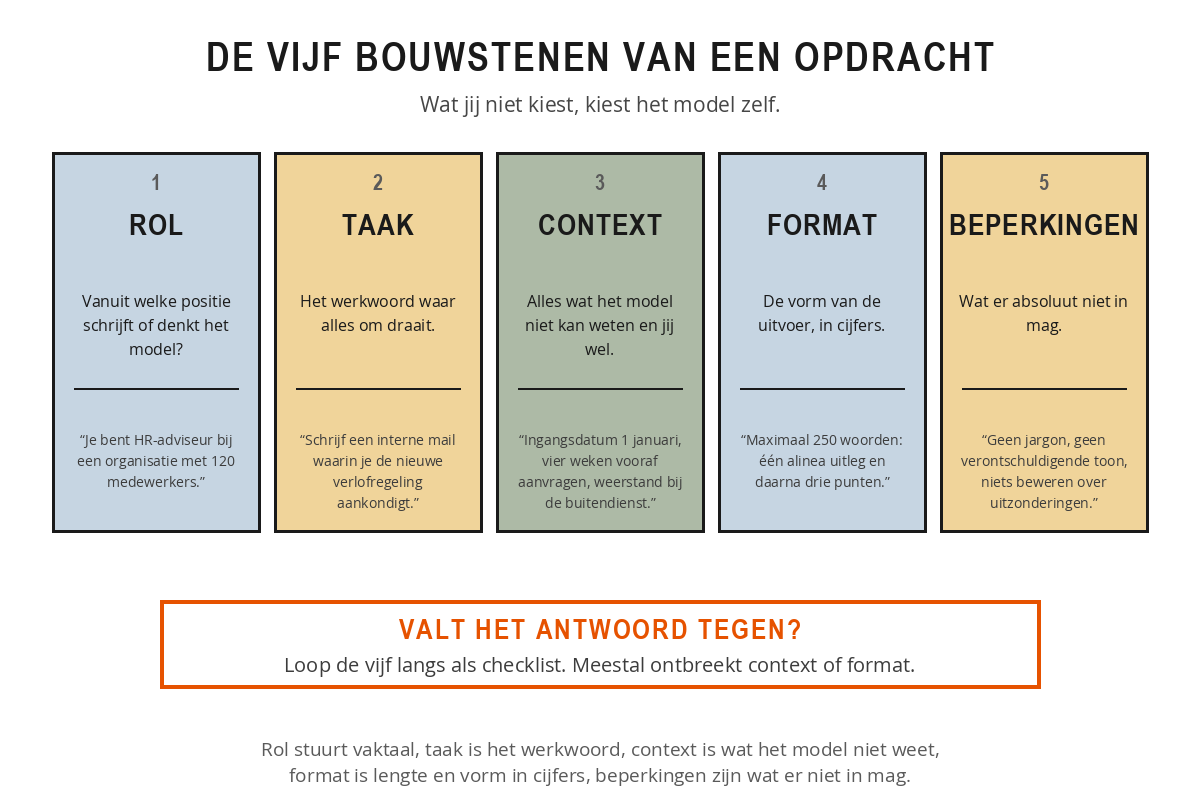
Role. You tell the model what position it is writing or thinking from. "You are an experienced employment lawyer" produces different wording, different caveats and a different structure than the same question without a role. The role mainly steers terminology and angle. It is the building block that makes the least difference, but it also only costs you half a sentence.
Task. The verb everything revolves around: summarise, rewrite, compare, come up with, assess. A vague task produces a vague answer. "Have a look at this text" is not a task. "Extract the three main objections from this text" is.
Context. Everything the model cannot know and you can: who it is intended for, what came before, what decision hangs on it, what sensitivities are at play. This is the building block that is most often missing and that produces the biggest leap.
Format. The form of the output: number of words, table or running text, number of variants, subheadings or not. A tight format also saves you reading time, because you get no more than you need.
Constraints. What absolutely must not be included. No inventing assumptions, no English loanwords, no promises about delivery times, no exclamation marks. Constraints work when they are concrete and not when they describe an atmosphere.
Hanneke works in the HR department of an organisation with 120 employees and has to announce a new leave policy. Her first attempt is: "Write an email about the new leave policy." What comes out is a neat, sugary email that could be about any leave policy at any company.
Her second attempt: "You are an HR adviser at an organisation with 120 employees. Write an internal email announcing the new leave policy. The policy takes effect on 1 January, employees must now request leave four weeks in advance instead of two, and resistance is to be expected from the field service, because they often find out late when a job will finish. Maximum 250 words: one paragraph of explanation followed by three points on what changes in practice. No jargon, no apologetic tone, and no claims about exceptions, because there aren't any yet."
Same tool, same model. The difference lies entirely in the five building blocks.
Context: what the model cannot possibly know
The model knows nothing about your organisation, your customer, your previous email or the agreement that fell through last week. Everything you take for granted has to appear somewhere in your prompt. A useful test: imagine a temp taking over this task from you on their first day at work. What would you tell that person before they start? That is exactly what belongs in your context. Usually it comes down to four things.
- The situation: what came before? "The customer complained two weeks ago about a late delivery and has not yet had a reply."
- The recipient: who is it for and what do they already know? "A team leader with no technical background who has to explain the decision to their team."
- The purpose behind the task: what should happen after reading? "I want them to fill in the form by Friday at the latest, not to start debating the policy."
- The raw material: what source material belongs with it? Minutes, an earlier email, figures, a section of policy text.
If you paste in a longer piece of source material, put a separator in. For example the word SOURCE TEXT above the material and TASK above your instruction. Without that separator it regularly happens that the model mistakes a sentence from your source material for an instruction, and then you get an answer to a question you never asked.
Rick works in customer service at a wholesaler and receives an angry email about a delivery that was six days late. He asks: "Write a reply to this complaint." He gets a generic apology letter that would fit any complaint from any company.
With context added: "SOURCE TEXT: [the complaint email]. TASK: write a reply on behalf of customer services. The delivery was indeed six days late due to a fault at our carrier. This is the second time with this customer, who spent around 40,000 euros last year, and we want to keep them. I am not allowed to offer a discount, but I can offer free shipping on the next order. Maximum 150 words, informal address, no apologies after the first sentence."
Rick throws the first version away. The second he adjusts by two words and sends.
Pointing out tone instead of naming it
The word "professional" means something different to you than it does to the model, and probably something different to your colleague as well. Instructions that do work are concrete and measurable: "an average of no more than fifteen words per sentence", "use the informal 'je', not the formal 'u'", "no 'we are delighted', no 'in the context of', no exclamation marks", "conclusion first, explanation afterwards". A comparison helps too: "the tone of a colleague you know well who is in a hurry".
If an answer disappoints, go through the five building blocks as a checklist before you type something new. In most cases context or a format is missing, and nothing more than that. That saves you a whole new prompt.
Five mistakes everyone makes at the start
Most disappointing answers are not down to the model, but to a handful of mistakes you can quickly eliminate once you know them.
- Too many tasks in one prompt. You ask for analysis, summarising, rewriting and translating all at once. The first goes well, the rest only half. Break a prompt like that into separate steps.
- Questions without criteria. "Is this a good plan?" gets you agreement, because the model is happy to build on whatever you suggest. "Assess this plan for feasibility within three months and name the four biggest risks" gets you substance.
- Politeness instead of instruction. "Could you perhaps see whether you could do something with this text?" contains no instruction. The model then guesses what you mean.
- Negations without an alternative. "Don't make it too long" gives no direction. "Maximum 120 words" does. Whatever you rule out, add what you want instead.
- Start over straight away. A new conversation throws away all the context you have built up. Carrying on in the same conversation almost always yields more, and that is what the next chapter is about.
Take a task you had to do this week anyway: an email, a summary, a piece of text for a colleague.
- Task: write down in one sentence exactly what you want done.
- Role: in an ideal world, who would write this for you?
- Context: write down three things the model cannot possibly know.
- Format: state length and form in numbers.
- Constraints: name two things that must not be included.
Put the five elements together in a single prompt and compare the result with a bare version of the same question. Note which of the five made the biggest difference.
Summary
- The model never leaves a gap open: whatever you do not choose, it chooses for you.
- The role steers terminology and angle; the task is the verb that everything revolves around.
- Context is what the model cannot know: the situation, the recipient, the purpose and the source material.
- Format is length and form in numbers; constraints are what must not be included.
- Mark off source material with a heading, otherwise the model will read an instruction into it.
- You steer tone with measurable instructions, not with words like "professional".
- The most common mistakes: too much at once, assessing without criteria, politeness without instruction, prohibiting without an alternative, and starting over too quickly.
You ask for a text and do not specify a length. What happens?
Which instruction about tone can the model actually work with?
Why do you put a heading above a long piece of source material that you paste in?