


2. The three channels of your message
You now know that part of your message comes across without words. Yet every conversation starts with what you say. Time to pull the three channels apart: your words, your body and your voice. They either reinforce one another, or they contradict one another, and the other person notices the latter sooner than you do.
After this chapter:
- You know which three channels you use at the same time and what each channel conveys.
- You know the five elements of non-verbal communication and the five of voice use.
- You know what the 55-38-7 ratio does and does not say.
- You recognise what happens when your channels contradict one another.
- You know why your voice on the phone has to do the work of your whole body.
Three channels at once
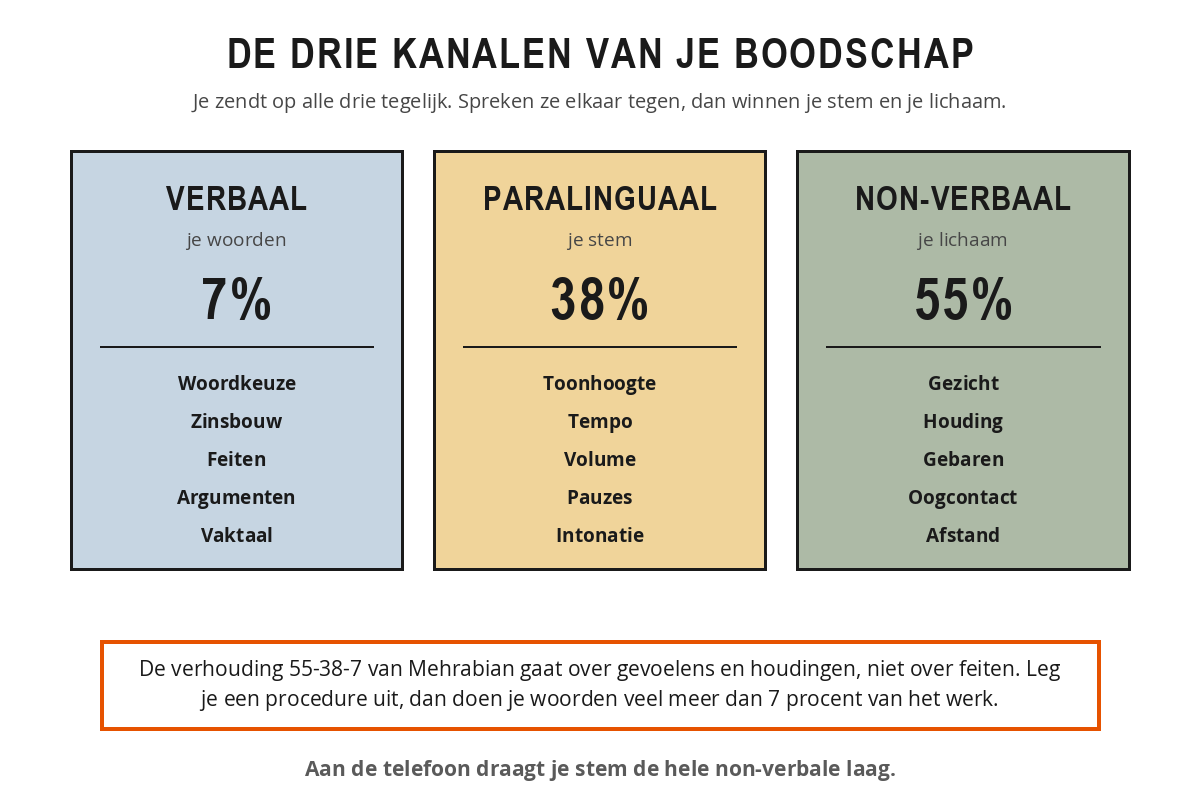
When you say something, you use not one but three channels at once:
- Verbal: what you say. The content of your words, your sentences, the facts and arguments you share.
- Non-verbal: how you say it with your body. Your facial expression, posture, gestures, eye contact and the distance you keep.
- Paralinguistic: how you say it with your voice. Your pitch, pace, volume, pauses and intonation.
The best-known figures come from Albert Mehrabian: body language 55 per cent, voice 38 per cent and the words themselves only 7 per cent. An important caveat goes with that ratio, because Mehrabian researched communication about feelings and attitudes, not the conveying of facts. If you are explaining a procedure, your words do far more than 7 per cent of the work. But as soon as feelings are involved, the ratio explains a great deal: that is why your tone on the phone matters so much, and why a forced smile in a video call immediately feels awkward. Your words say one thing, your body says another, and the other person believes your body.
The verbal channel: your words
Verbal communication is everything you convey with words. Spoken or written, this channel carries the factual information. You say what you think, ask, know or want. Your words are the building blocks with which the person you are speaking to reassembles your message in their own head.
Your words do several things at once. They inform ("the meeting has been moved to Thursday"), they direct ("can you have this finished by Friday?"), they express an opinion or feeling ("I find this a difficult proposal") and they build the relationship ("good of you to think along"). Often all of this happens in just a few sentences.
Your use of language is therefore never neutral. A question like "have you got a moment?" sounds friendly, but at the same time contains a request and a check on someone's availability. The word "moment" suggests it will be brief, even if you have half an hour in mind. Such small choices colour how your message lands.
Want to know whether your verbal message is clear? Before you say or email something, ask yourself three questions: what do I want the other person to know, what do I want him to do, and what do I want him to feel? Once you have an answer to all three, your wording will sharpen up by itself.
The non-verbal channel: your body
Your body is always talking too. Even when you are silent, your posture, your face and your gaze send a continuous stream of information to the other person. Non-verbal communication consists of five elements:
- Facial expression: your facial expression shows what you feel, often before you notice it yourself. A raised eyebrow or a brief smile makes a whole sentence unnecessary.
- Posture: upright or slouched, open or closed. Your posture says something about your involvement and about your position in the conversation.
- Gestures: hands that move along underline your words. Busy gestures, or hands that do not move at all, send a very different signal.
- Eye contact: looking at someone shows that you are listening and present. Too long feels confrontational, too little feels distant.
- Distance: the space you leave says something about the degree of familiarity and about the nature of the conversation.
What is remarkable is that the person you are speaking to picks up those signals largely unconsciously. You sense that someone is not being entirely honest, or that someone feels uncomfortable, without being able to pinpoint exactly what gives it away. That "gut feeling" is usually nothing more than body language processed quickly and unconsciously.
Nadia asks her colleague Wouter whether he can spend an hour on Thursday looking over her quotation with her. Wouter says "yes, fine", while not looking up from his screen, pushing his keyboard aside with a sigh and pressing his lips into a thin line. Verbally he says yes. Non-verbally and with his voice he says: I really do not want to do this. It is the latter that Nadia remembers. On Thursday she does not ask again and finishes the quotation herself, less well than it could have been. Wouter has no idea that he turned anything down.
The tricky thing about non-verbal communication is that you are often unaware of it yourself. You know how you feel, but not how you come across. A video recording of a conversation, or honest feedback from a colleague, can be confronting and at the same time very instructive.
The paralinguistic channel: your voice
Between what you say and what you show lies a third layer: how you say it. Paralinguistic communication is about your voice. Not the words, but the sound you cast them in. This channel also has five elements:
- Pitch: a high, thin voice sounds different from a low, full one. Your tone colours whether your message comes across as warm, businesslike, tense or relaxed.
- Pace: speaking quickly suggests haste, enthusiasm or nerves. Speaking slowly conveys calm and weight, but can also feel sluggish or patronising.
- Volume: speaking loudly draws attention and can come across as dominant. Speaking softly forces people to listen, but can also sound uncertain.
- Pauses: silences give the other person room to think and respond. A well-placed pause makes a message stronger than ten extra words.
- Intonation: the melody in your sentence determines whether something sounds like a question, a statement or a reproach. "Did you do that?" can sound curious or accusing, purely through your intonation.
On the phone this channel is decisive. There your body language falls away and your voice has to carry the entire non-verbal layer on its own. A forced smile cannot be heard, a genuine one can: a relaxed, light voice sounds different from a tense or irritated one.
Try saying the sentence "well done for doing that" in three different ways. Once warmly and sincerely, with a slight smile in your voice. Once flat and monotone. And once with a small, sharp edge to it. The same six words three times, three completely different messages: a compliment, a formality and sarcasm. The verbal channel is identical in all three cases.
Record yourself for a minute on your phone. Briefly describe what you did this morning, or explain your work to someone who is unfamiliar with it. Then listen back and pay attention to your voice alone.
- Pace: are you speaking faster or slower than you thought?
- Volume: does your voice sound firm or soft?
- Intonation: is there melody in it, or is it flat?
- Pauses: do you dare to let silences fall, or do you fill everything in?
Write down one thing you notice, and one thing you want to try out consciously in your next conversation.
Summary
- You are always transmitting on three channels at once: verbal (your words), non-verbal (your body) and paralinguistic (your voice).
- Mehrabian's 55-38-7 ratio is about feelings and attitudes, not about factual or technical information.
- Non-verbal communication consists of facial expression, posture, gestures, eye contact and distance.
- Paralinguistic communication consists of pitch, pace, volume, pauses and intonation.
- If the channels contradict one another, the other person will almost always believe your body or your voice, not your words.
- On the telephone your voice carries the entire non-verbal layer, so pace, tone and pauses count double there.
What is the right caveat to Mehrabian's 55-38-7 ratio?
A colleague says "yes, that's fine" while not looking up from his screen and sighing. What does the other person take away from this conversation?
Which row consists entirely of elements of the paralinguistic channel?