


Introduction
An invoice that goes out the door is not yet money in the bank. Between those two moments, your working capital sits with the customer. The longer that lasts, the more it costs and the smaller the chance that the amount will ever be received in full. Credit control is about that period: keeping it short without damaging the customer relationship.
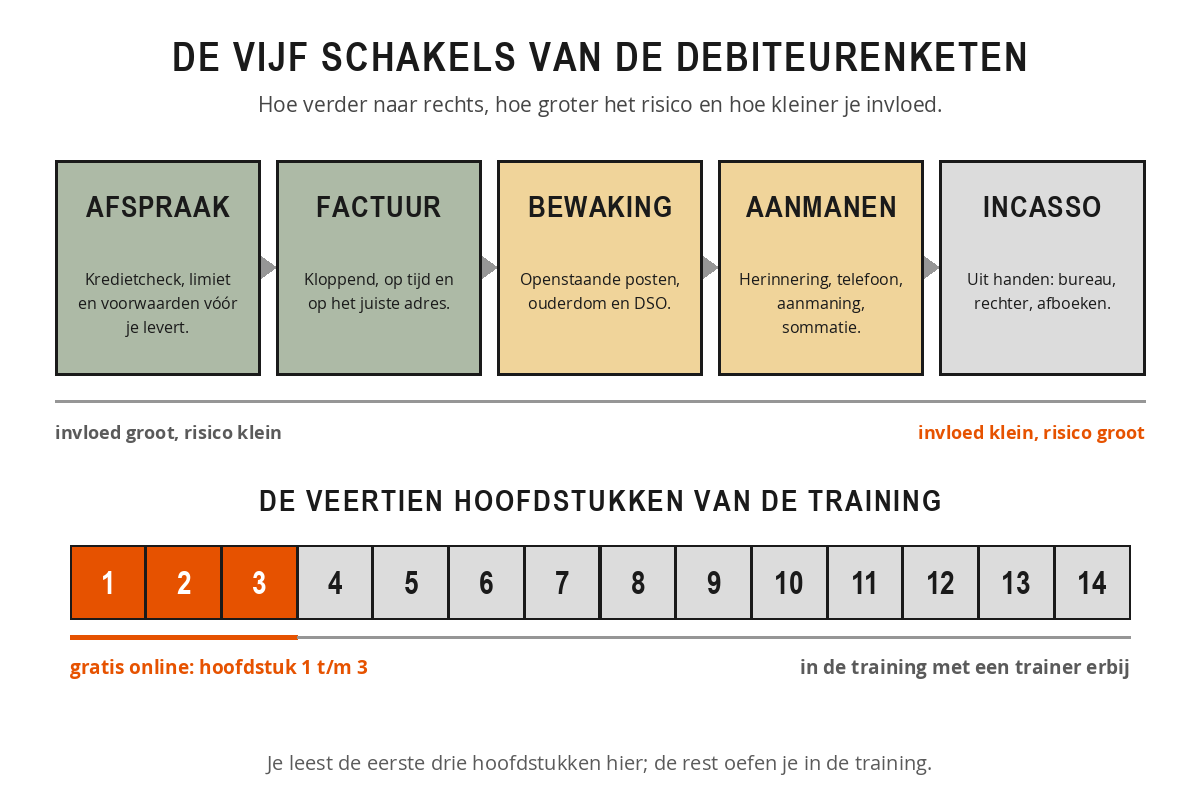
That chain runs from left to right, and that is also the heart of the job. With agreement beforehand you have all the influence and are still running almost no risk: you can vet the customer, set a limit and send your terms and conditions along. At the invoice you decide for yourself whether it is correct, on time and sent to the right address. At the monitoring the real work begins: you keep track of what is outstanding and how old it is. With the chasing payment you are already in repair mode. And with the debt collection you hand it over and little of your influence remains. Almost everything you come across on the right-hand side originated on the left.
This free course contains three chapters: the orange part of the bar above. At the bottom of chapter 3 you will find the full course.
What you will learn
You start with the overview. Without an outstanding items list you can rely on, you respond to customers who call rather than to invoices that have been outstanding for too long. You learn which fields make such a list usable, how to build an ageing analysis and how to calculate your DSO, the figure that shows at a glance how quickly your turnover turns into cash. After that it is about the customer: why is that invoice still unpaid, which excuses do you hear again and again, and what kind of payer are you actually dealing with? And in the third chapter you turn that knowledge into a fixed procedure, from a friendly reminder to a formal demand that means what it says.
How the course is structured
The full course follows the chain in the diagram above. You start with your own role and the policy you work within, then work through the process from customer acceptance via invoicing to the administration, next learn to read risks and payment behaviour and are given the legal framework that determines your position, and finish with the action side: sending reminders, collecting debts, holding conversations and dealing with resistance. The final chapter brings everything together in an improvement plan for your own practice. Each chapter contains theory, a model, examples from practice and an exercise that you apply to your own portfolio.
Practical tips for use
- Have a few figures to hand: your agreed payment term, your outstanding balance and the age of your items. That makes the theory measurable straight away.
- For each exercise, use real customer situations from your own records, not made-up examples. That is where you gain the most.
- Keep a notepad to hand headed "this is what I am going to do differently on Monday". One concrete action per chapter is enough.
- Don't read it all in one go. One chapter a week, with time to try things out, sticks better.
Each chapter ends with a short knowledge check of three questions: answer them correctly to mark the chapter as completed. Your progress is saved automatically in your browser.
This course touches on deadlines, interest and collection costs. What is permitted and required in your case depends on your contract, your terms and conditions and whether your customer is a business or a consumer. So use the texts here as a starting point and have your demands for payment and final demands checked by someone with legal knowledge of your own terms and conditions. This is not legal advice.
Enjoy the read, and above all: good luck with the money coming in faster.