


1. Insight into your outstanding items
Without an up-to-date overview of what is outstanding, you are not managing anything. You then respond to the customers who call you, not to the invoices that have been left too long. The outstanding items list and the ageing analysis reverse that order: they determine who you call today, instead of the other way round.
After this chapter:
- Whether you can read an open items list and judge which items require action.
- Do you know the six fields that make such a list genuinely usable.
- You can build an ageing analysis in buckets and explain the outcome.
- You calculate your DSO and know what the figure says about your collections process.
- You know when an item qualifies for a bad debt provision.
The list of outstanding items is your workload
The open items list is the overview of all the invoices you have sent that have not yet been paid in full. An important detail: each line is an invoice, not a customer. When a payment comes in and is matched, the line disappears or the remaining amount stays on the list. The list is therefore a snapshot. It is only accurate on the day you run it.
Everything you do in credit control starts here: calling, reminding, sending demands. That is why you need to be able to read the list and trust it. If you don't trust it, you will start working around it, and within a month you are back to responding to whoever shouts loudest.
The six fields you really need
A usable list contains more than a customer name and an amount. These six fields determine whether you can actually work with it.
- Due date. Not the invoice date, but the day on which the money has to be in. Sort by this and you immediately have the order of your calls.
- Days past due. The number of days the invoice is overdue. This field will later determine which bucket of your ageing analysis the item falls into.
- Outstanding amount. The outstanding balance, not the original invoice amount. Partial payments have to be visible, otherwise you are ringing about an amount that has long since been partly paid.
- Last action and date. What you last did and when. Without this field, one person calls the customer twice and another not at all.
- Dispute status. A marker that a substantive objection is outstanding. A disputed invoice does not belong in the same flow as a forgotten invoice.
- Contact person in accounts payable. The person who actually sets the payment in motion. That is rarely your buyer or your account manager.
At an installation company, an invoice for € 8.400 has been outstanding for 52 days. The "last action" field is empty. The credit controller rings and hears that the invoice never arrived: it had been sent to the project manager instead of to the accounts payable department. After resending it to the right address, the amount is in the bank within nine days. The real mistake was not the customer's, but a missing contact person field.
Keeping the list clean
An open items list becomes cluttered faster than you would think. Credit notes that have not been matched to the relevant invoice, payments allocated to the wrong item, differences of a few cents that stay on the list indefinitely: it all creates noise. You end up ringing about items that are in fact no longer outstanding, and that costs you credibility with the customer. Five habits keep it reliable.
You post payments daily rather than weekly, because a customer who paid yesterday and receives a reminder today will rightly complain. You match every credit note directly to the original invoice, so that the balance per customer adds up. Differences below a fixed amount, two euros for example, you clear up monthly in a single collective entry. You flag disputes as soon as they come in, with a short note and an owner. And each month you check whether the total of the list ties in with the trade receivables item in your general ledger.
That last step is your safety net. If the list of outstanding items does not reconcile with the general ledger, then somewhere there is an entry that has not gone through the accounts receivable module. You investigate that difference at the moment it arises, not three months later.
The ageing analysis in buckets
Your management does not want to see a list of four hundred rows. It wants to know how much money is outstanding, how old that money is and how much of it will probably never come in. That is what the ageing analysis is for: it divides all outstanding items into age groups, calculated from the due date. Those groups are called buckets.
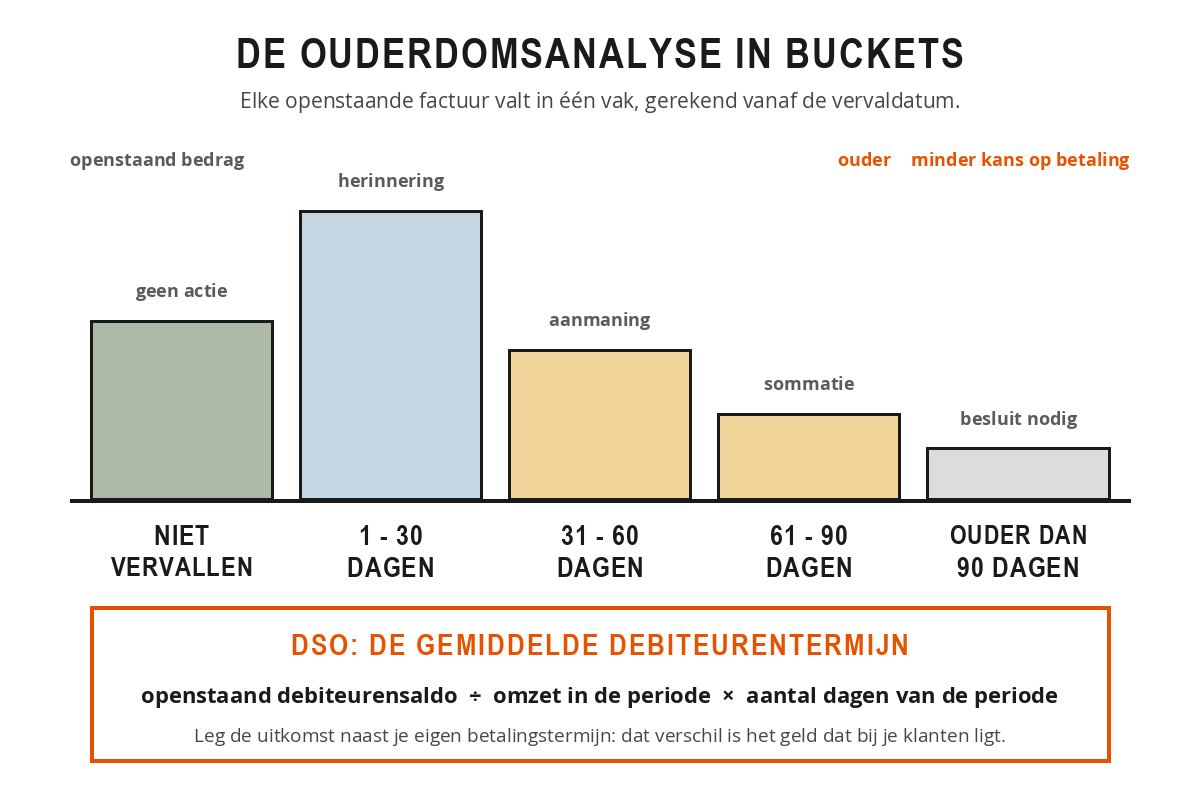
The standard breakdown has five boxes. The first is not yet due: there is nothing for you to do here, the money simply isn't due yet. Then 1 to 30 days overdue, the craft of the payment reminder. After that 31 to 60 days, where the reminder belongs. Next 61 to 90 days, where a final demand is appropriate. And finally more than 90 days old: there every item calls for a decision, because the chance of full payment gets smaller with every month.
The strength of those columns lies not in the individual figure, but in the shift between months. If the 31 to 60 days column grows two months in a row, your first reminders are faltering. If it is the last column that fills up, old cases are being left to linger without anyone making a decision. So always put last month's figures alongside them.
DSO as a management figure
DSO stands for Days Sales Outstanding, or the average debtor period. The figure shows how many days pass on average between sending your invoice and the money coming in. It is the key indicator in your field, because it sums up in a single number how quickly your turnover turns into cash flow.
You calculate it by dividing your outstanding accounts receivable balance at the end of a period by the turnover in that period, and multiplying the result by the number of days in the period. If you use a quarter, you use 90 days; if you take a month, 30.
With strongly fluctuating revenue that formula becomes distorted. A peak month in December artificially pushes your DSO down, a quiet summer pushes it up. In that case you use the countback method: you offset the outstanding balance against the revenue of the most recent month, then against that of the month before, and so on until the balance is used up. The number of days of revenue you needed for that is your DSO.
In itself the figure says little. It only takes on meaning once you set it against your own payment term.
Wholesaler Verstraten applies a payment term of 30 days. The outstanding accounts receivable balance at the end of the quarter is € 1.410.000, with turnover for that quarter at € 2.700.000. The DSO then works out at 1.410.000 divided by 2.700.000, multiplied by 90 days: 47 days. So customers pay an average of 17 days late. Average daily turnover is 2.700.000 divided by 90, or € 30.000. Those 17 days therefore represent well over € 500.000 sitting unnecessarily with customers. That is a rather different conversation with the board than "our customers pay a little slowly".
Four levers together determine your DSO. The first is the speed of invoicing: every day between delivery and invoice date counts in full, and invoicing daily instead of weekly saves three days on average. The second is the agreed term itself: with new customers you are still free to set them, and if you go from 45 to 30 days, you lower your structural baseline by fifteen days. The third is consistent monitoring: your follow-up schedule only works if the actions actually take place on the agreed day. The fourth is the dispute lead time: an invoice dispute left unresolved for six weeks counts as six weeks in your DSO. Resolving it quickly often yields more than making extra calls.
Always calculate your DSO on the same day of the month and using the same method. A figure that you calculate over a quarter one time and over a month the next cannot be compared. The trend matters more than the individual number.
Provision and file
An allowance for doubtful debts is the amount you set aside on your balance sheet for invoices you expect will not be paid, or not in full. You do not write the receivable off yet, but you do already adjust your expected income, so that the balance sheet gives a realistic picture. With the static method you assess each doubtful item separately and decide per customer what proportion to set aside. With the dynamic method you attach a fixed percentage to each bucket, for example 5 per cent at 31 to 60 days, 25 per cent at 61 to 90 days and 50 per cent beyond that.
The moment a file goes to a debt collection agency or to court, only what you can prove counts. That is why you don't build a good file after the fact, but add to it at every step. It should contain: the signed quotation or order confirmation, the proof that your terms and conditions were provided, all invoices sent, the delivery notes, the reminders and formal demands sent with their dates, and the notes from every telephone conversation.
Three requirements apply to conversation notes. You record the date and the name of the person you spoke to. You record the commitment as an amount and a date, so not as "he is going to look into it". And you describe facts, not judgements about the customer, because your note may later be requested in legal proceedings.
A credit controller notes: "22 April, spoke with Mrs Bakker (accounts payable). Commits to paying invoice 20341 of EUR 8,750 by 29 April at the latest. Confirmation sent by email the same day." Three months later the customer disputes that any agreement was ever made. The confirmation email makes the conversation demonstrable and the matter is settled within a week.
Confirm every commitment made by telephone within the hour by email, stating the amount, the invoice number and the agreed date. That email is both your evidence and the customer's reminder.
Run your own organisation's outstanding items list and count:
- How many lines are there on the list in total?
- For how many rows is the "last action" field empty?
- How many lines are more than 60 days old?
- How many rows have an outstanding amount of less than ten euros?
- Which of the six fields from this chapter are you missing?
Then draw up the ageing analysis: what amount is outstanding per bucket? Calculate your DSO over the last quarter and set it against your own payment term. Finally, choose the bucket you want to shrink first over the coming month, and note down the action you are going to take to do so.
Summary
- The list of outstanding items is your workload: every row is an invoice, not a customer, and the list is only accurate on the day you run it.
- Six fields make it usable: due date, days past due, outstanding amount, last action with date, dispute status and the contact in accounts payable.
- Post payments daily, link credit notes to the invoice, clear up differences of a few cents each month and reconcile the list with your general ledger.
- The ageing analysis has five columns: not yet due, 1 to 30, 31 to 60, 61 to 90 and over 90 days. The shift between months tells you more than the individual figure.
- DSO is the balance divided by turnover, multiplied by the number of days in the period. The figure only takes on meaning alongside your own payment term.
- Four levers drive your DSO: invoicing speed, the agreed payment term, consistent monitoring and the time it takes to resolve disputes.
- With a provision for doubtful debts you keep your balance sheet realistic; with a file full of facts you keep your case strong.
Your payment term is 30 days and you calculate a DSO of 47 days. What does that tell you?
Why is the 'last action and date' field on the outstanding items list so important?
The 31 to 60 days column has grown two months in a row. According to this chapter, what does that point to?