


2. Why customers do not pay
Two customers with the same payment term rarely pay in the same way. One transfers the money on day 28, the other only after the third phone call. That difference is not bad luck: it can be recognised, predicted and influenced. But then you do need to know where it comes from.
After this chapter:
- You know what payment behaviour is and which three main causes lie behind late payment.
- You distinguish between cannot pay, will not pay and not getting round to it.
- You recognise the best-known payment excuses and have a factual counter-move ready for them.
- You can place a customer in one of the four payer types.
- You adapt your approach to the type you are dealing with.
Payment behaviour is a pattern, not an incident
Payment behaviour is the observable pattern with which a customer settles their invoices: how quickly, how completely, how consistently and with how much prompting from your side. So it is not about one invoice, but about what a customer shows across a series of invoices. A customer who structurally pays on day 42 with a 30-day term does not have an incident. They have a habit, and that habit has been taught to them.
Behind every late payment lies one of three causes. The customer cannot pay, the customer won't pay pay, or the customer does not get round to it. These three call for a completely different approach, and misjudging them costs you weeks.
The customer who cannot pay
There is a genuine liquidity problem behind this. The customer is willing, but the money is not there. You can often see this type coming: payments arriving in instalments, a customer who calls you before you call them, suppliers in the market who are already becoming more cautious. Applying pressure achieves little with this group, because you are asking for something that is not there. A payment arrangement with a short term and a firm first instalment works better, provided you make sure your own position does not deteriorate in the meantime.
The customer who won't pay
With this group the money is there, but the willingness is not. Sometimes that is justified, for example when a delivery is not correct. In that case you are dealing with an invoice dispute and not with non-payment. Sometimes it is unjustified and the customer uses a complaint as a delaying tactic.
You make the distinction with one question, which you ask consistently: what exactly has to happen before this invoice is paid? Anyone who cannot give a concrete answer to that has no substantive objection but a need to postpone.
The customer who does not get round to it
This is the largest and the dullest category. The invoice has ended up with the wrong department, the purchase order number is missing, accounts payable only runs one payment run a month, or the person who has to approve it is abroad for two weeks. There is no conflict and no shortage of money, just a faltering route. And that is good news: you resolve this category without a single difficult conversation. Every time you find a cause like this, there should be a corresponding adjustment in your own process.
For every late invoice, note the cause in one word: can't-pay, won't-pay or hasn't-got-round-to-it. After two months you will see where you are really losing time. In many organisations the third category accounts for more than half of the delay, and in that case the gain is not in chasing harder but in repairing your invoice route.
Six excuses and your counter-move
Payment excuses are the standard reasons customers give for delaying a payment without refusing it. They sound roughly the same from every customer, and that makes sense: they work. An excuse you accept without a counter-question earns the customer a few extra weeks of credit at no cost to him.
The point is not that customers lie. The excuse is often partly true. You recognise the pattern by three features: the excuse only comes when you call, it cannot be verified and there is no date attached to it. That date is exactly what you are after. Every counter-move below has the same purpose: the conversation ends with an amount and a day.
- "I haven't received an invoice." Sometimes true, usually not verifiable. Remove the excuse straight away: ask for the exact email address of the accounts payable department, send the invoice while you are on the line and ask for confirmation of receipt. The payment date you agree is based on the original due date.
- "That one is in the next payment run." Sounds concrete, but contains no date. Ask when that run takes place, which amount is included and whether this invoice has already been approved. An invoice that has not been approved will never make the run. If the run only takes place once a month, ask for a separate payment or move your invoicing moment for this customer.
- "The invoice isn't correct." If this only comes after the due date, it is usually a delaying tactic. Keep asking until you know which line, which amount and which delivery it concerns. Agree on the undisputed part straight away; only the disputed amount goes into the dispute process.
- "Our authorised signatory is on holiday." Ask who is standing in, when the authorised signatory is back and which date follows from that. Note that name in the file, so that the same excuse does not work again next time.
- "We only pay once our own customer has paid." That is not a payment term, because you agreed your terms with your customer and not with your customer's customer. Point that out politely, ask for a partial payment now with a date for the remainder, and reassess the credit limit in the meantime.
- "I'll look into it and call you back." The classic line that ends your conversation without a result. Keep the initiative with yourself: agree that you will call tomorrow afternoon if there is still no payment or feedback by then.
A supplier of office materials is told by a regular customer for three months running that the invoice is "in the approval round". On the fourth call, the credit controller asks for the name of the approver and rings that person directly. It turns out they never saw the invoices: they were stuck with an employee who had left the company. Two days later the full amount is in the account. It was not unwillingness, but a dead email address.
Note the excuse word for word in the customer file, with the date and the name alongside it. If you hear exactly the same story with the next invoice, you have a pattern in your hands. You then do not say "that is what you said last time too", but: "on 14 March we agreed that it would go along with the run at the end of March. What has changed since then?"
Four types of payer
Payer types are profiles you build on the basis of two things: can the customer pay, and is he willing to cooperate. That combination determines your approach.
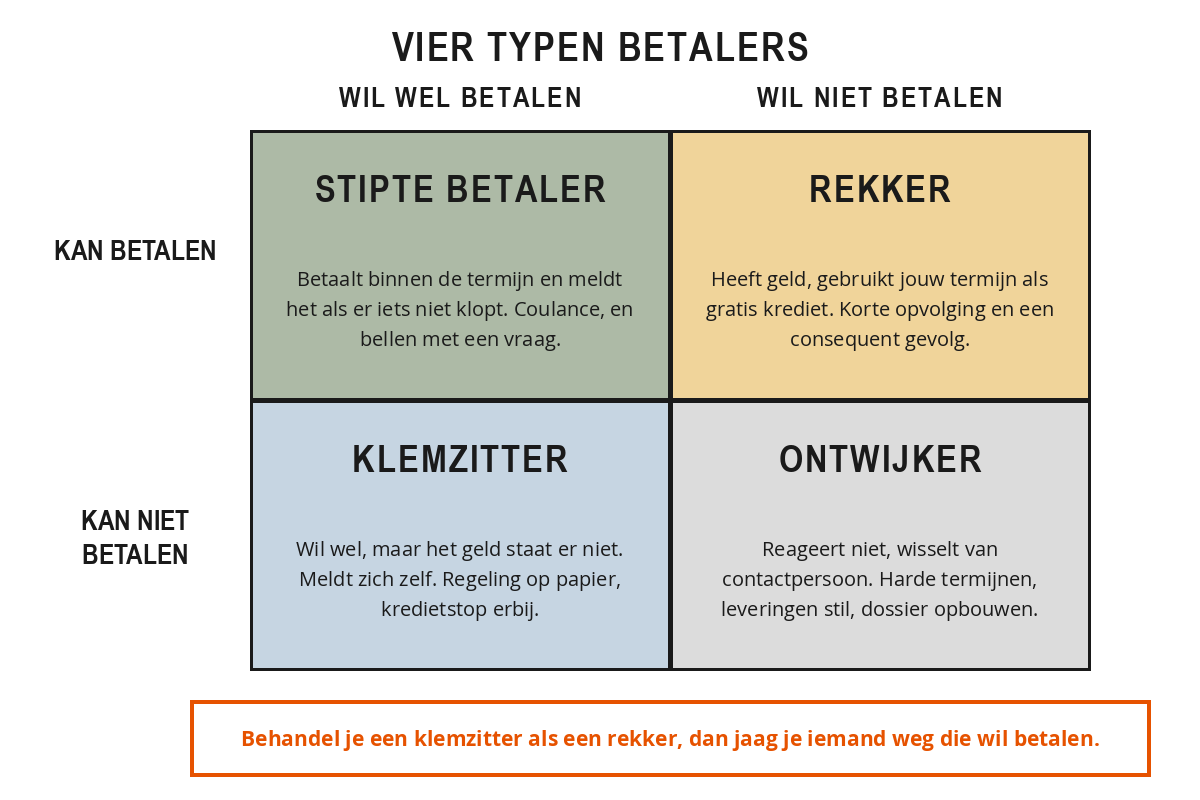
The prompt payer can pay and wants to pay. They settle within the term and get in touch if something is not right. Your biggest risk with this customer is that you damage the relationship with an automatic reminder after one day's delay. Your system should allow a few days' grace here, and with this group a phone call starts with a question, not with a reproach.
The squeezed payer wants to pay but cannot. He has a liquidity problem, comes forward of his own accord and puts forward proposals. Here a payment arrangement works best, provided you stay within your mandate. Record the arrangement in writing, agree that the whole debt becomes immediately due on the first missed instalment, and put a credit hold on new deliveries for as long as the arrangement runs.
The staller can pay but does not want to. They use your payment term as free financing. Understanding does not help, consequences do. You work with short follow-up, refer to the contractual interest and the collection costs, and impose a supply stop as soon as your agreed trigger is reached. Once the customer notices that stalling costs them something, your invoice moves up their pile.
The evader cannot and will not. He does not respond, changes contact person and moves appointments. Here you stop trying to convince and switch to deadlines. You send a written notice of default with a firm date, halt deliveries and prepare the file for handover. Every conversation you still have, you record.
Contracting firm De Ruiter has two customers with the same arrears of EUR 12,000. Construction firm Sterk calls of its own accord: its client has failed to pay an instalment, and it asks whether an arrangement is possible. That is a cash-strapped customer. Retail chain Marks responds to nothing, and after three weeks it turns out the contact person has been replaced without anyone passing this on. That is an avoider. De Ruiter agrees four instalments with Sterk, with a credit stop attached, and the money comes in. With Marks, the file goes out the door after the formal demand. The same arrears, two different routes, and the right outcome in both cases.
The mistake that costs the most is confusing the cash-strapped customer with the staller. Treat a cash-strapped customer as a staller and you drive away someone who is actually keen to pay. The other way round, you lose months with a staller you approach with understanding for too long.
Take the five oldest outstanding items from your own records and record for each item: the invoice number and the amount, the reason the customer gave in his own words, the cause category (can't pay, won't pay, hasn't got round to it), whether that reason is verifiable, and the question with which you attach a date to it.
Then place ten customers from your ledger in the quadrant. For each customer, note the ability to pay with your reasoning, the willingness based on response speed and promises kept, the type, what you currently do with this customer and what the quadrant says you should do. Mark the customers where your current approach and the appropriate approach differ. That is where your quickest gains are.
Summary
- Payment behaviour is a pattern across a series of invoices, not a characteristic of a single invoice.
- Behind every late payment lies one of three causes: the customer cannot pay, will not pay or has not got round to it. The third is usually the largest.
- With "won't pay" you ask one question: what exactly has to happen before this invoice is paid? No concrete answer means no substantive objection.
- Payment excuses always lack the same element: a date. So every counter-move ends with an amount and a day.
- The axes of ability and willingness produce four types: the prompt payer (leniency), the cash-strapped payer (a recorded arrangement), the staller (consistent pressure) and the evader (firm deadlines).
- The most expensive mistake is treating a cash-strapped payer as a staller, or the other way round.
A customer says: "the invoice is in the next payment run". According to this chapter, what is the best counter-move?
A customer calls of his own accord, explains that a major client has not paid him and proposes an arrangement. Which type is this, and what approach fits?
For two months you mark the cause of every late payment. Three of the five oldest items turn out to fall into the "hasn't got round to it" category. What follows from that?