


3. The dunning procedure
A customer who does not pay receives not a single letter from you, but a series of steps. Each step is heavier than the previous one, with its own deadline, its own tone and its own consequence. If that series is set out in advance, you do not have to work out again for each customer what you are going to do, and the customer knows where they stand.
After this chapter:
- You know what an escalation ladder is and which rungs it has.
- You can determine for each step which deadline and which tone are appropriate.
- You write a payment reminder that leads to payment rather than to irritation.
- Do you know the difference between a reminder, a demand for payment and a formal notice.
- You build up a set of standard texts that you only have to write once.
The escalation ladder
An escalation ladder is the fixed, predetermined sequence of actions you take as soon as an invoice passes its due date. Each rung has three features: a moment at which it takes effect, a tone in which you communicate and a consequence that you announce.
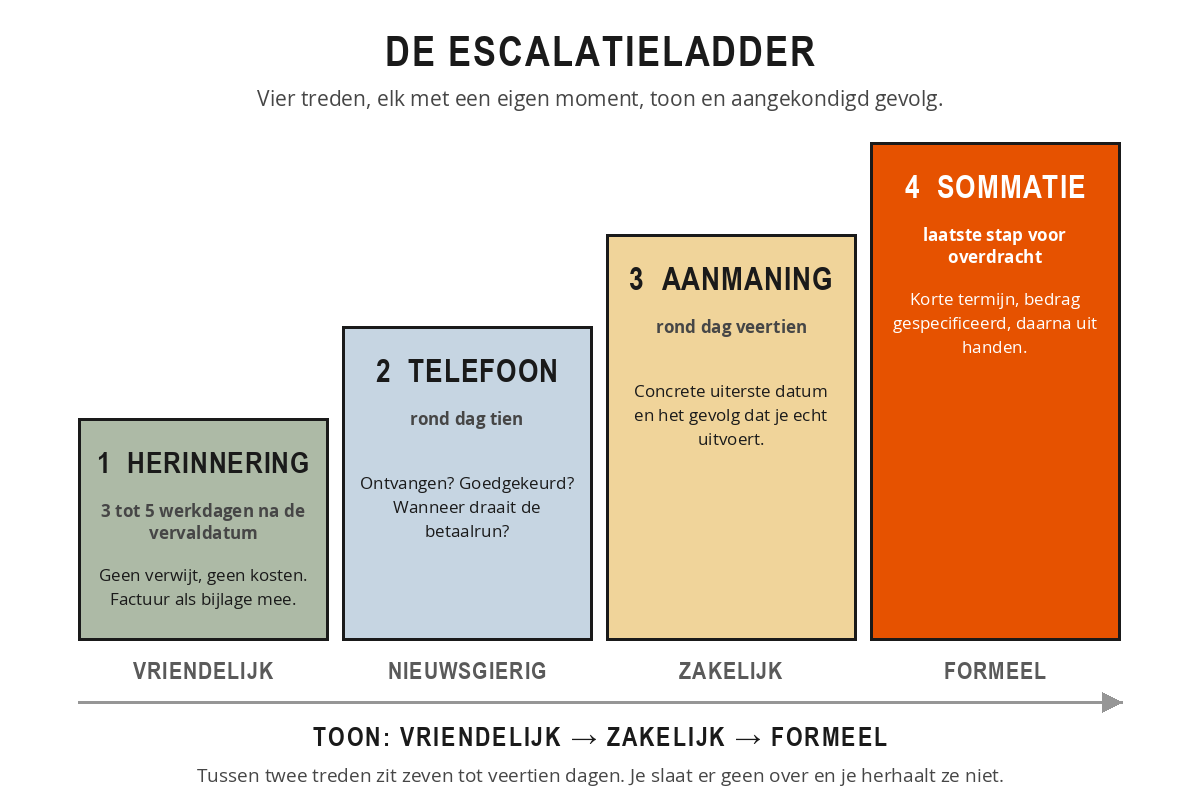
The classic ladder runs from light to heavy and has four steps. The first is the payment reminder: a neutral message shortly after the due date, without reproach, without costs and without any threat. The second is telephone contact, around day ten: a conversation yields information that a letter never provides. The third is the demand for payment, the written step in which you state a specific final date and announce what will happen after that. The fourth is the final demand, the last written step before handover, in which you tie a final deadline to an explicit consequence. What comes after that falls outside your own organisation: the file then goes to an external party.
The tone follows the steps: from friendly through businesslike to formal. But it is the tone that hardens, not the respect. As soon as a letter becomes accusatory, you lose the customer as someone to talk to and you do not gain a single day.
Three principles that make the ladder work
Predictability comes first. Customers soon learn what your organisation does about late payment. If you ring one customer on day ten and another only after six weeks, both will conclude that with you it isn't all that serious.
Rhythm is the second. The gap between two rungs is between seven and fourteen days. Shorter intervals come across as pushy, longer ones signal that your previous message was empty. You do not skip rungs and you do not repeat them endlessly.
Recording is the third. You record each step in the last-action field on the aged receivables list, with the date, channel and outcome. Without that note, the next colleague starts climbing again from step one.
Match the step to the payer type from chapter 2. With a stuck payer a third letter is pointless and a phone call works better; the money simply isn't there. With a stretcher the opposite is true: they only respond to the step that contains a date and a consequence.
The payment reminder
The payment reminder is the first message you send after the due date, with the sole purpose of drawing the customer's attention to an outstanding invoice. It is not a demand for payment and not a notice of default: you set no new deadline, you announce no costs, and your wording assumes that nothing is wrong.
That assumption is usually justified. A large proportion of late payments does not stem from unwillingness or a lack of money, but from a faltering route: the invoice ended up in the wrong mailbox, the purchase order number was missing, the payment run takes place once a month. A friendly reminder with the invoice attached resolves that kind of problem in one go.
Three to five working days after the due date is the right moment. If you wait two weeks, the invoice has by then fallen into the next payment window and you lose a whole cycle. If you send it the day after the due date, you catch the customers who paid that very morning. Email is the standard channel, with the original invoice attached and a payment link in the text. Address the message to the contact in the accounts payable department, not to your account manager's contact. That saves a few days on average.
From demand for payment to final demand
The reminder is friendly and non-committal. If payment still fails to arrive, your tone becomes more businesslike and your deadline shorter. Each subsequent step adds something: a firmer deadline, an explicit consequence, or an amount that increases.
A demand for payment is the second written step. You establish that the payment term has expired, you give a specific final date and you state what will happen if that date also passes. Where the reminder still assumes an oversight, the demand for payment assumes an obligation. You send it roughly seven to ten working days after the reminder, so around day fourteen after the due date. It should contain four elements:
- A statement of fact. Invoice number, amount, due date and the number of days the invoice has been outstanding.
- A specific deadline. A date, not a period. "By 14 May at the latest" works better than "within fourteen days", because the customer then does not have to do the sums.
- An announced consequence. Interest, collection costs or a credit stop. Only mention consequences that are set out in your credit policy and that you actually carry out.
- A personal signature. Name, job title and direct telephone number. A letter from "the finance department" does not invite contact.
If you phrase the deadline as a final reasonable opportunity to pay after all, the reminder also serves as a notice of default. That is precisely the moment at which the door to interest and extrajudicial collection costs opens.
A final demand is the last written step you take yourself: you demand payment within a short period, usually five to seven days, and you make it clear that the file will then be handed over. The amount is complete: principal sum, interest due and collection costs on separate lines one below the other. A final demand is not just another reminder in stronger words; the difference lies in its finality. You announce what you are actually going to do, and when.
Installation company Van Rooij has invoice 2024-0881 for 4.850 euro outstanding. Day 3: a reminder by email with the invoice attached. Day 12: telephone contact, which reveals that the invoice has been received but not approved. Day 14: the demand for payment, with a final date of 28 May and notice of interest and collection costs. Day 35: the final demand, payment before 12 June, specified as 4.850 euro principal, 41 euro interest and 599 euro collection costs, with notice that the file will be handed over on 13 June. On 11 June the full amount comes in.
The amounts in the example above relate to that one invoice; they are not a rule of calculation. How much interest and collection costs you may claim, and from what moment, depends on your agreement, your terms and conditions and whether your customer is a business or a consumer. In the case of a consumer, additional requirements also apply to the reminder, including the fourteen-day letter. That framework is covered in the full course. Have your reminder and demand texts checked by someone with legal knowledge of your own terms and conditions; this course is not legal advice.
Building up standard texts
Standard texts ensure that every debtor receives the same message, regardless of who sends it. They save time, they prevent sloppiness and they make your escalation ladder easy to follow. A workable template consists of fixed text and merge fields: you write the fixed text once and have it checked, and your system pulls the merge fields from the list of outstanding items. This is how you build up the set:
- Choose your steps: reminder, formal reminder and final demand, plus a separate variant for a disputed invoice.
- Write one version of each step for business customers and one for consumers, because the rules on costs differ.
- Put only one requested action in each text. Two requests in one letter lead to zero actions.
- Replace all amounts and dates with merge fields, so that nobody has to type them in by hand.
- Have the demand letter and the final demand reviewed by someone with legal knowledge of your terms and conditions.
- Note the version number and date in the footer, so that you can see later which text a customer received.
A wholesaler in packaging materials sent reminders for years with the subject line "Reminder". After a complaint from a customer who said he had received nothing, it turned out the email was sitting among dozens of identical messages in the accounts payable mailbox. The subject line was changed to "Invoice 2025-1147 overdue, your attention please". In the following quarter the number of calls with the reason "I haven't received an invoice" fell noticeably, and the items in the 31 to 60 day bucket emptied out. The text of the letter had not changed, only the line people search on.
Put the invoice number and the word "overdue" in the subject line. Accounts payable departments search by number, not by sender.
Draw the escalation ladder as it currently works in your organisation. For each rung, set out: the number and name of the action, the number of days after the due date on which it starts, the channel (email, telephone, letter), who carries it out and which consequence you announce in it. Put a cross next to every rung that is regularly skipped in practice and note in one sentence why that happens.
Then take the reminder text you currently use and assess it on six points: a subject line with the invoice number, a salutation addressed to a person, a specific final date rather than a period, payment details with a reference or payment link, a stated consequence that is actually carried out, and the name and direct telephone number of a member of staff who can be approached. Rewrite the two weakest elements and test the new text on one outstanding item.
Summary
- The escalation ladder runs from a payment reminder via telephone contact and a demand letter to a final demand, with ever shorter deadlines and an increasingly businesslike tone.
- Predictability, rhythm and recording make the ladder effective: fixed moments, seven to fourteen days between them, and every step noted on the file.
- The reminder assumes an oversight and you send it three to five working days after the due date, to the accounts payable department.
- The demand for payment sets a firm date and announces consequences that you actually follow through on. Formulated as a final reasonable deadline, it also serves as a notice of default.
- The final demand is the last step you take yourself: a short deadline, the amount broken down into principal, interest and costs, and then handover.
- Standard texts with fixed blocks and merge fields keep your letters consistent and quick to send. One requested action per letter.
- Which deadlines, interest and costs apply in your case depends on your terms and conditions and on the type of customer. Have those texts checked legally.
What is the difference between a payment reminder and a demand letter?
Why does this chapter allow seven to fourteen days between two steps of the ladder?
You send a demand for payment containing the sentence "we request that you pay within fourteen days". According to this chapter, what is less effective about that?
Ready for the next step?
You have completed the free starter of Credit Control. The next chapter in the full course is The role of the credit controller: The order-to-cash process in seven steps, what late payment costs your organisation and the mandate you need.
Take the 2-day course →From €1250,- excl. VAT · with an experienced trainer included