


Introduction
Your diary is full, your inbox is overflowing and yet you keep doing tasks that someone else could just as easily pick up. That is a familiar pattern, and it is rarely about unwillingness. Delegating sounds simple: you give work away. In practice, most people trip over the same three things. The agreement was vague, the authority was only half handed over, and as soon as things went differently than intended the work was back on their own desk within two weeks.
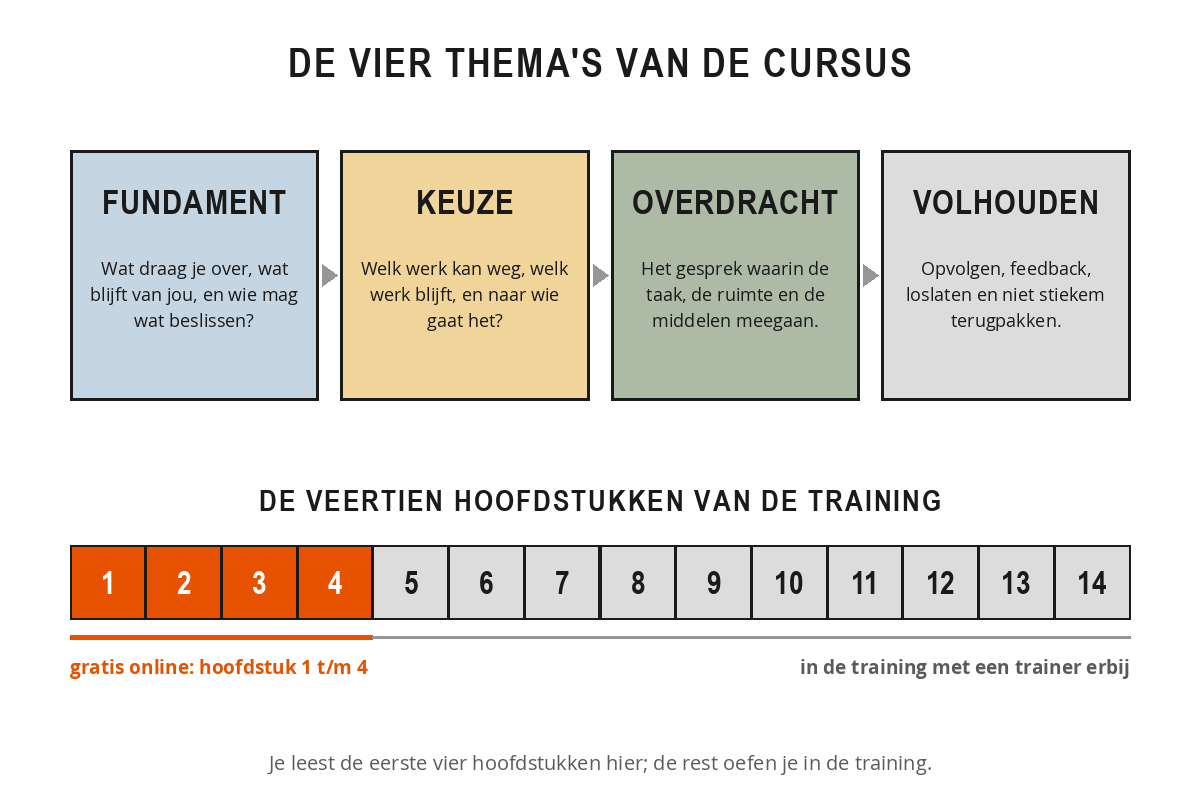
This free course contains the first four chapters: the orange part of the bar above. At the bottom of chapter 4 you will find the full course.
What you will learn
You first learn what delegating actually is, and how it differs from giving an instruction or throwing work over the fence. Then you see why authority and responsibility must always increase together, and what goes wrong if one of the two lags behind. In the third chapter you make the choice: which work can go, which work should stay with you, and which task you split in two. The fourth chapter is about the conversation itself, because that is where a task really moves across. The common thread: delegating is not a matter of letting go harder, but of agreeing better.
How the course is structured
The course follows four themes that build on one another. You start with the foundation: what do you hand over and what stays with you. Then comes the choice: which task goes to whom. Then the handover: the conversation in which you hand over the task, the room to decide and the resources. And you finish with keeping it up: following up, letting go and not taking it back. Each chapter contains theory, a diagram, examples from practice and an exercise that you apply to your own working week.
Practical tips for use
- Before you start, choose one task from your own work that you would like to hand over. All the exercises relate to that task, so as you read you are building a real handover.
- Keep a notepad or a blank document to hand. The exercises only work if you actually complete them.
- Don't read it all in one go. One chapter a week, with time to try it out, delivers more than reading through it in an afternoon.
- Start small. One task that moves across properly does more for your week than five tasks that are left half-finished.
- Come back to what you read earlier. Chapter 2 reads differently once you have done chapter 4, because by then you recognise where your own agreements were thin.
Each chapter ends with a short knowledge check of three questions: answer them correctly to mark the chapter as completed. Your progress is saved automatically in your browser.
Enjoy the read, and above all: enjoy the hours you get back.