


Introduction
A colleague cuts you off for the third time during a meeting. A client repeats the same reproach even though you have explained three times how it works. You feel the warmth creeping up the back of your neck and you hear yourself speaking more sharply than you intended. That moment, just before you react, is what this course is about.
Frustration is not a fault in your system. It is a signal that something is clashing between what you expect and what is happening. The difference between people who suffer from it and people who can do something with it is not in how much frustration they feel. It is in what they do with it in the seconds that follow.
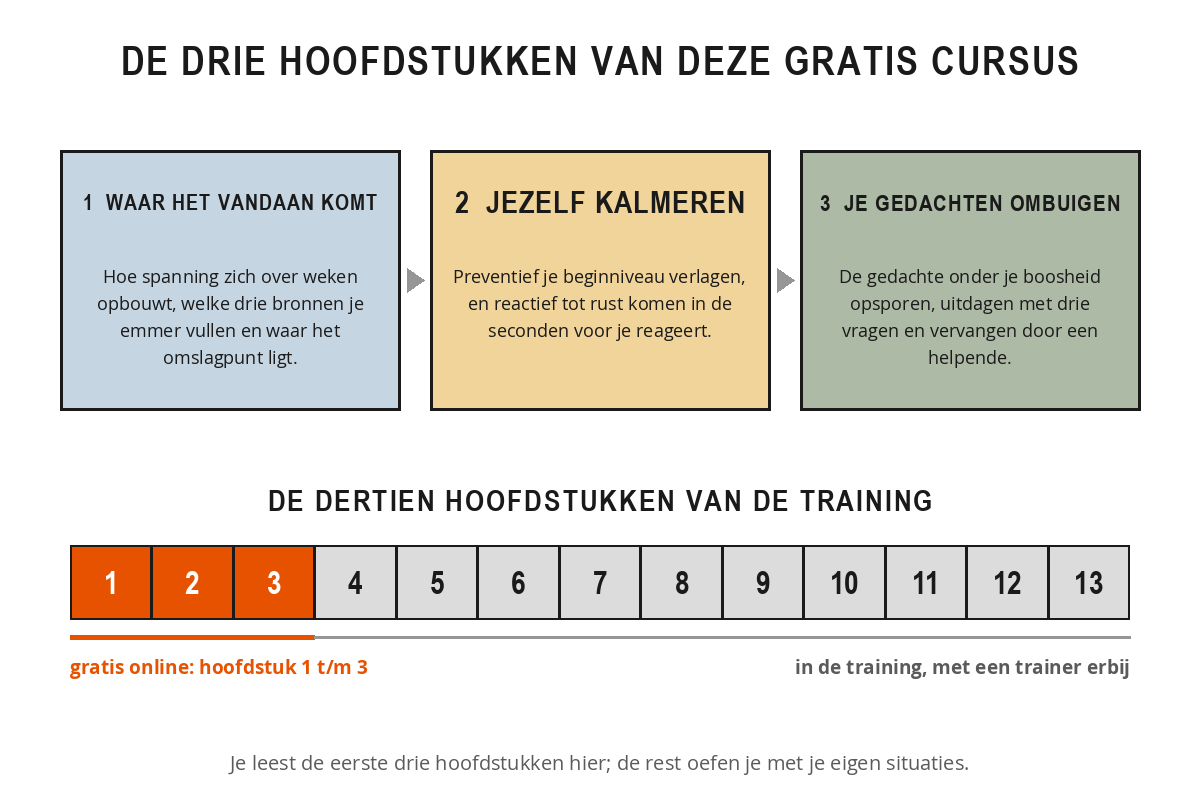
This free course contains the first three chapters: the orange part of the bar above. At the bottom of chapter 3 you will find the full course.
What you will learn
You first see how tension builds up over days and weeks, why the last straw always gets the blame, and where the point lies beyond which your reaction is no longer yours. You then learn to calm yourself at the two moments that matter: well in advance and in the middle of a conversation. Finally, you look at the thought underlying your anger, because that determines how hard a remark lands. You learn to track down that thought, test it with three questions and replace it with a sentence you can actually work with.
How the course is structured
The full course moves from the outside in and back again. You start with what happens between you and the other person: how a message lands, and how listening and asking follow-up questions keep the temperature down. It then moves inwards: where your frustration comes from, how you calm yourself, and how you examine your own thoughts. In the final part you bring it back to the conversation, with assertive responding, feedback and conflict handling. The three chapters you are reading here are the part that is about yourself, because that is where you have the most influence.
Practical tips for use
- Keep a notepad or a blank document to hand. The exercises only work if you actually complete them.
- Choose one situation from the past few weeks and use it in all three chapters. Looking at the same situation five times yields more than reading five models once.
- Don't read it all in one go. One chapter a week, with time to try things out, sticks better.
- Practise what you learn at a quiet moment. A technique you only know by hearsay is not one you will use when you need it.
- Start small. Sticking to one habit at a time works better than changing everything from Monday onwards.
This is about irritation and anger at work: the short fuse at the end of a busy week, the remark that lands harder than it was meant to. If you notice that the tension no longer subsides, that you sleep badly for weeks or that it affects you just as much at home, then it is not a matter of practising a technique better. A course is not therapy. In that case, discuss it with your GP or the occupational health doctor.
Each chapter ends with a short knowledge check of three questions: answer them correctly to mark the chapter as completed. Your progress is saved automatically in your browser.
Enjoy the read, and above all: enjoy the conversations that from now on end differently.