


1. Where your frustration comes from
An outburst rarely arises in the moment itself. The drop that makes the bucket overflow gets the blame, while the water had already been running in for weeks. Anyone who looks only at that last drop does not understand their own reaction, let alone the other person's. This chapter is about the water: where it comes from, how high it stands, and at what point you can still choose what you do.
After this chapter:
- You recognise how frustration builds up over days or weeks into an outburst.
- You identify which situations at work consistently pour water into your bucket.
- You distinguish the signals in your body, in your head and in your behaviour that precede an outburst.
- You know at which point in the build-up you still have a choice, and why that choice disappears afterwards.
- You see the difference between anger that is about something and aggression that hits the other person.
The bucket that overflows
Frustration build-up is the process in which small, individually insignificant irritations pile up into a tension that is out of all proportion to the immediate cause. Every irritation pours a little water into your bucket. As long as the level stays low, you hardly notice it. You catch a blunt remark, you shrug and you carry on working.
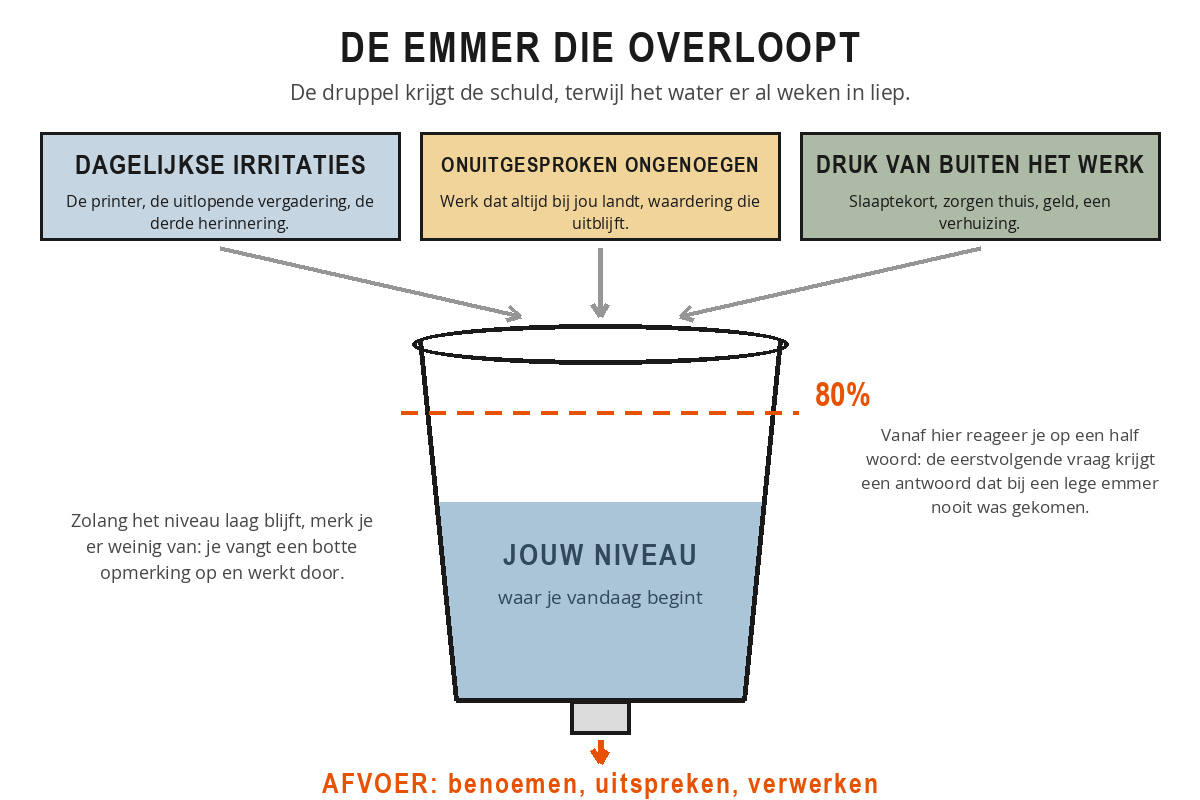
The problem rarely lies in the inflow, because you can only partly control that. The problem lies in the outflow. Anyone who does not voice and does not process their irritations is left with a bucket that only gets fuller. At a level of around eighty per cent you react at the slightest word. The colleague who asks whether you have a moment then gets an answer that would never have come if the bucket had been empty.
What pours water into your bucket
Three sources supply most of the water. The first are the daily irritations: the printer that jams, the meeting that overruns, the email you have to send for the third time. Each one too small to say anything about, together good for half a bucket. The second is unspoken discontent: the work that structurally ends up with you, the appreciation that never comes, the agreement that is broken time and again. This water stays put, because the subject is never raised. The third is pressure from outside work: lack of sleep, illness at home, money worries, a house move. Your bucket is already half full before you log in in the morning.
That third source explains why the same remark leaves you cold one week and cuts straight through you the next. The difference is not in the remark. It is in the level you started that day at.
Sanne works in a planning department. For three weeks in a row she takes over shifts from a colleague who calls in sick: six evenings and two Saturdays in all. She says nothing about it, because she does not want to come across as a moaner. Meanwhile she is sleeping badly because of building work at home. On the Thursday that same colleague asks whether Sanne can "just quickly" adjust a rota. Sanne replies sharply that she is not a temping agency. The colleague falls silent and has no idea what is going on. For him this was one request. For Sanne it was drop number twenty.
How an outburst unfolds
An outburst has a fixed shape, and that shape is why timing is everything. First there is the build-up: your tension creeps up slowly, often without you noticing. Then come the first signals: you start talking faster, you get warm, you hear yourself thinking that this really is not on. From that point up to the tipping point you still have a choice: you can still decide to wait, to breathe or to postpone the conversation. Once you go past the tipping point, what follows is the peak, and that chooses for you. After that comes the aftermath, and it lasts far longer than the outburst itself: you stay tense for hours, and the other person remembers it for weeks. In chapter 2 you will see which techniques work in which phase.
The signals of the tipping point differ from person to person, but they fall into three groups. In your body: faster breathing, a warm face, tense jaws or shoulders, a hand gripping the mouse too tightly. In your head: your thoughts become absolute ("always the same", "I'm not taking this"), you stop listening and start formulating your answer instead. In your behaviour: you talk more loudly, you interrupt, you type your email in one go and want to send it straight away. Anyone who knows their own three signals gains exactly the seconds they need.
Your self-image determines how hard it hits
Not all frustration comes from outside. Part of it you bring with you yourself, in the form of the image you have of yourself. That image determines how hard a remark lands and how quickly you become defensive. Someone who suspects somewhere that they are falling short reads neutral events as confirmation: a colleague who does not reply to an email is then not busy, but thinks you are unimportant.
The leap from that insecurity to a sharp reaction is smaller than it seems. If deep down you suspect the criticism is justified, every remark feels like an attack. Attacking is then a way of protecting yourself, not because the situation calls for it, but because you feel you have something to lose.
In a team meeting Ramon is asked whether he would mind checking his report again; it concerns two figures in a table. For the person asking, that is a detail. Ramon hears: you deliver sloppy work. He replies curtly that other people make mistakes too and that he is the only one who always delivers on time. The meeting freezes and the point itself never comes up again. Afterwards Ramon feels ashamed. In that moment he was not defending his report, he was defending himself.
If you notice that your reaction is far bigger than the cause, write down exactly which of the other person's words got to you. Often the same words keep coming back: "sloppy", "not necessary", "that is just how we always do it". Those words are your starting point for chapter 3.
Anger is useful, aggression is not
Anger has a function. It is the signal that a boundary has been crossed: yours, someone else's, or that of an agreement that matters. Suppressing anger is therefore not the aim, and a course that promises you will never be angry again is selling you something that does not exist. The question is what you do with that signal.
As soon as you cross the tipping point, the signal turns into behaviour that harms the other person or puts them under pressure. That happens in four forms. Verbal: shouting, swearing, sarcasm, making someone look ridiculous in front of others. Non-verbal: looking away, sighing demonstratively, slamming a door, standing too close to someone. Passive: carrying out agreements slowly, withholding information, "forgetting" to include someone in the cc, giving someone the silent treatment. And physical: pushing, grabbing hold of someone, throwing things. With that last form there is always a hard limit, whatever the cause.
You can hear the difference in what you are talking about. Justified anger is about behaviour and about a concrete interest: "this is the third time I have been given the rota on a Friday evening, and then I can no longer plan my own schedule". Aggression is about the person: "you only ever think about yourself". That distinction determines whether you are heard or whether the other person digs in.
This chapter is about annoyance at work, not about psychological complaints. If the tension does not ease after a day off, if you have been sleeping badly because of it for weeks, or if you notice you are just as short-tempered at home, then a technique from a course will not take you any further. A course is not a form of care. In that case, raise it with your GP or the occupational health doctor.
Map out your own bucket for the past two weeks. Take ten minutes for it and write it down.
- Which event gave you a stab of irritation, and what did you do with it?
- Which irritation repeated itself several times without you saying anything about it?
- Which pressure from outside work played a part during that period?
- What was your drain: spoken out, brushed aside or bottled up?
- What percentage do you estimate your bucket is at by the end of those two weeks?
- Which three signals did you notice in yourself just before you reacted more sharply than you wanted to?
Then put your estimate to someone who knows you well and ask whether they recognise it. That answer is often more instructive than your own score.
Summary
- Frustration builds up. The last drop gets the blame, while the water had already been running in for weeks.
- Three sources fill your bucket: daily irritations, unspoken grievances and pressure from outside work.
- The level determines your reaction. At around eighty per cent, the slightest remark is enough to set you off.
- An outburst runs through four phases: build-up, first signals, tipping point and peak, and after that a long aftermath. Before the tipping point you still choose, after it the impulse chooses.
- Your signals are in your body, in your head and in your behaviour. Know those three and you gain seconds.
- A self-image in which you feel you fall short lowers the threshold: a remark then lands as an attack.
- Anger is a useful signal and is about behaviour and interest. Aggression is about the person, in verbal, non-verbal, passive or physical form.
Why does this chapter call the drain more important than the inflow?
Sanne snaps at a colleague who asks whether she can adjust a schedule. What does this example mainly show?
According to this chapter, what is the difference between justified anger and aggression?