


2. Calming down before and during the peak
A grip on your frustration develops at two moments: long before the peak and right in the middle of it. The techniques that go with them are different, and swapping them around has the opposite effect. Anyone who only intervenes in the moment itself keeps putting out fires with a bucket that is always filled to the brim. Anyone who only works on their life balance still ends up red-faced in that one conversation.
After this chapter:
- You identify the difference between preventive and reactive calming, and determine which of the two fits a given situation.
- You map out your own life balance and point out which area is filling your bucket structurally.
- Choose at least three preventive habits that fit into your working week.
- You apply a breathing technique while a conversation is under way, without anyone noticing.
Two moments, two kinds of calming
Preventive calming is everything you do at moments when nothing is wrong, with the aim that your bucket fills up more slowly. It works in the long term and you only notice the effect afterwards: situations that put you on edge last year now leave you cold. Reactive calming is everything you use in the moment itself, between the first warning signal from chapter 1 and the tipping point. That works in seconds and it lasts no longer than that one conversation.
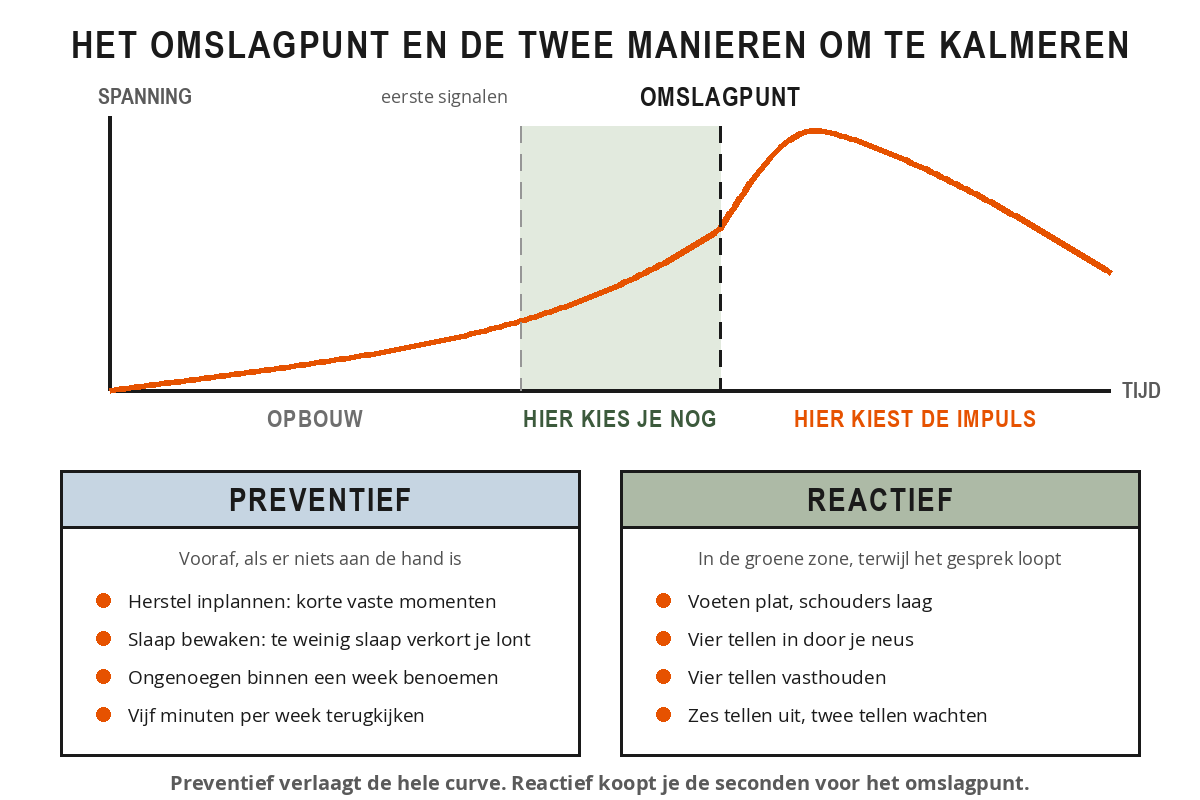
In the graph above you can see both. The orange line is your tension over the course of a conversation or a day. On the left the build-up, in which nothing appears to be the matter yet. Then the first signals, and that is where the green zone begins: here you can still choose. At the tipping point that choice ends and what follows is the peak. Working preventively pushes that whole line down, so that you start further away from the tipping point. Working reactively lengthens the green zone, so that you can do something with it.
Preventive: keeping your bucket low
A build-up of frustration rarely starts at work itself. The higher the water already stands when you come in, the smaller the drop needs to be. Preventive calming is therefore about the question of where your water is coming from, not about the most recent annoyance.
A useful starting point is your life balance: the distribution of your time and energy across the areas that matter to you. Seven are usually distinguished: work, relationships, family, health, relaxation, development and meaning. There is balance when each area gets the attention you assign to it. So it is not about seven equal parts, but about the difference between what you want and what it actually is. If one area is structurally snowed under, that tension leaks away through the area where you are every day, and that is usually work. A colleague who arrives late then costs you not a drop, but the last centimetre.
Wouter is a team leader at an installation company. He gives himself an 8 for work, a 7 for family, a 4 for health and a 3 for relaxation. Asked what he would like, he says: a 7 for relaxation. That gap of four points is the largest, so that is where he starts. Not with a gym membership, but with twenty minutes of walking after dinner, four evenings a week, put in the diary. Three weeks later he notices the difference not in his mood but in his reactions: the fault report at a quarter to five, which used to occupy him all evening, now costs him one phone call.
Four habits that lower the level
These four work, provided they recur in your week and do not just sit among your good intentions.
- Scheduling recovery: short, fixed moments without a screen and without a task. A ten-minute walk after lunch does more than one long sports session on a Sunday.
- Protecting sleep: too little sleep measurably shortens your fuse. Your colleague does not make you grumpier; you make yourself more irritable.
- Putting unspoken discontent on the agenda early: an irritation you name within a week costs you one conversation. After three months it costs you a conflict.
- Weekly review: five minutes in which you note down what put you on edge that week. That way you learn to recognise your own pattern before it repeats itself.
The third is the hardest and delivers the most. It is also the habit that comes closest to the rest of the course: how to say something like that without it becoming an attack is something you practise with giving feedback and responding assertively.
Reactive: breathing as an anchor
As soon as your tension rises, your breathing moves up into your chest and becomes shorter and faster. Your body is preparing for action. That also works the other way round: if you deliberately lengthen your exhalation, your body gets the signal that the danger has passed. Your heart rate drops, and with it the space returns to choose rather than react.
This is how the four-count technique works. First place both feet flat on the floor and let your shoulders drop. Breathe in through your nose while counting calmly to four; your stomach comes forward, your chest stays low. Hold your breath for four counts, without straining. Breathe out through your mouth over six counts, more slowly than you breathed in. Wait two counts and start again. Three to five rounds is enough. It is the most inconspicuous technique you have: you use it while the conversation simply carries on.
Besides your breathing, it helps to buy time. "I'd like to think about it for a moment, I'll come back to you this afternoon" is a complete sentence that you can always say and that nobody finds suspicious. Use it before the tipping point and you keep the conversation intact. Use it afterwards and it sounds like walking away.
Esther works in a customer service team. A customer is calling for the fourth time about the same invoice and says he "finally wants someone who actually knows what they're doing". Esther feels her jaw clench, and that is her signal. She mutes her microphone for a moment, breathes three rounds of four in, four held and six out, and that takes her forty seconds. Then she says: this is your fourth call about this and I would find that annoying myself; I am going to sort it out today and I will ring you back before five o'clock. The customer does not suddenly cheer up, but the conversation does not get out of hand and Esther can simply carry on with her work afterwards.
Practise this technique at moments when you are calm, for instance in the car or at your desk. A technique you only know by hearsay is not one you will use at the moment you need it most. Once a day for two weeks is enough to have it ready.
Map out your life balance and turn it into one step.
- Give yourself a score from 1 to 10 for each area: work, relationships, family, health, relaxation, development and meaning.
- Note down for each area the score you would want.
- Work out the difference and choose the area with the largest gap.
- Describe one action of no more than fifteen minutes that you will carry out in that area this week.
- Put the day and the time in your diary.
- Note down how you will tell in two weeks' time that it is making a difference.
In addition, do three rounds of the four-count technique once a day, at a quiet moment. After a week, write down in which situation you first really used it.
Summary
- You calm down at two moments: beforehand, when nothing is wrong, and in the green zone between your first signals and the tipping point.
- Preventive measures lower the whole curve; reactive measures extend the seconds in which you can still choose.
- Your life balance across seven areas shows where your water is coming from. It is about the difference between what you want and what it actually is, not about equal parts.
- Four habits work: scheduling recovery, protecting your sleep, naming discontent within a week and looking back for five minutes every week.
- The four-count technique: feet flat, four counts in through your nose, hold for four counts, six counts out through your mouth, wait two counts, three to five rounds.
- Buying time with one sentence works, but only before the tipping point.
- Both only work if you have practised them before you need them.
What is the difference between preventive and reactive calming?
What does this chapter mean by a skewed life balance?
During a conversation you feel your jaw clench. According to this chapter, what do you do with the four-count technique?