


3. Reframing limiting thoughts
Two colleagues hear the same news at the coffee machine. One shrugs it off, the other is unsettled for the rest of the day. The difference lies not in the event but in what they think about it. That is the core of RET, rational emotive training: between what happens and what you feel sits a thought. That thought feels like the truth, and that is precisely why you never examine it. This chapter is about how to track it down and adjust it.
After this chapter:
- You cut a situation apart into event, thought, feeling and behaviour.
- Recognise four fixed thinking patterns by their signal words.
- You bring one sentence to the surface out of a vague tension, one that you can examine.
- You challenge that sentence with the factual, the utility and the philosophical question.
- You formulate a helpful thought that is true and that gets you moving.
Event, thought, feeling, behaviour
The diagram you use for this has four boxes, and they come in this order. The event is what a camera would have recorded, without colouring words. The thought is what you think about it, often in a single sentence. The feeling is the emotion and what your body does. The behaviour is what you visibly do and say. The first, the third and the fourth are fairly easy to fill in. The second slips away, because a thought does not feel like an opinion but like a fact.
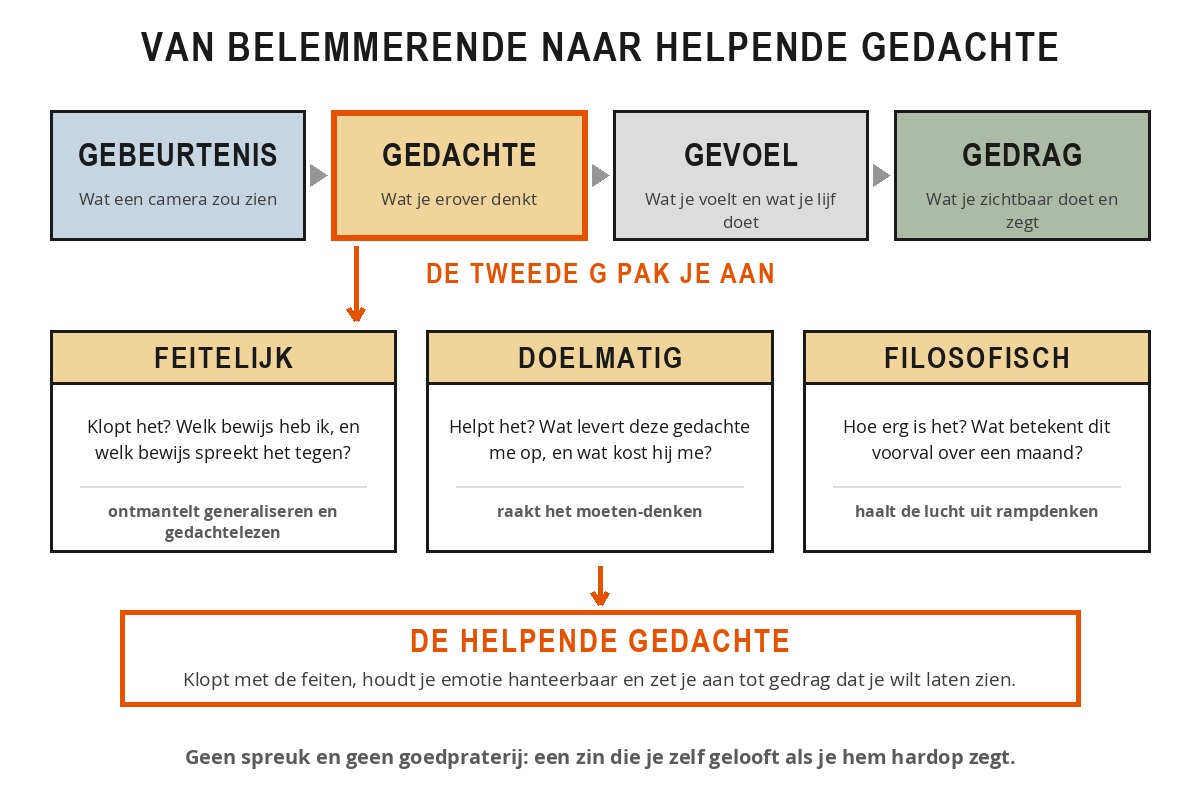
That second G is also the only box you have any influence over. The event has already happened, your feelings do not come to order and your behaviour is the result. Change the thought and your feelings and behaviour shift with it.
Underlying this diagram is Albert Ellis's ABC model: an event (A) leads, via your belief (B), to a consequence in feelings and behaviour (C). In our free Personal Effectiveness course there is a whole chapter on that model and on the beliefs that steer your patterns. Here we keep it brief and get straight to work on the thought itself.
Four thinking patterns and their signal words
What exactly you think differs from person to person, but the form in which it presents itself is strikingly recognisable. These four work as shortcuts: they skip the intermediate steps and deliver a conclusion straight away.
- Must-thinking: you impose a rule on yourself or on the other person that allows no exception. You hear it in must, should and should, and after that every deviation feels like a violation. "A colleague ought to answer an email within a day."
- Catastrophic thinking: you jump from a small setback to the worst imaginable consequence. You hear it in later and in a chain of "and then". One mistake in a report becomes a meeting with the board within five sentences.
- Generalising: you draw a conclusion about everything and everyone from a single incident. Words such as always, never, again and everyone give this pattern away.
- Mind reading: you fill in what the other person thinks about you and treat that assumption as fact. You can hear it in he thinks and they think, without anyone having said anything.
There is a fifth type of signal word, and that is the value judgement: rude, disrespectful, unfair. Words like these close off your thought before you have examined it. They are not a conclusion but a label, and it is precisely that label that makes you angry. Under time pressure you use these shortcuts most often, at exactly the moment when you are paying them the least attention. It is not a character flaw: it is a habit in your thinking, and habits can be interrupted.
Two team leaders hear at the coffee machine that their manager has taken a decision about the holiday planning, without consultation. Jamal thinks: apparently it was urgent. He sends a message asking what prompted it and ten minutes later he is at peace with it. Bianca thinks: she is going over my head again, this is the third time. She says nothing for the rest of the day, emails a long reply at half past ten that evening and is still bothered by it a week later. The same event, the same manager, two different thoughts and therefore two different days.
From vague tension to a single sentence
Often you only know that you are irritated, not what exactly you were thinking. This is how you bring that sentence to the surface. First describe the event in facts, as a camera would record it, without colouring words. Then find the moment at which your tension shot up; usually that is one sentence, one look or one silence. Next, complete this out loud: "and at that moment I thought that ...". Write down whatever comes, even if it sounds exaggerated. Then cross out the thoughts that are really feelings, such as "I felt awful"; you are looking for a statement, not a feeling. Finally, choose the thought with the most charge. That is the one you tackle.
Do this step on paper, not in your head. A thought you write down loses part of its self-evidence. You suddenly see that there is a sentence there that someone could also contradict.
Three questions that challenge your thought
A thought that is down on paper can be questioned. You do that with three questions, each of which pulls at the same sentence from a different angle. They work best in this order.
The factual question: is it true? You test your thought against what you actually observed. Is it true that your colleague never keeps you informed, or was it three times in two months? What evidence do you have for your conclusion, and what evidence contradicts it? This question mainly dismantles generalising and mind-reading.
The effectiveness question: does it help? You test whether the thought gains you anything. Even a thought that is true can get in your way. "He should have known" may well be true, but does it bring you any closer to a good agreement? This question hits must-thinking hardest.
The philosophical question: how bad is it? You test the weight of it. Is it truly disastrous, or mainly annoying? What will this incident mean in a month, or in a year? This question takes the air out of catastrophic thinking.
Whatever remains after those three questions, you cast into a helpful thought. Such a thought fits the facts, brings your emotion to a manageable level and prompts you to behave in the way you want. So it is not a positive slogan and not glossing things over. "I don't care" is not a helpful thought, because it isn't true.
At four o'clock on a Friday afternoon, Karin has a job passed on to her by a colleague. Her thought: she's dumping this on me again, she doesn't take me seriously. Factual: it is the second time this month, and the first time she asked politely and in good time. Effectiveness: with this thought I walk away sulking and say nothing, so next month it will happen again. Philosophical: it is annoying, it costs me an hour, it is not a disaster. Her helpful thought: this is the second time and I think that is too much, today I am going to say what this does to my planning. The conversation takes four minutes and the job is done on Monday.
Reframing only becomes usable once you apply it to your own situations, and not once but repeatedly. The first few times it costs you a few minutes on paper. After about three weeks you will notice that the challenging question presents itself while the conversation is still going on. That is also exactly where this chapter connects to chapter 2: the breathing buys you the seconds, the challenging question fills them.
Read your helpful thought out loud. If you don't believe it when you hear it, it is too good to be true. Tone it down to a sentence you can actually get out.
Take a situation from the past two weeks in which you reacted more sharply than you wanted to, and work it through.
- The event, in facts, two sentences at most.
- Your thought at the sharpest moment, in one sentence beginning with "I thought that ...".
- Your feeling: the emotion and what your body did.
- Your behaviour: what you visibly did and said.
- The signal word you find back in your thought, and which thinking pattern goes with it.
- Factual: what evidence for, what evidence against.
- Functional: what does this thought gain you, and what does it cost you.
- Philosophical: how bad is this really, seen a month from now.
- Your helpful thought in one sentence, and the behaviour that goes with it: concrete and doable today.
Repeat this over the next two weeks with two new situations. Keep them together and then see whether the same thought recurs. That is usually the case, and then you know where your gains lie.
Summary
- It is not the event that makes you angry, but what you think about it.
- The model has four boxes: event, thought, feeling and behaviour. Only the second one can be changed.
- Four thinking patterns give themselves away in language: should-thinking (must, should), catastrophising (what if, and then), generalising (always, never, again) and mind-reading (he thinks, they think).
- Value judgements such as rude or unfair close off your thought before you have examined it.
- Get your thought onto paper in five steps: facts, sharpest moment, "I thought that ...", cross out feelings, choose the sentence with the most charge.
- Challenge it with three questions: is it true, does it help, how bad is it.
- A helpful thought matches the facts and gets you moving. A slogan you do not believe yourself does nothing.
Why does this chapter focus on the second G, the thought?
"They think at the office that I can't handle this." Which thinking pattern is this?
According to this chapter, what is a helpful thought?
Ready for the next step?
You have completed the free starter of Dealing with Your Own Frustrations. The next chapter in the full course is The communication model: Sender and receiver, the three channels along which a message travels and why effect is something other than intention.
Take the 2-day course →From €1250,- excl. VAT · with an experienced trainer included