


1. Development versus appraisal
In practice these two meetings are constantly mixed up. The invitation is called "our annual meeting", the manager starts with development and ends with salary, and halfway through the member of staff no longer knows whether they can be honest or whether everything they say will end up in their file. Getting that distinction clear is the basis for everything that follows.
After this chapter:
- You know the three aims of the performance development meeting and why they are connected.
- You can name seven concrete differences between the performance development meeting and the performance review.
- Do you know which question determines which of the two formats suits your situation.
- Can you explain what goes wrong if you mix the two up.
- You know how to handle the three situations where the choice is uncomfortable.
What the performance development meeting should deliver
The performance review is a periodic one-to-one conversation about the work, the working relationship and development. You look back briefly in order to focus mainly on looking ahead. There is no judgement on the table and no pay rise attached to it. What does come out of it are agreements that make the work better for both of you.
Three aims are central. The first is strengthening motivation at work. Someone who notices that their efforts are seen, and that there is room to raise an issue, works with more enjoyment. Half an hour of genuine attention often does more for motivation than a bonus. The second is encouraging development: together you map out where someone's strengths lie, where they get stuck and which step logically follows. That could be a course, a new task, or simply more room to take something on themselves. The third is improving the working relationship. The conversation explicitly runs in two directions: the member of staff may also say something about your way of managing, about the information they are missing or about the priorities you set.
The conversation also serves as an early warning. You keep your finger on the pulse and pick up on problems that would otherwise only surface six months later. An employee who tells you he has been struggling with an outdated system for weeks is giving you information you can act on straight away. Waiting until things escalate always costs more time than the conversation itself.
Sanne is a team leader at an insurance company. In the performance development meeting with Youssef she asks how he has experienced the past six months. Youssef says that he enjoys the client contact, but that the reports take him a lot of time because he never properly learned to use the reporting system. Sanne had the impression that Youssef was "slow with administration". It turns out to be a knowledge problem, not a motivation problem. They agree that Youssef will spend half a day sitting in with a colleague. Two months later the backlog is gone.
Had this been a performance review, Sanne would probably have recorded an unsatisfactory score for "administrative accuracy" and the cause would never have come to light.
Seven differences at a glance
The appraisal meeting has a different character. In it you give a judgement on your employee's performance over a completed period, and that judgement is recorded. The two meetings differ on seven points, and each of those seven has direct consequences for how you sit at the table.
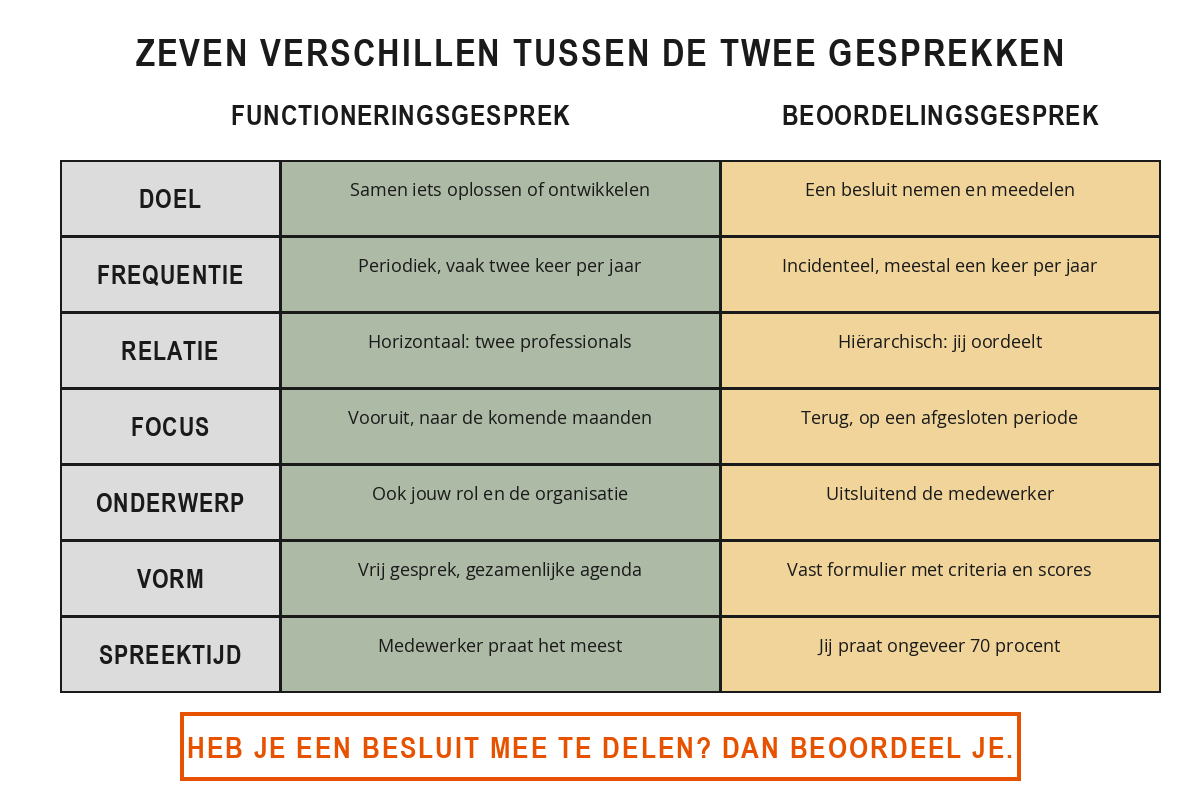
The purpose. The performance review exists to take a decision and communicate it. The performance development meeting exists to solve or develop something together.
Frequency. Appraisal is something you do occasionally, usually once a year or at the end of a probationary period. Performance development meetings are held periodically, for example twice a year, with shorter progress moments in between.
The relationship. In the appraisal the relationship is hierarchical: you judge, the other person is judged. In the performance review you sit at the table as equals, as two professionals looking at the work together.
Focus. The appraisal looks back on a completed period. The performance review uses the past only as a stepping stone to agreements for the months ahead.
The subject. The appraisal is exclusively about the employee. In the performance review your own role as a manager is open for discussion too, as are the conditions within the organisation.
The form. The appraisal follows a set form with criteria and scores. The performance review is a freer conversation with a shared agenda.
The speaking time. In the performance review you do the talking, roughly seventy per cent of the time. In the performance development meeting you reverse that ratio: the member of staff talks most, and you steer with questions.
That division of speaking time is not a law, but it is a useful thermometer. If you notice that you are talking continuously in a performance development meeting, you are probably appraising without having intended to.
The appraisal meeting is a moment of decision
An appraisal meeting is one-way traffic with consequences. You set out how you rate someone's performance over a completed period, and that rating is tied to a decision: an increment or not, renewal of the contract, promotion, an improvement plan or, in the worst case, parting ways. The judgement is already formed before you walk into the room.
So you are not after your employee's opinion on the score. You explain how you arrived at that score, which facts underpin it and what the decision means for the period ahead. That fixes five things. The judgement itself does not change halfway through the conversation because the other person becomes emotional. The relationship is hierarchical, because you speak on behalf of the organisation. The focus is on the past, on a defined period. You use the form the organisation prescribes, and that form goes into the personnel file. And you do most of the talking: the employee is given room to respond, but you bring in the content.
That is precisely why nothing new should come up in an appraisal meeting. Everything you assess has been discussed before. If someone hears in December for the first time that their case handling has been too slow for months, you are too late, and that is your fault, not theirs.
Six months later, Sanne has an appraisal interview with Youssef. His results are good, his cooperation with the back office is not. She scores him "partially meets expectations" on that point, which means no additional pay increment.
Youssef reacts sharply: "That is not fair, that back office never responds to my emails either." Sanne does not get into a discussion about the score. She says: "I hear that you see it differently, and I understand that this is unpleasant. The appraisal of last year stands. What you are raising now about the cooperation is something I want to take seriously. I will schedule that separately, in two weeks' time, so that we have time to look at it properly."
She leaves the decision intact and picks up the signal, in a separate conversation.
What an appraisal does and does not deliver
An appraisal meeting provides clarity. The employee knows where they stand, what the organisation thinks of their work and what follows from that in financial or contractual terms. That clarity is valuable, even when the verdict is disappointing.
What a performance review does not produce is development. Someone who has just been told that the promotion is not going ahead is not, at that moment, open to a conversation about learning goals. The emotion takes up all the space. That is why it works badly to squeeze both types of meeting into a single appointment: the development part disappears behind the decision. And there is another reason. As soon as your member of staff suspects that what they say will end up in their appraisal, they hold information back. That is precisely the information you need in order to improve something.
Always announce an appraisal meeting as such, at least a week in advance, and say which decisions are attached to it. An employee who only hears that in the room will not take in the rest of the conversation.
Choosing which meeting fits
The choice between the two formats starts with a single question: do you have a decision to communicate? If so, it is an appraisal meeting, however friendly the tone may be. If not, you have room for a performance review, with all the equality that comes with it.
Not every situation fits neatly into that scheme. There are three cases you will often come across in practice.
The employee raises pay during a performance review. You do not enter into the negotiation. You note the point, indicate when the salary decision will be dealt with, and pick up the thread of the conversation again.
There is a file that you have to build up. As soon as underperformance takes a legal route, it belongs in appraisal or improvement meetings that are recorded in writing. A performance development meeting is not the right instrument for that, because it involves no formal record.
Your organisation only has one annual meeting. Many companies combine everything into a single annual meeting. That is fine, provided you mark the distinction within that meeting: first the decision, then a clear transition, then the development part. You say out loud that you are switching format. For example: "That completes the appraisal. I am putting the form away. Now I want to talk to you about next year, and on that I have no judgement."
Go through the meetings you will be holding over the next three months. For each meeting, fill in:
- Name or initials of the employee.
- Is there a decision to communicate? Yes or no.
- The type of conversation that follows from this.
- Did you fill in "yes"? Which development topic do you take from it, and when will you schedule that separately?
- What risk do you foresee: a question about salary, an emotional reaction, a subject you would rather avoid?
- One sentence you prepare in advance to absorb that risk.
Afterwards, discuss your conclusion with a colleague. Where the two of you arrive at a different type of meeting is usually where the most interesting conversation lies.
Summary
- The performance review has three aims: strengthening motivation, encouraging development and improving the working relationship. It is also your earliest signal that something is going on.
- A performance review is a moment of decision: the judgement is fixed, the relationship is hierarchical, the focus is on a completed period, and it goes into the file via a form.
- The seven points of difference are purpose, frequency, relationship, focus, subject, form and the division of speaking time.
- The division of speaking time gives away which type of meeting you are actually holding, regardless of what it says in the diary.
- The key question when choosing: do you have a decision to communicate? If so, appraise. If not, there is room for development.
- If you combine the two in a single annual meeting, state out loud when you move from one part to the other.
During the performance development meeting, a member of staff says that a particular task takes a great deal of effort. Why is that valuable information in this type of meeting?
You notice that you are doing seventy per cent of the talking in a performance review. What does that tell you?
You are about to tell someone that their contract will not be renewed, and afterwards you want to talk about their development. What do you do?