


2. The annual cycle of agreements and appraisal
One conversation a year is not management. The performance review only works when it is part of a rhythm that runs throughout the year, with fixed moments at which you make agreements, adjust course and show appreciation. This chapter is about that rhythm, and about what you do between the conversations so that the final conversation has nothing left to argue about.
After this chapter:
- You know which fixed moments make up the annual cycle and how those moments follow on from one another.
- Can you distinguish the purpose of a planning meeting from that of a progress meeting.
- You know what record-keeping involves and which four kinds of notes you record throughout the year.
- You recognise the four points at which the cycle breaks down and know how to repair them.
- You can distinguish a factual note from a label.
Three moments in the annual rhythm
The annual cycle, also known as the Performance Management Cycle, is the fixed yearly round in which you agree objectives with your employee, adjust them along the way and assess them at the end. Not an HR form, but a way of making performance predictable: everyone knows when each meeting takes place and what that meeting is about.
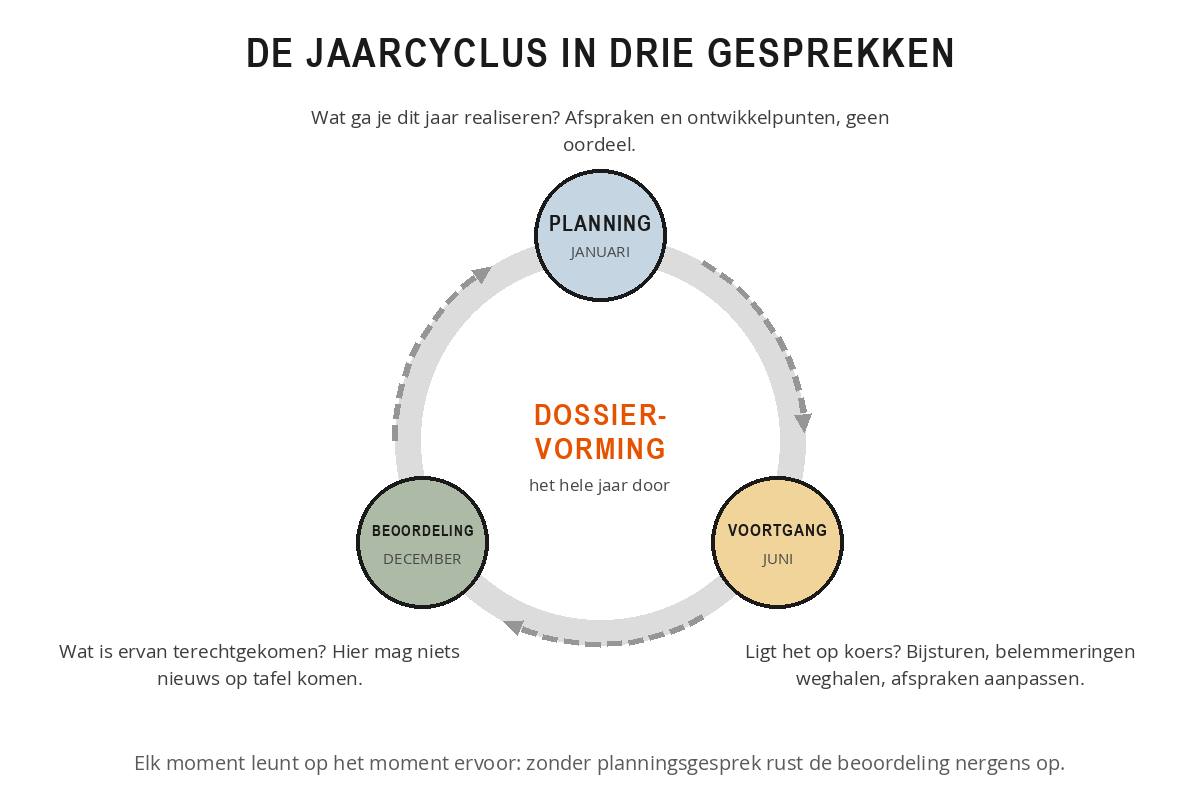
The cycle has three conversation moments. The first is the planning meeting, at the start of the period. In it you agree what the employee is going to achieve over the coming year: the performance objectives, the way you measure them and the development points. This meeting looks purely ahead and no judgement is passed.
The second is the progress review, halfway through. Together you look at whether the agreements are on track. If something is stuck, you adjust the agreement or remove an obstacle. This is usually where the performance review from chapter 1 finds its place, and some organisations schedule two a year.
The third is the appraisal meeting, at the end of the cycle. You look back on what came of the agreements, and nothing raised there should come as news.
That last sentence is the heart of it. If an employee hears in December for the first time that his case handling has been too slow for months, then something went wrong in June. If he did not know in June what he had to meet, then something went wrong in January. Every moment leans on the one before it.
Why the order matters
Many managers unwittingly start the cycle at the end. They dutifully hold an appraisal, because it is tied to the salary round, but skip the planning meeting. The result is that the appraisal rests on nothing. You are judging expectations that were never spoken out loud, and your employee has a strong case if he objects.
A cycle that does work gives you three things. You have a yardstick that is known in advance. You have a moment along the way to correct course. And at the end you have a conversation about facts rather than impressions.
Karim is a team leader at an insurance company, with eight claims handlers. In January he agrees with Femke that she will take on the complex personal injury claims this year, with the agreement that by the end of June she will have handled five of those cases independently.
By June it turns out to be three. Femke explains that on two cases she had to wait weeks for a medical opinion. Karim adjusts the agreement to eight cases by the end of December and arranges for Femke to contact the medical advisory bureau directly.
By December there are nine of them. The appraisal interview takes ten minutes and produces no discussion whatsoever. Everything Karim says, Femke has already heard twice before.
Record-keeping throughout the year
Keeping a file means recording concrete observations throughout the year, so that you can later substantiate what you say. A file is therefore not a secret folder of incriminating material, but the memory of the working relationship. Without a file, you build your judgement in December on the last six weeks you can still remember. With a file, you build it on twelve months.
That difference is bigger than it looks. Human memory is coloured by what is recent and what is emotional. An employee who made one serious mistake in November will, without a file, be judged more harshly than they deserve. Someone who got a difficult project moving in March but stayed invisible afterwards is underrated.
What you record
A useful note describes facts, not labels. "Sloppy" is a label. "Quotation 2024-118 contained three calculation errors, client called about it on 14 March" is a fact. The same applies to the positive things: "doing well" won't help you in December, "took the initiative to spend three weeks training the new colleague" will.
Four types of notes are worth making. Agreements and commitments: the record of the planning meeting, confirmed by email, and the records of the progress reviews with the amended agreements and the reason for the amendment. This is the basis against which you assess later on. Specific achievements: results achieved, problems solved, a project delivered early, a presentation that went down well with the board. Signals and incidents: a customer complaint with a date, missed deadlines, conflicts, but also a striking dip in quality or energy. And interim corrections and development steps: the moment you raised something, what you said at the time and which agreement followed from it, plus courses taken, new tasks and feedback from colleagues or customers.
How to keep it up in practice
Most managers don't fail on willingness, but on the system. A file you only update when it occurs to you never becomes a file. Here's how to keep it light enough to sustain. Create one document per employee, somewhere you go every day. For each event, note three things: the date, the factual observation and your response or the agreement made. Do this within twenty-four hours, while you still remember what was literally said. Once a month, go through your entire team in ten minutes and add what you've forgotten; often there is nothing to report and you're done straight away. And summarise every six months: three lines per employee about the overall pattern.
Share what you write down. A record the employee knows about works very differently from a record he only gets to see in December. Just say: "I'm putting in my notes that this came up today, so we can look back at it in June." That takes the tension out of it and it forces you to write it down factually.
The record also carries legal weight. If you want to attach consequences to an appraisal, from a pay rise to an improvement programme, you have to be able to show how you built up that judgement. A judgement without underlying facts and without earlier conversations in which the problem was named rarely stands up in a dispute. The employee must have had the chance to improve, and that must be evident from your notes.
Two managers hold an appraisal interview in December about the same employee.
The first says: "I get the feeling you were a bit less sharp on deadlines this year." The employee replies: "I don't recognise that, I delivered everything on time." From there it is one word against another and the conversation gets bogged down.
The second says: "In March, in June and in October a delivery was more than a week late. In June we agreed that you would raise the alarm a week in advance if a delay was looming. In October I only heard about it on the deadline itself." The employee can do something with that. From that moment on the conversation is about the cause and not about whether it is true.
When the cycle breaks down
In practice, the cycle rarely fails through unwillingness. It fails through busyness, through reorganisations and through the idea that it can just as well wait until next week. Four breaking points can be spotted early, and that makes them repairable.
The planning meeting is skipped. No agreements have been made, so in December there is nothing to assess against and your judgement becomes an impression. Remedy: make agreements after all, even if it is March, and state from which date they apply.
The progress review evaporates. The meeting is in the diary, but it gets moved three times and then disappears. The result: an employee who only hears at the end of the year that things were not going well. The fix: schedule thirty minutes instead of an hour, so that moving it is less tempting.
The objectives are out of date. The organisation changed course halfway through the year, but the individual agreements stayed as they were. You are then judging someone on work that nobody needs any more. The fix: adjust the agreements explicitly and record the change with the date and the reason.
The employee gets a new manager. The record does not move with them and the new manager starts from zero. The fix: when handing over, always pass on the notes and the current agreements, and discuss them in the first meeting.
When the cycle breaks down, the reflex is often to write off the year and start again next year. That costs you a year of development. It is better to repair things at the point where they broke, and to tell the employee honestly what went wrong in your process. That takes two sentences and earns you a great deal of credibility.
Map out your own cycle for the current year.
- Planning meeting: have you held one, and if so, when?
- Performance agreements: can you write down for one employee what you agreed, without looking it up?
- Progress review: is there a date in the diary?
- File: write down from memory three events from the first half of this year, with the date and a factual description. Then check whether you can find those three in your notes.
- Which of the four breaking points applies most to you?
Pick the weakest link and note down one measure you will introduce this week: a fixed moment for making notes, a rescheduled progress review or a revised set of agreements.
Summary
- The annual cycle consists of a planning meeting, a progress review and an appraisal, and only holds up if you feed it with notes throughout the year.
- The planning meeting only looks ahead, the progress review adjusts course, and in the appraisal interview nothing new should come up.
- Record-keeping means documenting agreements, performance, signals and development steps, in factual terms and with a date.
- Make notes within twenty-four hours, go through your team monthly and share with the employee what you record.
- A judgement without evidence and without a prior warning will not hold up, neither in the meeting nor outside it.
- The cycle usually breaks at four points: no planning meeting, progress that evaporates, objectives that are out of date, or a change of manager. Each breaking point can be repaired without writing off the year.
A manager dutifully holds an appraisal interview every year, but skips the planning meeting. What is the most important consequence of this?
Which of these notes can be used as evidence in an appraisal meeting?
Your organisation has changed course halfway through the year, but the agreements with your employee are still in place. What do you do?