


3. Preparing for the review
Anyone who sits down at the table without preparation talks about impressions. Anyone who prepares talks about behaviour. That difference determines whether your employee recognises himself in what you say or feels ambushed. And preparation is not only your job: the way you invite someone determines whether the other person arrives with points of their own or can only react.
After this chapter:
- Whether, for each discussion point, you put a specific, factual example on paper rather than a general impression.
- You know the five points of leverage and determine which one applies to a given area for improvement.
- You can fill in a preparation form to use as a guide during the conversation.
- Set up the invitation in such a way that your employee can prepare on substance.
- You arrange the practical conditions: room, seating arrangement, time and record-keeping.
From impression to example
Preparation begins when you set the appointment, not when you open your diary the evening before. Your own preparation revolves around one question: on which task aspects is this employee performing well and on which is improvement needed? You run through the agreed objectives and add an observation to each point, with your notes from chapter 2 beside you. That way you do not fall back on whatever you happen to remember.
The difference lies in the wording. "You are careless with quotations" is a label that the other person can only argue against. "Quotation 2024-118 contained three calculation errors and the client rang about it on 14 March" is a fact you can look at together. So for each point, find at least one specific example: what happened, when, and what the consequence was.
The same applies to strengths. Compliments are the first thing to fall by the wayside during preparation, whereas it is precisely a specific compliment that sticks. "That presentation to the board on 9 May was sharply structured" lands; "you're doing well" is forgotten within a day.
The point of leverage for influence
Every area for improvement comes with a follow-up question that many managers skip: what is actually causing it? The point of leverage is where your influence really has an effect. Choose the wrong one and you end up sending someone on a course who has long since mastered the skill but isn't given the time for it. Or you challenge someone on their motivation when it was never explained to them how the system works.
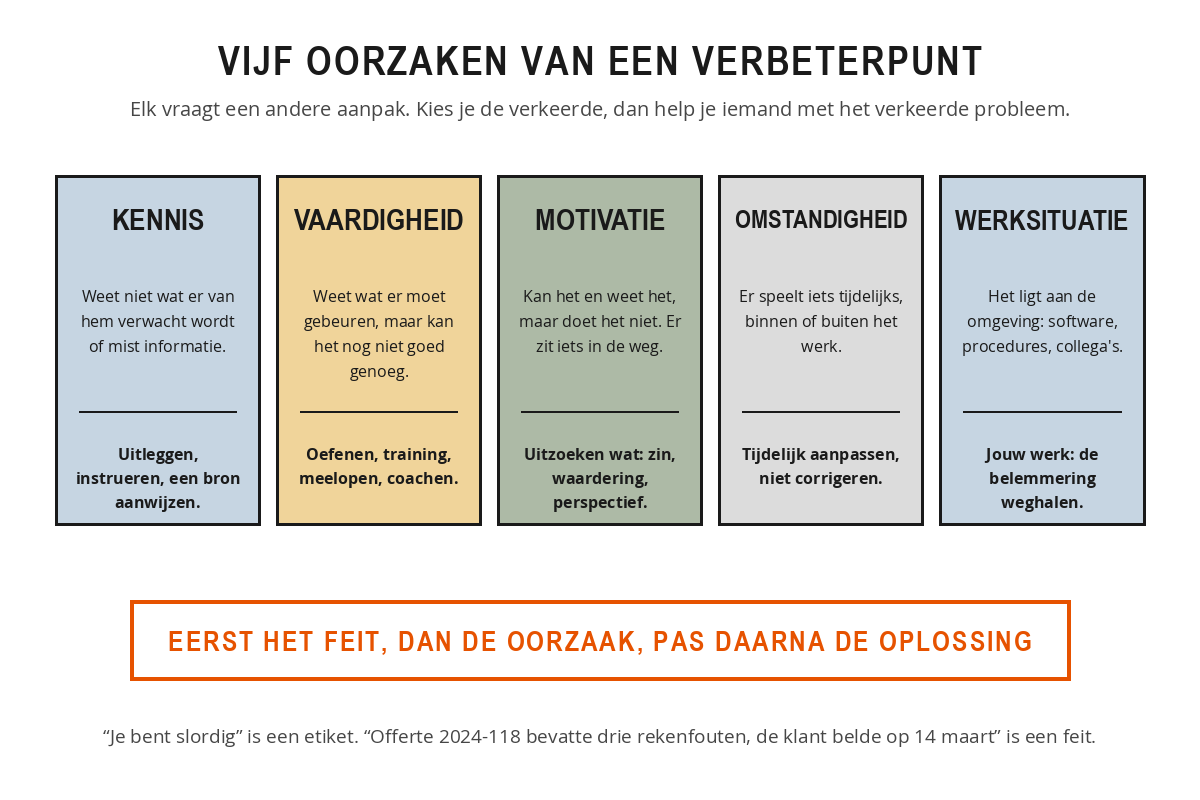
There are five points of leverage that you run through during your preparation.
Knowledge. The employee does not know what is expected of him or lacks substantive information. You solve this with an explanation, instruction or a source of knowledge.
Skill. He knows what needs to be done, but cannot yet do it well enough. Here practice, training, shadowing a colleague or on-the-job coaching will help.
Motivation. They can do it and they know it, but they don't do it. Then you look for what is getting in the way: enjoyment of the work, recognition, prospects or conflicting priorities.
Special circumstances. Something is going on outside work, or temporarily within it: illness in the family, a house move, a reorganisation. The approach is then to adjust temporarily, not to correct.
Obstructive factors in the work situation. It isn't down to the person but to the environment: outdated software, too many interruptions, unclear procedures or a colleague who isn't delivering their part. Removing this is your job.
For each point you think of one or two possible solutions in advance, but you keep those up your sleeve. The bulk of the thinking should be done by your employee during the meeting. Your preparatory work simply ensures that you are not empty-handed if he gets stuck.
Sanne consistently submits her monthly reports two days late. Her manager first notes the fact: three of the four reports in the second quarter came in after the deadline. He then works through the five points of leverage. Is knowledge lacking? No, she knows exactly what has to go in. Are her skills falling short? No, the reports are strong in substance. Is it a matter of motivation? Not that either, she enjoys her work. Is something particular going on? Not as far as he knows.
That leaves the work situation, and that is where the problem lies: she only receives the figures from the finance department two days before the deadline. Without that analysis the meeting would have turned into a correction. Now it becomes a conversation about the supply chain of information.
The preparation form
A preparation form is the single sheet of paper on which you can set out your entire preparation and which you place in front of you during the meeting. It is not an appraisal form and it does not go into the personnel file; it is your working sheet. For each point of discussion you note down four things: the task aspect, the specific observation with the date, the likely point of leverage and the question with which you will open the subject.
That last column is the most important. Anyone who formulates the opening question in advance is less likely to fall back on a judgement during the meeting. Compare "you are late with your reports" with "the monthly report came in between four and six days after the deadline in March, April and May, which means I cannot inform the management on time. What happens during that week?" The second opens a conversation; the first closes one.
Having the employee prepare
An employee who only hears what the conversation is about on walking in can do nothing but react. Someone who has had two weeks comes in with points of their own. That difference largely determines whether the employee does most of the talking, and that is precisely the intention.
What you put in the invitation determines the picture your employee has in mind in the run-up to the meeting. An empty appointment with nothing but "meeting" in the title creates tension; people then fill in for themselves what is going on, and that is rarely something positive. So send the invitation at least two weeks in advance, state explicitly what type of review it is, repeat in one or two sentences what the meeting is for, ask for their own agenda items and include preparation questions.
Four questions are enough to get someone thinking. How do you look back on your own performance over the past period, and what went well? Which parts of your work would you like to improve, and what do you need for that? How is the cooperation with your colleagues and with me going? And: where do you want to be in a year's time, and what step does that involve?
Send the same four questions along every year, in the same order. After two rounds your employee knows exactly what is coming, and their preparation time goes into the substance rather than into deciphering your questions.
Your employee looks back on the same year through a different frame of reference. What you saw as a difficult project may for him have been the first time he served a client independently. Those differences only come to light if he was given the chance beforehand to organise his own version of events. So do not ask for his answers in advance: as soon as you assess the submitted piece, the meeting shifts from an exchange to an assessment. He brings his notes, you bring yours, and at the table you lay them side by side.
Two different invitations are conceivable for the same conversation.
Version 1: "Hi Karim, I've put Thursday 10:00 in your diary for our conversation. Regards, Anja."
Version 2: "Hi Karim, our performance review is scheduled for Thursday 10 April at 10:00, in the small meeting room. We'll take an hour. It's about how the work is going, what you need and what your next step could be. I'm interested in your points, so do bring topics along. Four questions by way of preparation: ... Best, Anja."
With version 1, Karim comes in asking what the problem is. With version 2 he comes in with three points on paper.
Practical conditions
The substance may be right and the conversation can still fail because the circumstances work against you. A glass-walled room, a buzzing phone or fifteen minutes' leeway in the diary cost you more than you think. This part of the preparation is entirely in your hands.
A conversation about performance is not one you hold at your own desk with your monitor beside you. You choose a separate room without a view in from outside where no one will knock, and if necessary you hang a sign on the door. You put your phone out of sight rather than face down on the table: even a phone turned over still holds your attention.
The seating arrangement is a non-verbal message. If you sit directly opposite one another with a wide desk in between, you confirm the hierarchical relationship. In an appraisal that may be appropriate. For a performance review a ninety-degree angle works better: you can look at each other without it becoming a confrontation, and look away without it seeming evasive.
Allow an hour and then leave fifteen minutes free afterwards. If the conversation overruns because something important comes up, you don't have to cut it short. If it doesn't overrun, you can finish your notes while everything is still fresh. Don't schedule it just before a deadline or a management meeting, because then your mind will only be half on it and the other person will notice. Never put three conversations back to back: after two you slip into a routine and the third one ends up being about the previous two. Avoid Friday afternoons and the day before a holiday, because any agreements you make should be capable of being put into practice within a few days. And agree at the outset who will write up the record, so that there is no discussion afterwards about what exactly was agreed.
Choose one employee with whom you will be holding a conversation shortly. Complete a preparation form for three discussion points, covering for each point:
- Task aspect: which part of the work it concerns.
- Observation: exactly what happened, with the date and the consequence.
- Point of leverage: knowledge, skill, motivation, circumstance or work situation.
- Opening question: the question with which you put this point on the table.
Then check whether your observations contain words such as "often", "always" or "a bit sloppy". Replace those with a date, a number or a consequence. Finally, run through the practical conditions: which room, which seating arrangement, how much time with what margin, how many days in advance you send the invitation and who writes the record. Put the point you most often skip in practice in your diary first.
Summary
- Your preparation has three layers: the content, the approach towards your employee, and the practical side.
- Replace every impression with a concrete example: what happened, when, and what was the consequence. That applies to compliments as well.
- For each area for improvement, determine the point of leverage: knowledge, skill, motivation, exceptional circumstances or the work situation. Each calls for a different approach.
- For each point, your preparation form sets out the task aspect, the observation with the date, the point of leverage and the opening question.
- Send the invitation two weeks in advance, state the type of conversation, ask for the employee's own agenda items and include the same four preparation questions every year.
- Arrange a room without a view in from outside, a ninety-degree seating angle, an hour with fifteen minutes' margin and an agreement about the written record.
An employee has been delivering good work for months, but always just a little too late. You know he is capable of it and that he is motivated. What do you do in your preparation?
Why not ask your employee for the answers to the preparation questions in advance?
Which sentence belongs in the "opening question" column of your preparation form?