


4. Conducting the conversation from opening to agreement
The first five minutes of an appraisal review often set the tone for the whole hour. Anyone who launches straight into a substantive point skips the stage in which you establish together what the conversation is about. And at the end the same thing happens in reverse: a conversation that went well but ends badly achieves nothing. This chapter works through the conversation, from the opening to the agreement that still stands three months later.
After this chapter:
- You open a performance review using the DATA structure and set the agenda together.
- You know which five steps the conversation goes through and why the order matters.
- Discuss your previous agreements in such a way that there is a clear outcome: achieved, still in place, or to be revised.
- You make a vague point concrete in terms of situation, frequency, consequence and desired situation.
- You know how to leave the thinking with the employee, even when the proposal is weak.
The opening with DATA
The DATA opening is a short, fixed routine. You run through four points before touching on the first substantive topic. It takes five minutes at most and produces a conversation in which nobody has to guess what is coming.
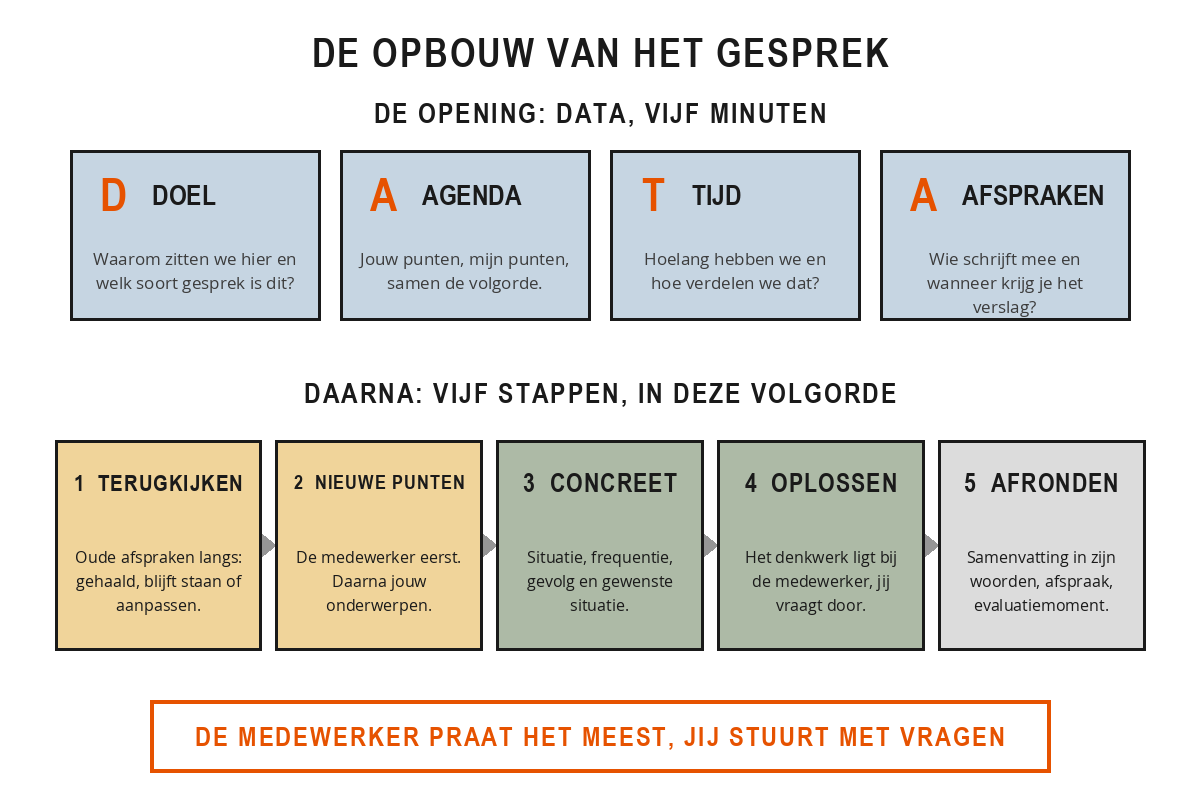
The D for Doel (purpose): in one or two sentences you say why you are both here and what kind of conversation this is. Especially if your organisation works with an annual review in which several types of conversation come together, that marker is necessary. Without that sentence your employee will be wondering whether this has consequences for his salary.
The A for Agenda: you ask which points the employee has put forward, name yours, and together you decide the order. This is where the conversation stops being yours and becomes a shared one. Someone who sees his own points on the agenda approaches the conversation differently from someone who has a list read out to him.
The T for Time: you state how long you have and how you will divide that time across the points. Someone who knows there are three more topics waiting will not spend twenty minutes on the first one.
The A for Agreements: you say in advance how you will record what comes out of it. Who takes the notes, what goes into the report, when does the employee receive that report, and how do you deal with things that stay confidential.
Put your preparation form on the table where it can be seen, instead of keeping it under your folder. Your employee then sees that you have prepared and that nothing is being held back. That saves suspicion in the first few minutes.
Step 1: looking back at earlier agreements
Once DATA is in place, you work through the agenda in a fixed order of five steps. You start with what was already on the table, because otherwise you stack new agreements on top of old ones that were never kept. This first step looks like a formality, but it is where the credibility of your entire review cycle lies. If agreements from the previous conversation can lapse without consequence, your employee learns that agreements are non-binding.
You take out the report of the previous conversation and go through the agreements one by one. The order matters: you first ask how the employee sees it, and then you say how you observed it. Reverse that, and what you will mainly hear is agreement with your view.
Every agreement ends in one of three outcomes. Achieved: you express appreciation, name concretely what you have seen, close off the agreement and don't return to it. Not yet achieved, remains in place: the agreement was sound, but the time was too short or something got in the way, so it remains in place with a new deadline. Revised: on closer enquiry the agreement turns out to be unachievable, no longer relevant or aimed at the wrong point of leverage, so you reformulate it and note down why.
That third outcome is the most underrated. An agreement that stays on the list for three conversations in a row is not a motivation problem but a design fault.
Last year you agreed that Karim would "become more visible in meetings". On enquiry it turns out that he speaks up perfectly well in the team meeting of eight people, but clams up in the management meeting with thirty. The agreement was worded too broadly.
You adjust it together: over the coming six months Karim will present a project update twice in that large meeting, with a practice session with you beforehand. Not "becoming more visible", but twice, with a date attached.
Step 2: raising new topics
Once the old agreements have been run through, the agenda with new points comes up. The employee speaks first. If you start with your points, everything he raises afterwards automatically becomes a response to your agenda. He defends himself, or he swallows his own topic because it no longer fits after your criticism. If he starts, you immediately establish the horizontal relationship that belongs to this type of conversation.
In practice this means asking: "You've written down some points of your own. Which one would you like to discuss first?" After that you keep quiet for longer than feels comfortable. What comes out in that silence is often the point that really matters.
Then come your topics. The important difference from the appraisal interview: here you are not correcting or judging, you are putting a problem on the table that you are going to solve together. That comes through in how you phrase it. Not "you're late with your reports", but "the monthly report came in between four and six days after the deadline in March, April and May. That means I can't inform management on time. What happens during that week?"
Step 3: from complaint to concrete problem
Topics rarely come in as a clear problem. They come in as a feeling: "things aren't running smoothly with purchasing" or "I'm not getting enough room". As long as it stays that broad, nothing can be done about it. You first make the point concrete, and only then do you move on to solutions.
You do that with four questions. About the situation: when did you last notice that, and what exactly happened? To the frequency: how often does this happen, every week, or was this a one-off? Then the consequence: what does it cost you, in time, in quality, in job satisfaction? And then the desired situation: what should it look like instead? Only once you have all four answers do you know what you are talking about.
Sanne raises the fact that she feels "passed over" in the allocation of projects. Her manager asks further questions. It concerns two projects in the past quarter, both assigned to a colleague who has been with the company for less time. Sanne only heard about it once the kick-off had already been scheduled. As a result she doubts whether her ambition is taken seriously, and what she would like is to be asked beforehand.
Now there is no longer a vague feeling on the table, but a concrete point: the allocation decision has been taken twice without consulting her. You can make an agreement about that; you cannot about "feeling passed over".
Step 4: leaving the problem-solving to the employee
In this phase you move from a clearly defined problem to a workable solution. The rule is simple and, for many managers, difficult: the thinking is the employee's job, not yours.
You know the work and you usually see the solution within twenty seconds. Yet saying it out loud is rarely the quickest route. A solution the employee comes up with himself gets carried out. A solution you impose gets tried for as long as you are watching. So you ask questions instead of giving answers. What have you already tried yourself, so that you don't suggest something that failed last month? What options do you see, and then you keep asking until there are at least two alternatives on the table, because with one option there is no choice, only resignation. What do you need from me, which brings your own role into view: room to manoeuvre, budget, a decision, a conversation with another department. And finally: what is the first thing you are going to do? The first step turns an idea into an action.
Sometimes the employee comes up with a proposal that you know straight away will not work. If you shoot it down immediately, the thinking stops and he waits for your version. It is better to ask further questions: "Suppose you do that, what happens in week three?" Or: "What other option do you have if this does not work?" Usually he spots the weak point himself. If he does not spot it, you may name it, but with a follow-up question: "How could you get round that?" Thinking along is fine; you put a suggestion forward as one option among the others, not as a final verdict.
Step 5: closing the conversation
In the closing stage you turn what has been discussed into something you can both fall back on three months from now. You end with a summary of the agreements, preferably given by the employee. What he gives back in his own words is what he has understood. If that differs from what you meant, you notice it now rather than at the review. Record every agreement in such a way that an outsider could see whether it has been kept.
An agreement without a feedback moment disappears. So agree during the conversation itself when you will look at how things are going, and choose that moment so that adjusting still makes sense: halfway through the period, not a week before the next annual review. Often a regular progress meeting is the logical place for it.
Put the agreements and the review date straight into both diaries, before the employee has even left the room. Actions that depend on you, you set in motion immediately: that email about the course, that conversation with the other team leader. Agreements that become part of day-to-day business get kept; agreements that only exist in a written report drop out of sight. Send the report within a week, asking whether it is correct. That confirmation will be your evidence later on.
Choose a problem that an employee recently put on your desk and that you solved. Work out:
- The problem, described in facts and not in labels.
- Your response at the time: what exactly did you say?
- Who provided the solution, you or the employee?
- Three questions with which you could have left the thinking with him.
- The agreement that came out of it: who does what, by when, and how will it be visible?
- The review moment: was it agreed? If not, when should it have taken place?
Finally, look at the result: is the solution you put forward still in use three months later?
Summary
- Open with DATA: purpose, agenda, time and agreements about the record. It takes five minutes and takes the guesswork out.
- Then five steps: looking back, new points, making things concrete, resolving and closing.
- Old agreements end in achieved, still standing or to be adjusted. An agreement that remains standing three times is a design fault.
- The employee raises his points first; otherwise everything he says becomes a reaction to your agenda.
- Make every point concrete in terms of situation, frequency, consequence and desired situation before you move on to solutions.
- The thinking lies with the employee: you keep asking questions instead of supplying answers, even when the proposal is weak.
- Close with his summary, recorded agreements, an evaluation moment that leaves room for adjustment, and actions that go straight into both diaries.
Why do you let the employee raise his topics first?
An agreement from the previous conversation appears unchanged for the third time. What is the most likely conclusion?
Your employee comes up with a solution that you are certain will not work. What do you do?
Ready for the next step?
You have completed the free starter of Performance and Appraisal Interviews. The next chapter in the full course is The communication model: Sender and receiver, three communication channels, the laws of communication and the manager's attitude.
Take the 2-day course →From €1250,- excl. VAT · with an experienced trainer included