


1. Recognising boundary-crossing behaviour
A remark that was meant as a joke, a colleague who is always the last to speak, a hand on a shoulder that stays there just a little too long. Where does unpleasant end and inappropriate begin? This chapter gives you a workable answer to that question, and a classification with which you can name behaviour without immediately attaching a label to it.
After this chapter:
- You can describe what inappropriate behaviour is.
- You know why the boundary lies with the recipient and not with the sender's intention.
- You recognise the five forms that most organisations distinguish.
- You know in which places and at which moments the risk of things going off the rails is greater.
- Can you explain why a low number of reports says nothing about safety.
From discomfort to criminal offence
Inappropriate behaviour is behaviour in which someone crosses another person's personal boundary, leaving that person feeling unsafe, hurt or humiliated. It concerns behaviour in the context of work: between colleagues, between manager and employee, and towards interns, agency workers or suppliers.
In legislation and organisational policy you will usually come across the broader term inappropriate behaviour as well. That term covers everything that undermines social safety at work. You can see it as two circles that largely overlap: undesirable conduct is the formal policy term, while boundary-crossing behaviour describes what actually happens in practice.
That behaviour runs along a spectrum. At one end sits low-level discomfort: a remark that briefly leaves you speechless. At the other end sit things that are simply criminal offences. There is no fixed tipping point between the two. It is precisely at the left-hand end of that spectrum that the difficult work lies, because one misplaced remark is not a crime, but a hundred such remarks make a workplace unliveable. Anyone who only steps in at the right-hand end is structurally stepping in too late.
The boundary lies with the recipient
A personal boundary is the point at which another person's behaviour shifts, for you, from acceptable to burdensome. That boundary is not in the same place for everyone, and it is not fixed either. Where it lies depends on your upbringing, your earlier experiences, your position in the team and on the sort of day you happen to be having.
That makes the subject slippery for anyone looking for a single objective yardstick. No such yardstick exists, and it is not needed either. The starting point is simple: the recipient decides whether behaviour crosses the line, not the sender.
That comes with a second distinction, and it is perhaps the most important one in this chapter. Behaviour has two sides that stand apart from each other: what the sender meant and what it did to the receiver. Almost nobody walks in in the morning planning to harm someone, and yet it happens every day. The sentence "that wasn't how it was meant" is usually sincere, and at the same time it is irrelevant to the question of whether someone felt unsafe. Intention says something about how blameworthy the sender is. Effect says something about the harm to the receiver. You need both to assess a situation properly, but you start with the effect.
If someone tells you that your behaviour went too far, "sorry, that wasn't how I meant it" rarely helps. Turn it around: "I didn't realise that, tell me what it did to you." You move the conversation from your intention to the effect, and that is where it belongs.
The five forms
Most organisations work with five categories. In practice they regularly overlap: in a single situation you will often recognise two or three forms at the same time.
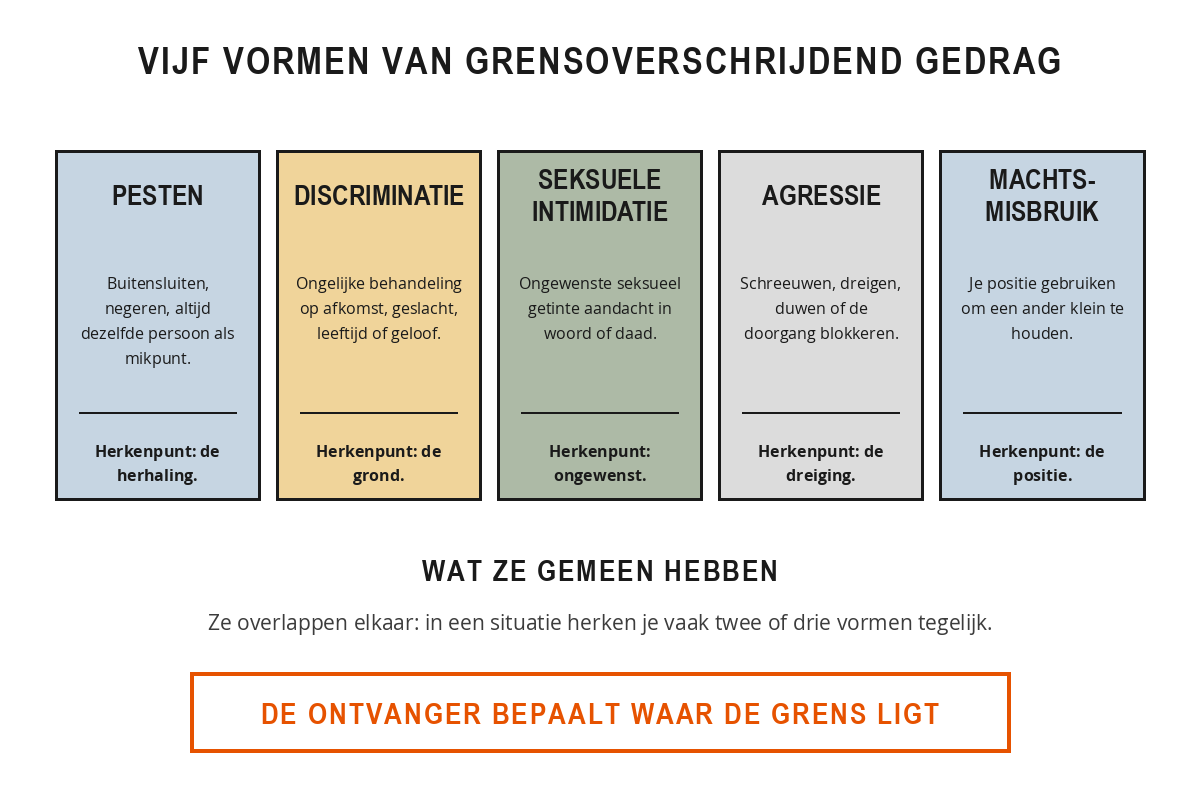
Bullying is repeated, systematic behaviour directed at one person or a small group. Being excluded at lunch, jokes that are always about the same person, someone's contributions being consistently ignored in meetings. What characterises it is the repetition, and the difference in power that gradually develops.
Discrimination is unequal treatment on the grounds of background, gender, age, religion, sexual orientation, disability, chronic illness or pregnancy. This goes further than a blunt remark about an accent: an older colleague who is consistently passed over for training or promotion also falls under it.
Sexual harassment is unwanted attention of a sexual nature in word, gesture or deed. From persistent remarks about someone's appearance and messages outside working hours to unwanted touching. Here too, it is the recipient who determines whether it is unwanted.
Aggression and violence is verbal aggression such as shouting, swearing and threatening, and physical aggression such as pushing or blocking someone's way. This occurs internally, and just as much from customers, patients or visitors.
Abuse of power is using your position to put pressure on someone else or to keep them down. A manager who refuses leave requests arbitrarily, someone who threatens a poor appraisal or the non-renewal of a contract, or a senior colleague who withholds information so that a junior fails.
In the logistics department, Ramon has been called "the professor" for months, because he is the only one with a university of applied sciences degree. At first he laughed along. By now nobody asks him for advice any more, he is passed over at the work meeting and he eats his lunch in the van. There is not a single event that is serious in itself. The pattern of a hundred small moments is.
Where the line is crossed more often
Certain moments and places keep coming back in reports and studies. It helps to know where the chance of things going wrong is greater.
The informal setting is one of them. Friday afternoon drinks, team outings and conferences have a looser atmosphere in which alcohol, hierarchy and humour run into one another. What happens there carries on through to Monday morning.
Digital channels are the second. A chat group without the manager in it, a reply in the team chat, an image that goes just over the line. Online the threshold is lower, and what is written stays written.
Relationships of dependency form the third. Interns, temporary workers, people on fixed-term contracts and newcomers have more to lose by raising the issue of someone's behaviour. That is precisely where the chance of looking the other way is greatest.
In a service desk of eight people there is a WhatsApp group with all the colleagues in it, without the team leader. If a new colleague makes a mistake in a ticket, a mocking image invariably appears. "Just a joke", says the team. The new colleague laughs along and calls in sick after four months with stress-related complaints. No single message on its own is serious enough to take issue with. The sum of them is: repetition turns a joke into a pattern, and a pattern into structural exclusion.
Why it is rarely reported
Research into working conditions has shown the same picture for years: roughly one in six employees says they have experienced unwanted behaviour from colleagues or managers in the past year. If you also count behaviour by customers and visitors, that share is higher. Between what people experience and what is officially reported there is a large gap, and that gap is no coincidence.
People doubt themselves: am I making a fuss? They fear consequences for their position, their contract or their relationship with the team. They do not know where to turn, or they have seen what happened to an earlier whistleblower. And often the idea prevails that reporting it will only make the problem bigger.
There is a practical conclusion attached to this, whether you are a manager, an HR adviser or simply a colleague. A low number of reports says little about how safe your team is. It may just as well mean that people cannot find the route or do not dare to use it. So look at the signals around it: short-term absence rising in one team, turnover concentrated under one manager, exit interviews in which the same theme keeps coming back.
Think of a situation at work that fell somewhere between "uncomfortable" and "clearly over the line". You don't have to share this with anyone.
- Write down exactly what happened: observable behaviour only, no interpretation.
- Note which of the five forms you recognise in it, and whether more than one is at play.
- Write down what you suspect the sender's intention was.
- Also note what the effect on the recipient was, or what you don't know about that.
Then read your note through again. Does your judgement change if you look only at the effect?
Summary
- Inappropriate behaviour crosses another person's personal boundary; undesirable conduct is the broader policy term.
- It runs along a spectrum from discomfort to criminal, with no fixed tipping point. The difficult work sits at the milder end.
- It is the recipient who determines whether a line has been crossed, not the sender. You start with the effect, not with the intention.
- Five forms: bullying, discrimination, sexual harassment, aggression and violence, and abuse of power. They often overlap.
- The risk of things going wrong is greater in informal settings, in digital channels and in relationships of dependency.
- Few reports does not mean it is safe. Absenteeism, staff turnover and exit interviews often tell you more.
A colleague says that a remark of yours went too far. You meant it as a joke. What is the starting point?
A team leader repeatedly refuses one employee's leave requests without explanation. Which form is this mainly?
In a department of forty people, not a single report came in last year. What can you conclude from that?