


4. Writing up and learning from your interview
The interview is over, you shake hands, you walk out. And that is where it goes wrong for most people: they get into the car, drive to the next appointment and only open their notes three days later. At that point they still know what was said, but the colour has gone out of it. They no longer remember at which sentence it went quiet, what they meant by the keywords "department, last year, difficult" and which statement stood out so much at the time. This chapter is about the hours and days after the conversation, because that is where it is decided whether your interview is worth anything.
After this chapter:
- You know what to record in the first half hour after a conversation and why that cannot wait.
- You can choose between full transcription, a summary write-up and a time-coded index.
- Organise your material by theme rather than by the order of the conversation.
- Keep fact, opinion and quotation separate in your final product.
- You evaluate an interview at three levels: content, process and your own role.
- you translate a learning point into behaviour you can recognise in yourself.
The first half hour
The hours straight after an interview are worth their weight in gold. Your memory is still fresh, the intonations are still ringing in your ears, and you still know which look went with which statement. So plan your interviews in such a way that you have at least twenty minutes afterwards. That is not a luxury, nor is it overrun: it is part of the job, just as much as the preparation.
There are four things you do in that half hour. You you supplement your keyword notes to full sentences, as long as you still know what you meant by them. You records impressions of the atmosphere: how was the other person sitting, when did it go quiet, where did the eyes light up, when did the arms go across the chest. Those observations are rarely in your notebook and do colour your eventual story. You note down your first impressions: what struck you, which statement stayed with you, what surprised you? That first reaction is usually the best compass for what will later become the core of your piece. And you write down your own questions: what is still unclear, which statement do you want to verify, what do you need to come back to. If you do not do this straight away, it is gone.
In the car or on your bike, record a five-minute audio memo on your phone about what struck you. That often produces more usable material than an hour behind your laptop, because you hear yourself thinking and pick up nuances that you would never capture in written notes.
Recognise or not
A recording gives certainty: you can always go back to what was literally said, and in a discussion about a quotation you have a strong position. At the same time a recording tempts you into laziness during the conversation itself, the familiar "I'll listen properly later", and into endless transcription afterwards. An hour-long interview soon costs three to four hours of transcription.
So make a deliberate choice for each conversation, and let your information objective decide. For a profile in which quotations carry the piece, a recording is indispensable. For an exploratory user interview in which you are mainly looking for patterns, good notes will get you a long way. For a job interview a recording is usually excessive and legally sensitive. And whatever you choose: recording is only permitted with consent, and you ask for that beforehand, not while you are already switching on the recorder.
Three ways to write up a recording
Not every recording has to be written out in full. There are three forms, and the middle one and the last one are badly underused.
The full transcription means typing out word for word, including the ums and the silences. Necessary for qualitative research, legal files and situations where the exact wording matters. Allow four to six times the length of the conversation. The summary worked example gives a paragraph per topic with the essentials, plus a few verbatim quotes on the points that matter. This suits by far the majority of journalistic and business interviews. Allow one to two times the length of the conversation. The time-coded index is the quickest: you listen back and note down per block what is being discussed, and only where it matters do you transcribe a passage verbatim. Useful if you want to be able to search back for specific points later without typing everything out.
Annelies interviews an entrepreneur about the takeover of her company. The conversation lasts 75 minutes. Transcribing it in full would take her a working day, and she doesn't have that. Instead she makes a time-coded index: 00:00 to 08:00 background and reason, 08:00 to 22:00 the negotiation process (important), 22:00 to 34:00 financing and risks, 34:00 to 51:00 the first hundred days (emotional, collect quotations), 51:00 to 75:00 reflection and lessons.
She then writes out only the blocks from 08:00 to 22:00 and 34:00 to 51:00 verbatim. The rest she summarises in two paragraphs. Processing time: well over half less than a full transcription, without losing anything. And if the editor asks three weeks later where that one figure about the funding came from, she knows it is somewhere between 22:00 and 34:00 and has it back within two minutes.
Organising by theme, not by sequence
Your notes follow the order of the conversation, and a conversation rarely runs logically. Topics come back, people add something at question nine that really belonged with question three, and the best quote about the beginning comes at the end. If you write your piece in the order of your notes, you are writing down the conversation instead of the story.
So add a second layer. First read your notes or transcription all the way through without doing anything. Then mark the main theme of each passage in the margin, in one or two words. Create a new document with those themes as headings and put each passage under the right heading. Where there are contradictions, add an explicit note: here she says X, earlier she said Y. What you are left with is a thematic document in which your interviewee is, as it were, talking to you in an ordered way, and that is the material you will write with.
Give three types of material their own colour: facts, opinions and quotations you want to use verbatim. When writing you then see at a glance what you can use where, and you avoid the mistake that is made most often: an opinion ending up in your report as a fact because it was phrased so firmly.
Evaluating on three levels
The material is in, the deadline beckons and the next conversation is already in the diary. That is precisely why almost everyone skips the evaluation, and precisely where the growth lies. A good evaluation looks beyond "did it go well?" and separates three levels, because otherwise one mediocre element colours your entire judgement.
Content: did you get what you needed? Put your interview guide next to what you gained. Which questions yielded a lot and which remained superficial? Where did you have to improvise because your preparation fell short? Process: how did it go as an interaction? Who was speaking and how much? Did you keep control or were you carried along? At what point was there real contact and when did it feel awkward? Your role: what did you do well and what did you let slip? Did you follow up at the right moment, did you allow silences, did you respond to emotion or step over it because it became uncomfortable?
If you have made a recording, you have something invaluable for your development. Hearing yourself back is confronting: you hear your own ums, you notice that you steer an open question halfway into a leading one, you hear yourself humming in agreement with something you did not actually agree with. That is not a reason to avoid it, that is the reason to do it. Pick two fragments of three to five minutes, one where it flowed and one where you got stuck, and compare them. What do you do in the first fragment that is missing in the second? The answer usually lies in small things: a pause, a summary, an open follow-up question.
You only see patterns after ten conversations
One interview gives you a snapshot. Only over a series of interviews do you see what you do structurally. So keep a simple logbook, a few lines per interview: date and interviewee, what went well, what was difficult, and one concrete learning point for next time. After five to ten interviews you read it back and the penny drops. You may find that you always probe too soon on facts and so miss the story behind them. Or that you keep losing control with a dominant interviewee. Those are no longer incidents, those are your development points.
Formulating a learning point is easy; actually doing things differently is another matter. So work with small, concrete intentions for one next conversation. Not "I'm going to listen better", because you can't measure that against anything, but "after every answer I'll leave three seconds of silence before I follow up". That is measurable, you know straight away whether you managed it, and you can apply it tomorrow.
After four interviews, Linda notices the same thing in her logbook: she always comes in with a follow-up question too quickly. Her intention for the next interview is small and concrete: with every answer, first summarise in one sentence, and only then probe further. After that interview she notes: "Managed it about half the time. With factual questions I kept forgetting." Her intention for the time after that: summarise after short answers too. Two interviews later she does it automatically. That is how you build a habit, in steps small enough to keep up.
Completing the cycle
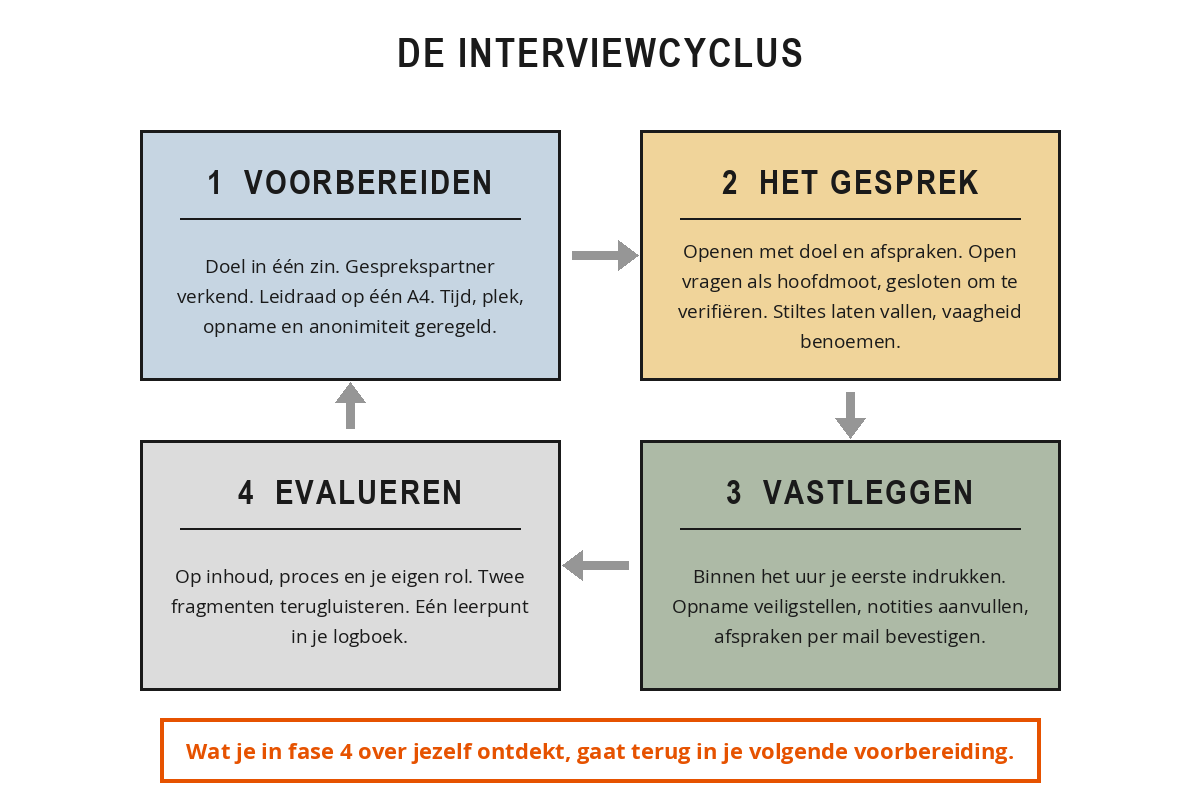
That completes the circle, and the four chapters of this course are also the four phases of an interview. You prepare: objective in one sentence, interviewee researched, guide on a single sheet of A4, practical matters arranged. You conducts the conversation: you open with the purpose, the duration and the ground rules, ask open questions as the main body and closed questions to verify, allow silences, name vagueness and contradiction, and close with a summary and a follow-up appointment. You wrap up straight away: first impressions within the hour, securing the recording, completing your notes, confirming agreements by email. And you evaluates: on content, on process and on your own role, listen back to two fragments, one learning point in your logbook, one intention for next time. That intention is immediately the start of your next preparation.
Take the recording or the notes from an interview you have conducted recently and work through these four steps.
- Assess the conversation separately on content, process and your own role. Give each level a mark from 1 to 10 and note in one sentence why.
- Choose two fragments of three to five minutes, one that went well and one that was difficult. Describe in no more than five sentences what caused the difference.
- Formulate one concrete, measurable intention for your next interview. Not "listen better", but behaviour you can recognise in yourself while you are doing it.
- Put in your diary when you will evaluate this intention, preferably within 24 hours of that next conversation.
Summary
- Schedule twenty minutes immediately after the interview: filling out keywords, impressions of the atmosphere, first impressions and your own open questions.
- Decide deliberately whether to record. A recording gives certainty and costs time to work out; permission is asked in advance.
- Three ways of working it up: full transcription (four to six times the length of the conversation), summarising write-up (one to two times) and a time-coded index.
- Organise your material by theme rather than by the order of the conversation, and note contradictions explicitly.
- Keep fact, opinion and quotation apart, for example using colours. Otherwise a firmly stated opinion slips into your report as fact.
- Evaluate on three levels: content (did I get what I needed), process (how did the interaction go) and your own role (what did I do).
- Keep a log of a few lines per conversation. You only see patterns after five to ten interviews.
- Turn every learning point into a small, measurable intention for one next conversation.
You have recorded a 75-minute conversation and want to move on with it quickly without losing anything. Which form of working up the material suits this best?
Why do you organise your material by theme rather than by the order of the conversation?
Which intention meets the requirements this chapter sets for it?
Ready for the next step?
You have completed the free starter of Interview Techniques. The next chapter in the full course is What sets an interview apart from a conversation: The interview as a purposeful instrument, four common interview types and the role you take on as interviewer.
Take the 2-day course →From €1250,- excl. VAT · with an experienced trainer included