


1. What IPMA-D is and who it is intended for
Certification through IPMA is about competences: what you know, what you can do and how you behave. Before you start on the material, it is useful to know where that material comes from, which four certificates exist and why D looks different from the rest.
By the end of this chapter:
- You know what the ICB4 is and what role that document plays in certification.
- You know the four IPMA certification levels and the differences between them.
- You can name the three competence areas Perspective, People and Practice and tell them apart.
- You understand how competence elements are structured and why they are worded the way they are.
- Do you know what it means that at D level the assessment is knowledge-based.
The ICB4 as a standard
ICB stands for Individual Competence Baseline, the international standard of the IPMA, the International Project Management Association. It sets out which competences someone needs in order to manage projects, programmes or portfolios. The fourth version, ICB4 for short, appeared in 2015 and forms the basis of all IPMA examinations worldwide.
What makes the ICB4 distinctive is what it does does not contain. You will find no prescribed way of working, no mandatory documents and no step-by-step plan. The standard describes the person, not the method. Two project managers can work in completely different ways and both still be competent according to the ICB4.
That also explains a confusion many candidates have. IPMA is not a method like PRINCE2 or Scrum. Those methods are covered in the course, and in the exam you are expected to know them in broad outline, but the ICB4 does not prescribe a single one. It describes what you as a project manager should be able to do, regardless of which method you use to do it.
Four certification levels
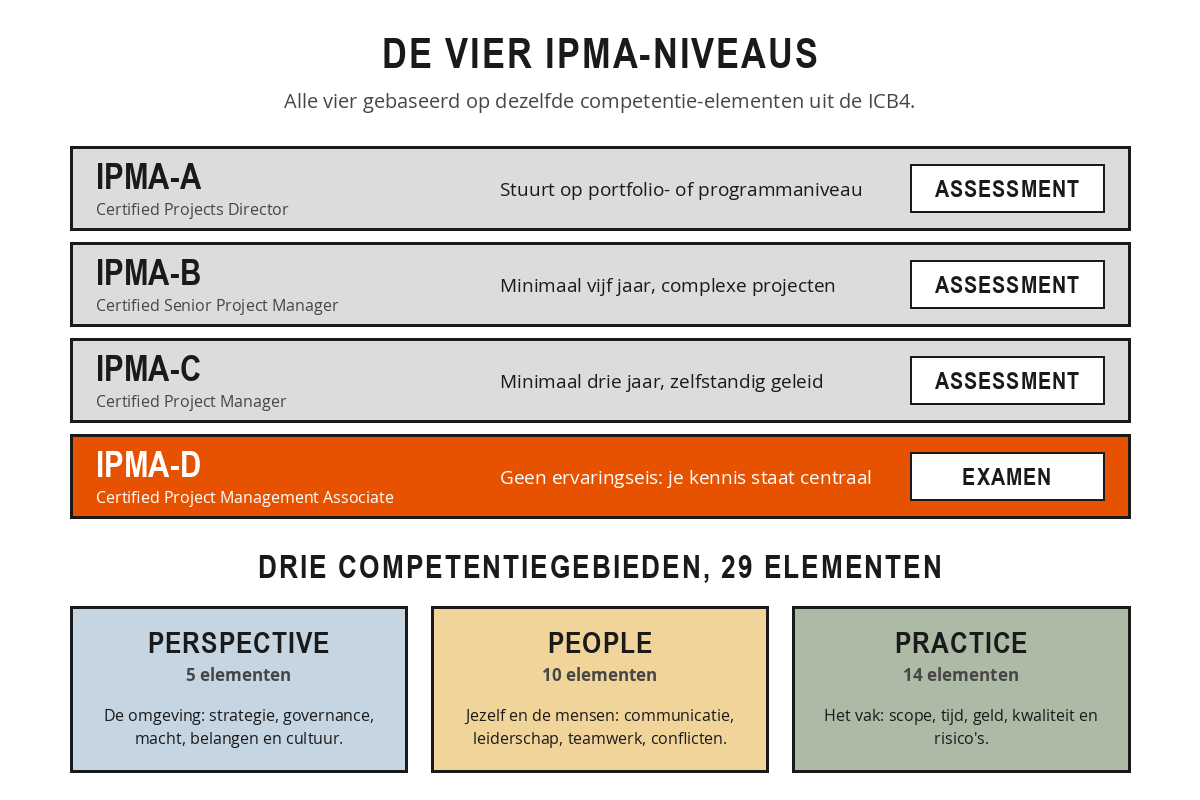
All four levels are based on the same ICB4 competence elements. The difference lies in the complexity of the work you can handle, and in the way that is assessed.
IPMA-D, in full Certified Project Management Associate, is the level of this course. You demonstrate that you have mastered the knowledge from the ICB4 and can apply it to situations put before you. Experience is not an entry requirement.
IPMA-C, Certified Project Manager, requires at least three years' experience with projects of limited complexity, and you demonstrate that you have led them independently.
IPMA-B, Certified Senior Project Manager, requires at least five years' experience, a substantial part of which with complex projects: several sub-projects, many stakeholders, a long lead time and a considerable budget. At that level you also manage other project managers.
IPMA-A, Certified Projects Director, is the level at which you steer at portfolio or programme level and are responsible for the strategic coherence between projects.
The distinction therefore comes down to two things at once: how much complexity you can handle and how you demonstrate it. At C, B and A you go through an assessment centred on your own projects. At D your knowledge is central, and that involves an exam. This is exactly why D is the starting point for many people: you can obtain it before you have ever led a project.
Ilse has worked for four years as a project support officer at a municipality. She draws up plans, maintains the risk log and takes the minutes of the steering group, but she has never led a project herself. Her colleague Ramon has been leading implementation projects for five years, two of them with a budget above two hundred thousand euros and four sub-projects beneath them. Ilse is not eligible for C, because she does not meet the experience requirement of three years of leading independently; she is going for D and tests her knowledge with an exam. Ramon can go straight into a C assessment, in which his own projects are the test material. They study largely the same material, but the evidence they have to provide is an entirely different kind of evidence.
Do not see IPMA-D as a lower qualification, but as the foundation. You need the knowledge you gain here at C and B level in order to make sense of your experience. The D certificate is valid for three years and counts in a later C trajectory as proof of knowledge, which means that there you mainly have to demonstrate your experience. Many project staff therefore obtain D before they lead their first project.
The three competence areas
The ICB4 organises the profession into three areas. Perspective is about the environment in which the project operates: strategy, governance, power and interests, culture. People is about yourself and the people around you: communication, leadership, teamwork, dealing with conflict. Practice is about the profession itself: scope, time, money, quality and risks.
The IPMA eye is the symbol with which IPMA represents the coherence between those three areas. It stands for the project manager's gaze: you look at the environment, at the people and at the work itself. Anyone who excels in one area and neglects the other two will come unstuck. The tightest schedule won't help you if the councillor wants something different halfway through, and the best feel for relationships won't save you if your network planning is wrong.
Competence elements as building blocks
Each area is built up from competence elements: clearly defined pieces of craftsmanship, made up of knowledge, skill and behaviour. The ICB4 describes 29 in total, divided into five under Perspective, ten under People and fourteen under Practice. Practice is therefore by far the largest area, and you notice that in the exam.
Every element has the same structure: a definition, a purpose, a description of the content and a list of key competence indicators. Those indicators describe concrete behaviour that you can observe. That is no coincidence. A competence such as "copes well with pressure" cannot be assessed; "can identify conflicts at an early stage and name the cause" can.
The element "Conflict and crisis" belongs to the People area. The ICB4 describes the aim as: the project manager can recognise, analyse and resolve conflicts and crises without putting the project result at risk. An accompanying indicator reads, for example: "can identify conflicts at an early stage and name the cause". That is not an abstract trait, but something an assessor can observe and something an exam question can be about.
Knowledge-based assessment at D level
At D level you are assessed on what you know and understand, not on what you have done. The competence elements therefore determine exactly what the assessment covers. Each element comes with behavioural indicators with measurable criteria. At C level and above you demonstrate with evidence that you display that behaviour. At D level you are asked whether you recognise the behaviour, can argue for it and can translate it to a situation put before you.
That has consequences for the way you learn. Learning separate concepts by heart is not enough; you also need the ability to link them to a case. In the next chapter you will see how the structure of the exam gives shape to that.
Take the element "Risks and opportunities". A question at D level rarely asks only for the definition of a risk. More often you are given a short project situation, for example a supplier announcing a two-week delay, with the question of which control measure fits best and why. You then need the theory as well as the insight to apply it to the situation. An answer such as "you take a control measure" gets you nowhere. An answer in which you state that you absorb the delay using the float on that path, and what happens once that float has run out, does earn points.
Think of a project you are working on or have worked on.
- Note down one situation in which the project got stuck or ran into difficulty.
- Determine which competence area was under the greatest strain here: Perspective, People or Practice.
- Write down in two sentences why you are choosing that area.
- Then determine which of the three areas feels least familiar to you personally. That is your starting point for your study planning in chapter 2.
Summary
- The ICB4 is the international standard of the IPMA, published in 2015. It describes the person, not the method: no prescribed way of working, no mandatory documents.
- There are four levels. D is Certified Project Management Associate with no experience requirement, C requires at least three years of independent leadership, B at least five years with complex projects, and A operates at portfolio or programme level.
- All four levels use the same competence elements. At C, B and A you go through an assessment based on your own projects; at D you sit an exam on your knowledge.
- The D certificate is valid for three years and counts as proof of knowledge in a later C track.
- The ICB4 has three competence areas: Perspective (the environment), People (yourself and the people around you) and Practice (the profession).
- Together these areas contain 29 competence elements: five under Perspective, ten under People and fourteen under Practice.
- Each element consists of a definition, a purpose, a description and key competence indicators that describe observable behaviour.
- At D level you are tested on knowledge and on your ability to apply that knowledge to a situation put in front of you.
What is the main difference between assessment at D level and assessment at C, B and A level?
How are the 29 competence elements of the ICB4 divided across the three areas?
A colleague says: "The ICB4 prescribes how you should approach a project." What is wrong with that?