


Introduction
You have worked on a few projects, you know the terms that get thrown around, and now you want it in black and white that you understand the profession. IPMA-D is the logical certificate for that: you do not need years of experience as a project manager behind you, but you do need to know how a project works. From defining the assignment to delivery, from scheduling techniques to the conversation with a difficult stakeholder.
The question that comes before that is a different one: what does that exam actually ask of me, and is this something for me? This free course answers that, and at the same time teaches you two topics that come up in every IPMA-D exam.
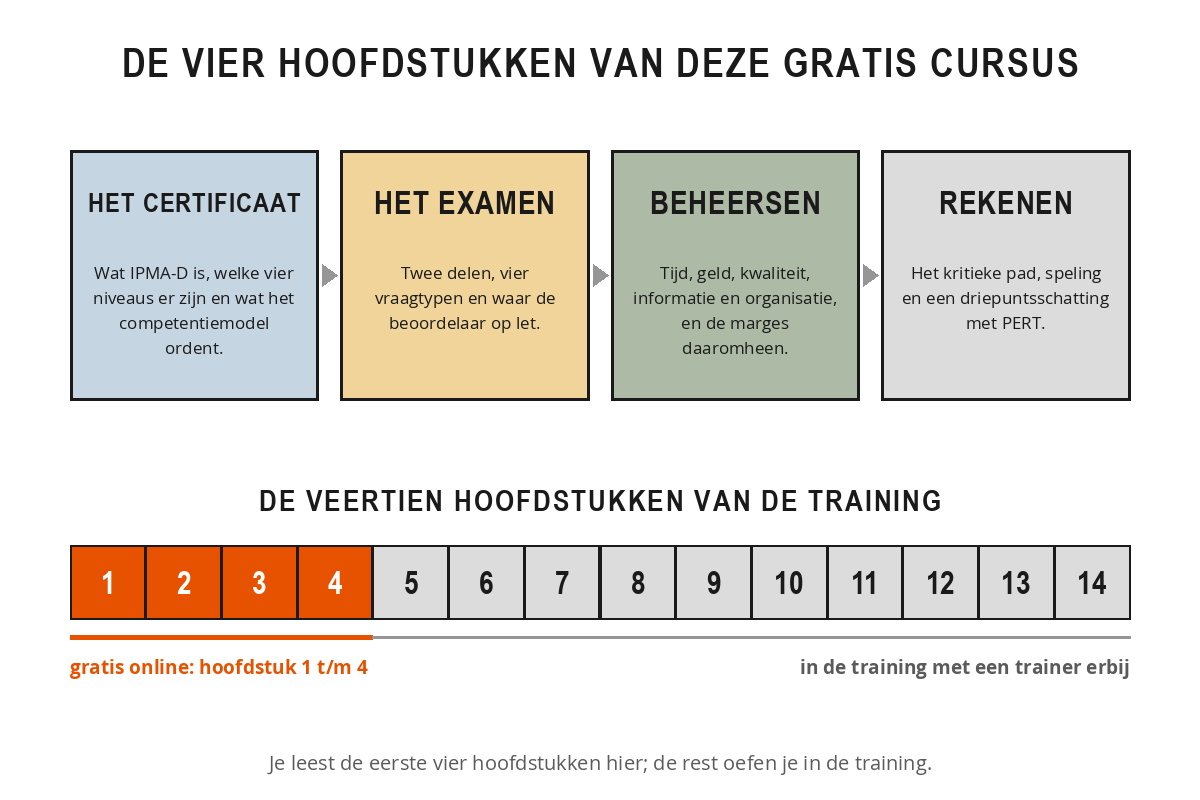
This free course contains the first four chapters: the orange part of the bar above. At the bottom of chapter 4 you will find the full course.
What you will learn
You start with the certificate itself. What is the ICB4, which four IPMA levels are there, and why is D the only level where you finish with an exam rather than an assessment. After that you look at the exam: two parts, four signal words in the wording of the questions, and three things an assessor looks for. That chapter ends with a study plan that counts back from your exam date.
The last two chapters are genuine subject matter, and not by chance the two topics that come up most often in the open questions. First you learn to control a project on time, money, quality, information and organisation, using the devil's triangle and the margins within which you may decide for yourself. After that you work through a network plan: forward pass, backward pass, critical path, float and a three-point estimate using PERT. That last chapter involves calculation and is best followed with pen and paper beside you.
How the course is structured
The full training course has fourteen chapters and runs from working in projects through the assignment, the phasing and the tools to the people around the project. This free course takes four chapters from it: two that tell you what you are getting into, and two in which you actually learn something. Each chapter has learning objectives, a diagram, examples with names and figures, and an exercise that you apply to your own situation.
Practical tips for use
- Keep pen and paper to hand. Chapter 4 stands or falls on working through the calculations yourself; simply reading along is not enough.
- Do not read it all in one go. One chapter at a time, with a day in between, sticks better than reading straight through for an afternoon.
- Adopt the terms literally. In the exam you are asked for the term as the standard uses it, not for the word that is common in your own office.
- Have an exam date in mind now. In chapter 2 you count back from there to build your study plan.
- For each chapter, choose one project from your own work to apply the material to. That helps with the case questions, where a general answer earns few marks.
Each chapter ends with a short knowledge check of three questions: answer them correctly to mark the chapter as completed. Your progress is saved automatically in your browser.
The number of questions, the duration of the exam and the pass mark are set by the examination body and may differ from one round to the next. This course is about the content and the set-up; for the current figures, consult the exam guide of your own examination body.
Good luck with your preparation.